Miracles and the Nature of Reality
Exploring the Intersection of Faith, Philosophy, and Existence
Many assume miracles are either impossible superstitions or divine interventions that bypass natural law entirely.
191 pages9 chaptersJun 17, 2026Philosophy
About this book
But what if miracles reveal something deeper about the nature of reality itself? This book explores miracles not as violations of physics, but as phenomena that challenge our fundamental assumptions about existence, causality, and consciousness. You'll discover how miracles have been understood across philosophical traditions, why they matter to questions about meaning and purpose, and how examining them can expand your understanding of what's possible. Whether you approach this from faith, skepticism, or genuine curiosity, you'll find a rigorous exploration that respects both reason and experience. This is not a book about proving miracles happen—it's about understanding what miracles reveal about the nature of existence and why the question matters to how you live.
Table of contents
- IntroductionWhy Miracles Matter to Philosophy and Existence, Beyond Belief: A Rational Inquiry, How to Approach This BookRead below
- Chapter 1: Defining the MiraculousWhat Exactly Is a Miracle?, How Different Traditions Define Miracles, Miracles Versus Anomalies and Coincidences
- Chapter 2: The Problem of Natural LawUnderstanding Natural Law and Its Limits, Do Miracles Violate Natural Law or Reveal Hidden Dimensions?, Rethinking Causality in a Complex Universe
- Chapter 3: Miracles Across Philosophical TraditionsWestern Philosophy: From Hume to Contemporary Thought, Eastern Philosophical Approaches to the Miraculous, Indigenous and Non-Western Understandings of Miracles
- Chapter 4: Consciousness and the MiraculousThe Role of Consciousness in Perceiving Miracles, How Mind and Reality Interact, The Gap Between Experience and Interpretation
- Chapter 5: Faith, Reason, and ExperienceThe Apparent Conflict Between Faith and Reason, Personal Testimony as Philosophical Evidence, Integrating Multiple Ways of Knowing
- Chapter 6: The Metaphysics of MiraclesMultiple Levels of Reality and Existence, Transcendence and Immanence: The Sacred in the Material, Expanding Our Understanding of What's Possible
- Chapter 7: Miracles and MeaningWhat Miracles Suggest About Purpose and Existence, Human Agency, Free Will, and Divine Action, Miracles as Narrative Turning Points in Life
- Chapter 8: Skepticism and CritiqueAddressing Scientific and Rational Objections, Cognitive Biases and Pattern Recognition, Maintaining Intellectual Honesty in the Debate
- Chapter 9: Living With MysteryAccepting the Limits of Human Knowledge, Cultivating Wonder and Awe in a Rational Age, How Belief in Miracles Changes How We Live
- ConclusionSynthesizing Philosophy, Faith, and Experience, Moving Forward With Open Eyes and Mind
- Further Reading and Resources
Introduction
Something strange happens when you ask people about miracles. The word itself seems to split the room. Some people lean forward with recognition, ready to share a story that changed their life. Others lean back with skepticism, already preparing a rational explanation for whatever comes next. Very few people are genuinely neutral on the subject. And that reaction, that immediate, almost reflexive response, tells you something important. Miracles touch something deep in how human beings understand reality, meaning, and their own place in the universe.
This book is not here to tell you whether miracles happen. That question, while important, is not the most interesting one available to us. The more compelling question is what miracles reveal about the nature of reality itself. When someone describes an event as miraculous, they are not just making a claim about what happened. They are making a claim about what is possible, about how the universe is structured, and about whether there is something more to existence than the physical processes science can measure. Those are philosophical questions of the highest order, and they deserve serious, careful attention.
The conversation about miracles has been trapped for too long between two inadequate positions. On one side, there is uncritical acceptance: miracles happen because faith says so, and questioning them is a sign of spiritual weakness. On the other side, there is dismissive rejection: miracles are superstitions held by people who do not understand science, and any serious thinker should move past them. Both positions close the inquiry before it begins. This book opens it back up. The goal is to think rigorously and honestly about what miracles are, what they might mean, and what they reveal about the deepest questions of existence.
What you will find in these pages is a philosophical exploration that takes both reason and experience seriously. It draws on Western and Eastern philosophy, theology, physics, cognitive science, and the testimony of human experience across cultures and centuries. It does not ask you to abandon your skepticism, and it does not ask you to abandon your faith. It asks you to think more carefully, more openly, and more deeply than the usual debate allows. That is a harder task than simply picking a side, but it is also a far more rewarding one.
Why Miracles Matter to Philosophy and Existence
Philosophy has always been driven by questions that resist easy answers. What is real? What can we know? What does it mean to exist? These questions have occupied thinkers for thousands of years, and they remain genuinely open. Miracles sit at the intersection of all of them. A miracle, by almost any definition, is an event that challenges our assumptions about what is real, what is possible, and what forces or principles govern existence. That makes miracles philosophically significant regardless of whether you believe they occur.
Consider what is actually at stake when someone claims a miracle has happened. They are asserting that the ordinary course of events was interrupted or transcended by something that cannot be explained within the usual framework of cause and effect. That claim immediately raises questions about the nature of causality itself. Is causality a fundamental feature of reality, or is it a pattern that holds under normal conditions but can be exceeded? Is the universe a closed system, or is it open to influences that operate outside the boundaries of physical law? These are not trivial questions. They go to the heart of how we understand existence.
The philosopher David Hume famously argued that miracles are so improbable that no testimony could ever be sufficient to establish them.[1] His argument has been enormously influential, and it deserves serious engagement. But Hume's argument rests on assumptions about the uniformity of nature that are themselves philosophical commitments, not established facts. Modern physics has revealed a universe far stranger than Hume imagined, one where particles can be entangled across vast distances, where the act of observation affects what is observed, and where the foundations of matter dissolve into probability fields at the quantum level. The question of what is and is not possible in such a universe is genuinely open.
Miracles also matter because they are connected to questions of meaning and purpose. If the universe is a purely mechanical system governed by fixed laws, then human life is ultimately a byproduct of blind physical processes, and meaning is something we construct rather than discover. But if miracles are possible, if the universe is open to something beyond its ordinary operations, then the question of purpose takes on a different character. The existence or non-existence of miracles is not just a theological question. It is a question about the kind of universe we inhabit and the kind of beings we are within it.
There is also a deeply personal dimension to this inquiry. Across cultures and throughout history, people have reported experiences they describe as miraculous: unexpected healings, moments of profound clarity, events that seemed to respond to prayer or intention, encounters with what felt like a presence beyond the ordinary world. These experiences are among the most significant in human life. Dismissing them without examination is not intellectual rigor. It is a failure of philosophical curiosity. Understanding what these experiences are, what they reveal, and how they relate to the broader structure of reality is a task that philosophy is uniquely equipped to undertake.
Finally, miracles matter because they force us to examine our assumptions. Every philosophical framework rests on foundational commitments about what exists and how it behaves. Materialism assumes that physical matter and energy are all there is. Determinism assumes that every event is the inevitable result of prior causes. These are powerful and productive assumptions, but they are assumptions nonetheless. Miracles challenge them directly. Whether or not miracles occur, the challenge itself is valuable. It pushes us to examine what we actually know, what we merely assume, and where the genuine boundaries of human understanding lie.
The question is not simply whether miracles happen. The question is what kind of universe would have to exist for them to be possible, and what that universe would mean for how we understand ourselves within it.
This is why miracles belong in philosophy. Not because philosophy can prove or disprove them, but because thinking carefully about miracles illuminates the deepest questions about reality, knowledge, and existence. That illumination is valuable regardless of where you stand on the question of whether miracles actually occur.
Beyond Belief: A Rational Inquiry
One of the most persistent obstacles to serious thinking about miracles is the assumption that the inquiry must begin with a prior commitment. Either you believe in miracles because you have faith, or you reject them because you trust science. This framing is not just unhelpful. It is philosophically lazy. Genuine rational inquiry does not begin with conclusions. It begins with questions, follows evidence and argument wherever they lead, and maintains honesty about what remains uncertain. That is the approach this book takes.
Rational inquiry into miracles does not mean approaching the subject with cold detachment. It means bringing the full range of intellectual tools available to bear on a genuinely difficult question. Those tools include logical analysis, historical investigation, scientific understanding, phenomenological attention to experience, and philosophical reflection on the assumptions that shape how we interpret what we observe. None of these tools alone is sufficient. Together, they allow for a richer and more honest engagement with the subject than either pure faith or pure skepticism can provide.
It is worth being clear about what this inquiry is not. It is not an attempt to use philosophy to prove that miracles happen. Philosophy cannot do that, and any book that claimed otherwise would be misleading you. It is also not an attempt to debunk miracles by showing that they are always explicable in natural terms. That project has been tried many times, and it consistently runs into the problem that absence of explanation is not the same as absence of occurrence. What this inquiry can do is clarify the concepts involved, examine the arguments on multiple sides, and help you think more precisely about what you actually believe and why.
A rational inquiry into miracles also requires intellectual honesty about the limits of current knowledge. Science is extraordinarily powerful, but it is not complete. There are phenomena that current scientific frameworks cannot fully explain, including consciousness itself, the fine-tuning of physical constants that make life possible, and the nature of quantum measurement.[2] Acknowledging these limits is not a retreat from rationality. It is an expression of it. Intellectual honesty requires admitting what we do not know, not just asserting what we do.
The history of science itself offers a useful lesson here. Many phenomena that were once considered impossible or supernatural have been incorporated into scientific understanding as knowledge advanced. Meteorites were dismissed as superstition by educated Europeans in the eighteenth century because rocks falling from the sky contradicted the prevailing understanding of the cosmos.[3] The lesson is not that everything currently considered miraculous will eventually be explained scientifically. The lesson is that the boundary between the explicable and the inexplicable is not fixed. It moves as understanding deepens, and humility about where it currently sits is warranted.
A rational inquiry also takes testimony seriously as a form of evidence, while remaining appropriately critical about it. Human beings are not perfectly reliable witnesses, and cognitive biases can shape how experiences are remembered and reported. These are real concerns that deserve attention, and this book addresses them directly in later chapters. But the existence of cognitive biases does not mean that all testimony is worthless. Millions of people across vastly different cultures, historical periods, and belief systems have reported experiences they describe as miraculous. That convergence is itself a phenomenon that demands explanation, not dismissal.
The approach here is what philosophers sometimes call epistemic humility: a commitment to holding beliefs with a degree of confidence proportional to the evidence and argument available, and remaining genuinely open to revision. This is not the same as refusing to reach conclusions. It means reaching conclusions carefully, holding them honestly, and being willing to follow the argument wherever it leads, even when that is uncomfortable. Applied to miracles, epistemic humility means neither confidently asserting that miracles happen nor confidently asserting that they do not. It means thinking as clearly as possible about a genuinely difficult question.
What makes this inquiry worthwhile is not the prospect of a definitive answer. It is the quality of thinking that the question demands. Engaging seriously with miracles requires you to examine your assumptions about causality, consciousness, the nature of evidence, and the structure of reality. That examination is valuable in itself. It makes you a more careful thinker about everything, not just about miracles. And it opens up a richer, more nuanced understanding of the universe and your place within it than either uncritical belief or reflexive skepticism can provide.
How to Approach This Book
This book is organized to take you through the inquiry in a logical sequence, building understanding progressively from foundational questions to more complex ones. But it is also designed so that each chapter can stand on its own if you want to explore a particular topic. Whether you read straight through or move between chapters based on your interests, the goal is the same: to give you the conceptual tools and philosophical frameworks needed to think seriously about miracles and what they reveal about reality.
The book begins by examining what miracles actually are. Before you can think clearly about whether miracles happen or what they mean, you need a precise understanding of what the word refers to. Chapter 1 explores different definitions of miracles across traditions and distinguishes miracles from related concepts like anomalies, coincidences, and unusual events. This definitional work is not just academic housekeeping. The way you define a miracle shapes every subsequent question about it.
From there, the book moves into the philosophical heart of the inquiry. The chapters that follow address questions including:
- What natural law actually is, and whether it is the kind of thing that can be violated or transcended
- How different philosophical traditions, from ancient Greece to contemporary analytic philosophy to Eastern thought, have understood the miraculous
- What the relationship between consciousness and reality suggests about how miracles might be perceived or experienced
- How faith, reason, and personal experience can be integrated into a coherent approach to knowledge
- What the metaphysics of miracles looks like when you take seriously the possibility of multiple levels of reality
- What miracles suggest about meaning, purpose, and human agency
- How to engage honestly with skeptical objections without either dismissing them or being paralyzed by them
The final chapters turn toward the practical and existential dimensions of the inquiry. Living with genuine uncertainty about deep questions is not easy, but it is also not the same as living without orientation. The book closes by exploring what it means to cultivate wonder and intellectual openness in a culture that often demands certainty, and how your relationship to the possibility of miracles shapes how you actually live your life.
A few things are worth knowing about how to engage with this material. First, you will encounter ideas from multiple philosophical and religious traditions. The goal is not to suggest that all traditions say the same thing or that differences between them do not matter. They do matter, and the differences are often illuminating. The goal is to bring multiple perspectives into conversation so that each one can sharpen and challenge the others. Approach these perspectives with genuine curiosity rather than looking for confirmation of what you already believe.
Second, you will encounter arguments that challenge positions you may hold. If you come to this book as a believer, you will find serious engagement with skeptical objections that deserve honest consideration. If you come as a skeptic, you will find serious engagement with philosophical arguments for the possibility of miracles that go beyond simple appeals to faith. In both cases, the challenge is an invitation to think more carefully, not an attack on your position. The most productive way to read this book is to hold your current views lightly enough to examine them, while trusting that careful examination will leave you with something more solid than you started with.
Third, this book uses technical philosophical terms where they are genuinely useful, but always explains them in plain language. You do not need a background in academic philosophy to follow the arguments. What you need is a willingness to think carefully and a tolerance for sitting with questions that do not resolve quickly. Some of the most important questions in this book do not have clean answers. That is not a failure of the inquiry. It is an honest reflection of where human understanding currently stands.
The aim is not to hand you a conclusion but to give you the tools to reach your own, with greater clarity and depth than you had before.
Finally, bring your own experience to this reading. If you have had an experience that felt miraculous, or if you have witnessed something you could not explain, that experience is relevant data for this inquiry. It does not settle the philosophical questions, but it is part of the evidence that any honest account of miracles must engage with. The same is true if you have never had such an experience and find the whole concept puzzling. Your perspective, whatever it is, is a legitimate starting point for the inquiry. The goal is not to change where you start. It is to deepen where you end up.
What follows is an invitation to one of the most profound and genuinely open questions available to human thought. The nature of reality, the limits of knowledge, the possibility of transcendence, and the meaning of existence are all in play when you take miracles seriously as a philosophical subject. That is not a small thing. It is, in many ways, the whole thing. Welcome to the inquiry.
This is the end of the free sample. The full book has 9 chapters.
Want this book written for you?
Tell us your goals and background, and get your own version of this book, tailored by AI to you.


Benefits of AI-tailored books
- Read one book, not ten:
- all the Philosophy knowledge you need, gathered into a single book.
- Save days of learning:
- tell us your goals, choose your topics, and the whole book is built around them.
- Learn effortlessly:
- Philosophy book written for your specific background and expertise.
- Understand at a glance:
- includes charts, tables, timelines, checklists, decision trees, and more.
- Stay current:
- written the day you order it, not years ago.
- Trust what you read:
- every book is checked for accuracy, with real research when your subject needs it.
Create your unique book in 3 steps
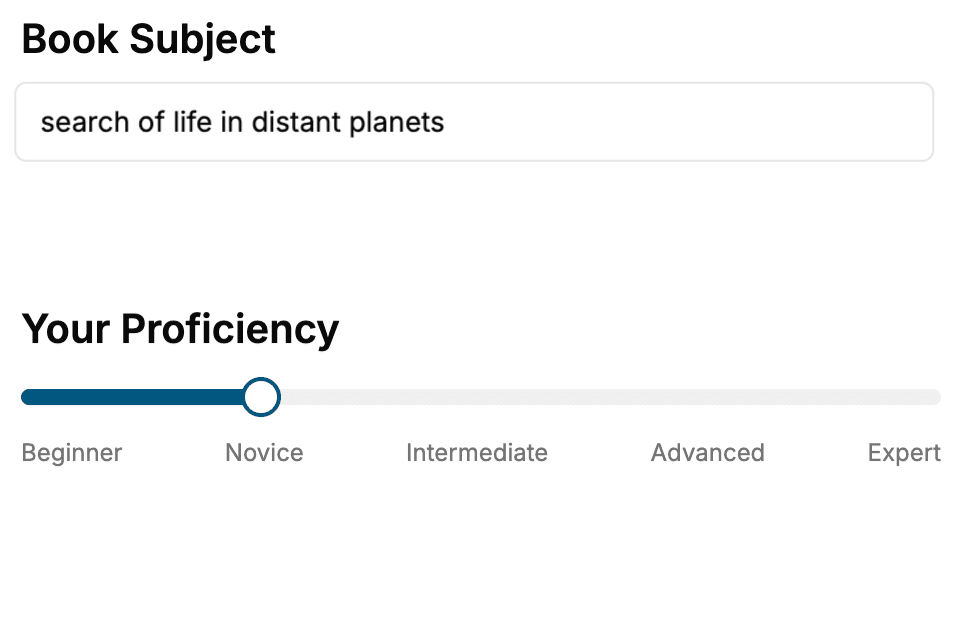
- 1. Select your focus
Select the focus of your Philosophy book and share your background
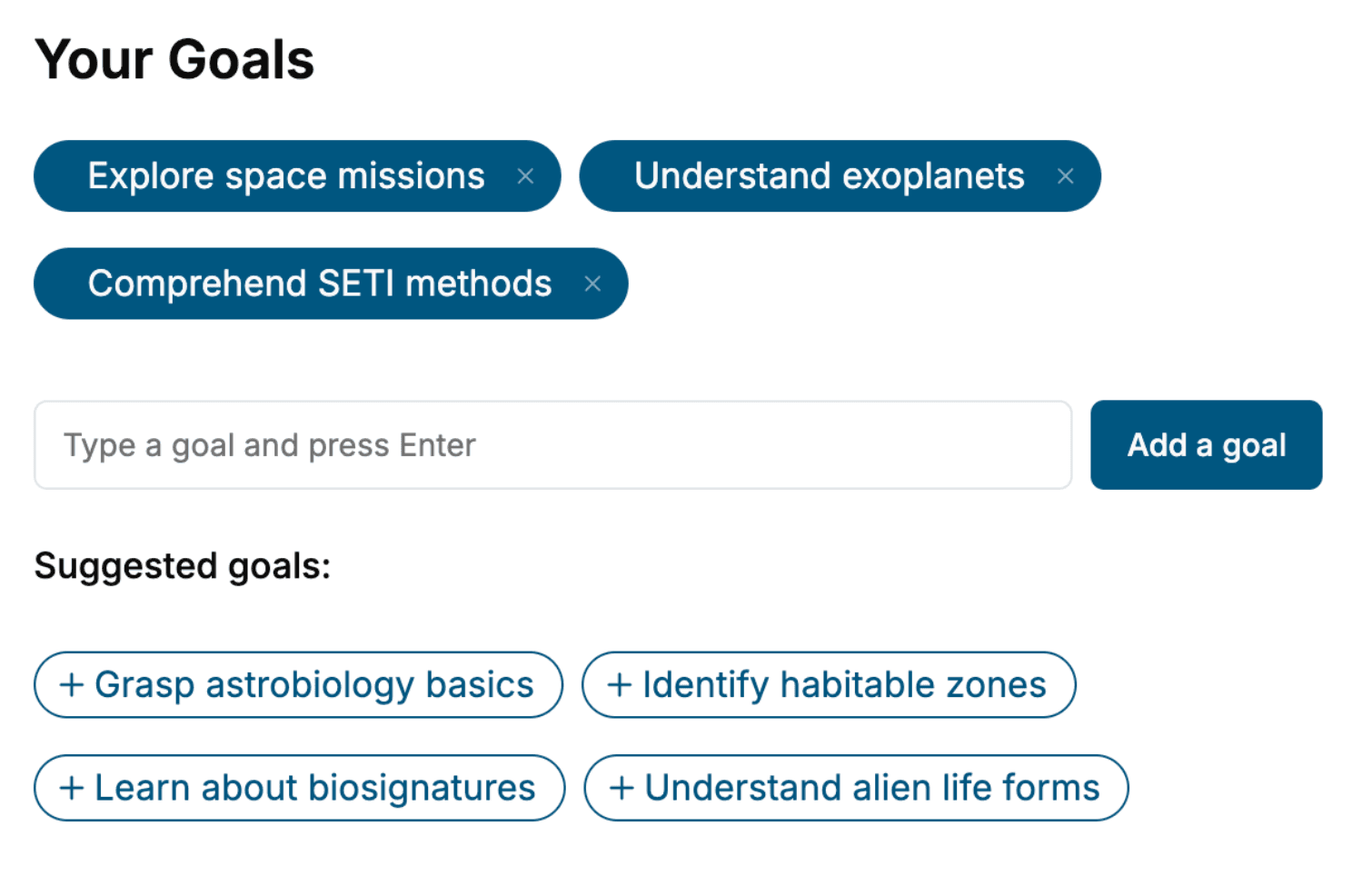
- 2. Personalize your book
Specify your goals and choose sub-topics to include
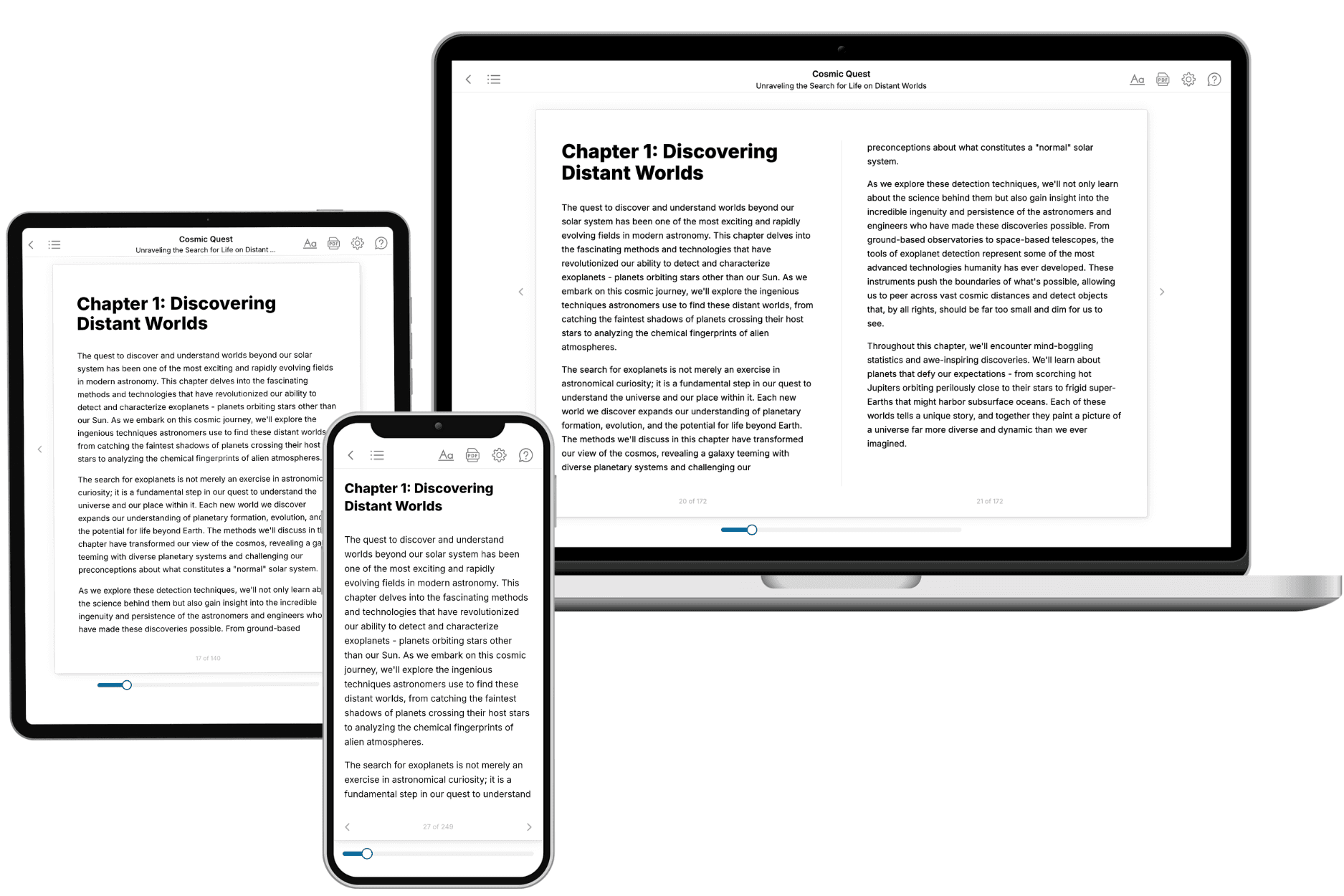
- 3. Get your tailored book
Your book is ready in 10 minutes. Read it online, download as EPUB or PDF, or send to Kindle.
Frequently asked questions
- What is TailoredRead?
TailoredRead creates complete, full-length nonfiction ebooks, written specifically for you. Tell us what you want to learn and why, and TailoredRead writes you a complete ebook on it, with charts, tables, and diagrams throughout. Read it online, on Kindle, or on any e-reader, or download it as a PDF or EPUB. Every book is written fresh the day you order it.
- How is the book tailored to me?
Before anything is written, you answer a few short questions about your goals, your background, and the topics you care about. Your book is then planned around your answers: written at your level, focused on your goals, and covering the topics you chose, instead of the one-size-fits-all book a store sells everyone.
- Will it read like generic AI content?
No. Your book isn't a chat transcript: it's planned chapter by chapter before a single word is written, told in a clear book voice, and explains ideas visually with charts, tables, and diagrams. After writing, every book goes through an editorial pass that polishes chapters so the book reads consistent from start to finish. Judge for yourself: browse thousands of sample books on our Explore Books page.
- How accurate is the content?
Our AI first checks whether your subject needs live research. Niche and fast-moving subjects are researched before writing, and the book plan and chapters are grounded in what it finds. After writing, every book goes through a quality pass that checks its facts and consistency, and researched books list their sources in a Notes section at the back.
- How long is the book?
You choose the length: Comprehensive (250-300 pages), Detailed (150-200 pages), Essential (70-100 pages), or Short (30-50 pages).
- Does the book include visuals?
Yes. Every book includes charts, tables, and diagrams: timelines, checklists, step-by-step guides, decision trees, comparison tables, matrices, and bar charts. A typical book includes dozens of these visual elements.
- Can I read it on Kindle? What formats can I download?
Yes. Every book can be read in our online reader or downloaded as a PDF or EPUB. The EPUB can be opened with Kindle, Apple Books, Kobo, and any e-reader. The Commercial and Author licenses also include an editable Word (DOCX) and Markdown download.
- How much does it cost?
About the price of a regular ebook. The exact price depends on your book's length and complexity, from $2 for the shortest books to $35 for the most comprehensive, and it's shown when you review your book, before you commit to anything. Each book is a one-time purchase, yours to keep, no subscription. Licenses that let you share, teach, or publish your book range from $35.99 to $49.99.
- Can I preview the book before purchasing?
Before you pay, you'll see what your book will cover: the title, a detailed description, the estimated length, and the complete chapter-by-chapter table of contents, so you know what you're getting before you decide. The full text itself is written after you purchase.
- How long does it take to create a book?
About 10 minutes. You can start reading the opening chapters while the rest is still being written.