Financial Risk Management Books
Explore tailored Financial Risk Management books created by our AI
Expected Shortfall
Mastering Risk Measurement Through Monte Carlo Integration
Imagine confidently measuring the true tail risk of your portfolio, knowing exactly what losses to expect in the worst-case scenarios. This book equips you with the mathematical and computational tools to calculate Expected Shortfall using Monte Carlo Integration—a technique that has become essential in modern finance and risk management. You'll move beyond traditional risk metrics to understand how Expected Shortfall captures the severity of extreme losses, not just their probability. Through clear explanations and practical examples, you'll learn how Monte Carlo methods approximate complex risk calculations that would otherwise be impossible to solve analytically. Whether you're managing financial portfolios, pricing derivatives, or analyzing operational risks, this guide bridges the gap between theory and implementation. Discover how to validate your models, optimize computational efficiency, and navigate the real-world challenges of data quality and model assumptions. By the end, you'll have a complete framework for implementing Expected Shortfall in your own work, backed by both rigorous mathematics and practical wisdom.
The 2008 Global Financial Crisis reshaped the world economy and left millions struggling with unemployment, foreclosures, and shattered savings. This book walks you through the events that triggered the worst economic collapse since the Great Depression, revealing how decisions made in boardrooms and regulatory agencies cascaded into a global catastrophe. You'll discover how subprime mortgages became toxic financial weapons, why ratings agencies stamped AAA on garbage investments, and how deregulation created a perfect storm of risk. Through clear explanations of complex instruments like mortgage-backed securities and CDOs, you'll understand how the housing bubble inflated and why its collapse froze global credit markets. You'll meet the key players—from Lehman Brothers to the Federal Reserve—and see how their choices shaped the crisis. Most importantly, you'll learn what changed afterward: the Dodd-Frank reforms, tighter lending standards, and new oversight mechanisms designed to prevent another 2008. Whether you're studying history, investing, or simply want to understand the financial system that affects your life, this book provides the clarity and context you need.
Moral Hazard
Understanding Risk, Incentives, and Economic Behavior
What happens when people stop worrying about the consequences of their decisions? Moral hazard—the tendency to take greater risks when protected from the full impact of failure—is one of the most powerful forces shaping modern economies. From bank executives gambling with depositors' money to drivers with comprehensive insurance taking reckless chances, moral hazard distorts behavior in ways that ripple through financial systems and society. This book explores the mathematical and economic foundations of moral hazard, revealing how incentive misalignment creates predictable patterns of risk-taking. You'll discover why traditional solutions often fail, how institutions inadvertently encourage dangerous behavior, and what evidence-based strategies actually work. Whether you're analyzing financial markets, designing insurance products, or understanding policy failures, this guide provides the conceptual tools and practical insights needed to recognize and address moral hazard in its many forms.
The biggest obstacle crypto traders face is the gap between understanding market theory and executing profitable trades consistently. You know the basics, but converting that knowledge into systematic profits while managing emotions and risk remains elusive. This book bridges that gap with a personalized roadmap designed specifically for experienced traders ready to master advanced techniques. You'll learn how to identify market cycles before they fully develop, recognize high-probability entry and exit points using technical analysis and market microstructure, size positions scientifically to protect capital while maximizing returns, and build the psychological discipline that separates profitable traders from the rest. This isn't theory—it's a practical framework covering candlestick patterns, momentum indicators, volatility trading tactics, altcoin evaluation methods, and systematic trading rules. You'll discover how to evaluate emerging tokens, manage drawdowns effectively, and create a trading plan that adapts to changing market conditions. Whether you're refining swing trading execution, optimizing portfolio rebalancing, or building sustainable income streams, this book provides the advanced strategies and psychological tools you need to trade with confidence and consistency.
The Structural Integrity of Price
A Technical Framework for Swing Trading Success
What if the markets operate with the same structural logic as the buildings you design or the financial systems you audit? This book reveals how price movements follow predictable architectural patterns that can be mapped, analyzed, and traded systematically. Rather than chasing random price movements, you'll learn to identify the structural integrity of price through market structure analysis, support and resistance mapping, and price action patterns. Drawing on your background in technical auditing and cost analysis, you'll discover how to apply systematic frameworks to swing trading—from analyzing order flow and liquidity zones to optimizing risk-reward ratios and position sizing. This isn't about predicting the future; it's about understanding the structural foundations that drive price behavior. You'll develop a comprehensive trading plan, master entry and exit strategies, and build the disciplined habits that separate consistent traders from those who rely on luck. By treating markets as systems to be audited rather than puzzles to be solved, you'll gain the confidence to execute trades with precision and accountability.
Most aspiring traders believe they need complex algorithms or years of experience to profit from the stock market. The truth is simpler: swing trading success comes from mastering a few core technical skills and applying them with discipline. This book cuts through the noise and teaches you exactly what works. You'll learn to recognize candlestick patterns that predict price movement, identify support and resistance levels where trades set up perfectly, and use momentum indicators to confirm your entries. More importantly, you'll discover how to size your positions correctly, place stops that protect your capital, and build a trading journal that turns every trade—win or loss—into a learning opportunity. Whether you're looking to replace lost income or build wealth through active trading, this guide provides the practical, step-by-step framework you need. No theory without application. No indicators without context. Just proven technical analysis methods combined with risk management principles that let you trade with confidence and consistency.
Building accurate financial models is challenging when markets exhibit complex, non-linear patterns that traditional statistical methods struggle to capture. This book bridges the gap between machine learning theory and practical financial applications by teaching you how to construct, train, and deploy feedforward neural networks specifically designed for financial forecasting and analysis. You'll learn the mathematical foundations of neural networks, master data preparation techniques tailored to financial datasets, and discover how to architect networks that generalize well to unseen market conditions. The book covers critical topics including handling financial data's unique characteristics, preventing overfitting through regularization, interpreting model decisions, and integrating neural networks with existing financial frameworks. Whether you're forecasting asset prices, assessing credit risk, or optimizing portfolios, this guide provides practical, implementable strategies grounded in both theory and real-world experience. By the end, you'll have the knowledge and confidence to build neural financial models that deliver genuine predictive value.
What if your polyacrylonitrile procurement strategy is missing the macroeconomic signals that predict price movements months in advance? This book provides supply chain professionals with a comprehensive framework for understanding how feedstock costs, global production capacity, and currency dynamics drive PAN pricing in the aerospace industry. Rather than treating pricing as an unpredictable commodity, you'll learn to analyze the interconnected macroeconomic factors that create measurable patterns. Discover how to build predictive models that anticipate price trends, develop hedging strategies tailored to your risk profile, and strengthen your position in supplier negotiations by understanding their cost structure and market constraints. Through practical financial modeling techniques and real-world case studies, you'll master the analytical tools needed to optimize procurement decisions, protect margins against volatility, and transform raw material cost management from a reactive function into a strategic competitive advantage. This is essential reading for supply chain leaders who want to move beyond guesswork to data-driven decision-making.
Real Options Valuation
Making Smarter Decisions Under Uncertainty
Most decision-makers rely on traditional financial analysis that treats the future as fixed and unchangeable. This approach systematically undervalues projects with flexibility and overestimates risk in uncertain environments. Real options valuation offers a fundamentally different perspective: your ability to adapt, wait, expand, or pivot has real economic value that standard methods ignore. This book teaches you how to recognize and value the hidden options embedded in your strategic decisions. You'll learn why uncertainty creates opportunity rather than just risk, how to quantify the value of flexibility, and when to trust your intuition over spreadsheet analysis. Whether you're evaluating a new product launch, deciding whether to expand a facility, or choosing between competing strategies, real options thinking will help you see possibilities that others miss. By the end, you'll have practical frameworks to apply real options valuation to your own decisions, understand when traditional analysis fails, and make more confident choices in an uncertain world.
Most financial professionals believe that wealth growth requires years of patient investing and market timing luck. The reality is far different. Within 30 days, you can systematically optimize your portfolio, eliminate hidden fees, recapture tax inefficiencies, and accelerate cash flow generation through proven tactical frameworks. This book reveals the specific mechanisms that separate high-performing portfolios from mediocre ones—and shows you exactly how to implement them. You'll discover how to leverage asset allocation precision, strategic rebalancing, tax-loss harvesting, and behavioral discipline to generate 2-4% additional risk-adjusted returns. Learn the exact sequencing of portfolio adjustments, cash flow optimization tactics, and risk management protocols that create measurable wealth acceleration. Whether you're managing client portfolios or your own wealth, this system provides the actionable playbook to achieve significant financial progress in just 30 days, with frameworks you can repeat quarterly for sustained momentum.
The Madoff Deception
Inside the Greatest Fraud in Wall Street History
Imagine understanding exactly how one man deceived thousands of intelligent investors, evaded regulators for decades, and orchestrated a $65 billion fraud that shook the global economy. You'll gain unprecedented insight into the mechanics, psychology, and systemic failures that enabled the largest Ponzi scheme in history. This comprehensive examination takes you inside Bernard Madoff's operation, revealing how he built an empire on lies, maintained the illusion of legitimacy, and why even sophisticated institutions fell victim to his deception. You'll discover the warning signs that were missed, the regulatory breakdowns that allowed the fraud to flourish, and the devastating human cost when the scheme finally collapsed. Through detailed analysis of the scheme's construction, the investigation that exposed it, and the aftermath that continues to reverberate through the financial world, you'll develop a deeper understanding of white-collar crime's complexities. You'll learn to recognize the patterns of deception, understand the psychological tactics fraudsters employ, and appreciate why preventing such schemes requires vigilance at every level. This is the definitive account of a scandal that changed how we think about trust, oversight, and the dark side of ambition.
This book guides you through the computational mathematics that powers modern finance. You'll discover how algorithms and numerical methods solve real-world financial problems—from pricing derivatives to optimizing investment portfolios. Starting with foundational concepts in numerical analysis, you'll progress through Monte Carlo simulations, linear algebra applications, and differential equation solutions that underpin option pricing models. Each chapter builds practical understanding through concrete examples and applications, showing how computational techniques handle the complexity that traditional mathematics cannot. You'll explore how financial institutions use these methods for risk management, portfolio construction, and trading strategies. By the end, you'll understand not just the mathematics, but how to apply it responsibly, recognizing both the power and limitations of computational models in finance. This is essential reading for anyone seeking to understand the quantitative foundations of contemporary financial markets.
Discover how Median Absolute Deviation transforms your statistical analysis by providing unparalleled robustness against outliers and data anomalies. This comprehensive guide takes you beyond standard deviation to master a statistical measure that remains stable even when your data contains extreme values or unexpected patterns. You'll learn the mathematical principles underlying MAD, explore its practical advantages in variance reduction, and discover how to implement it across diverse analytical scenarios—from quality control and financial risk assessment to machine learning and environmental monitoring. With clear explanations, practical examples, and step-by-step applications, this book equips you with the knowledge to choose the right dispersion measure for your specific challenges and leverage MAD's unique properties to improve your analytical accuracy and decision-making confidence.
What if the complexity of options trading was actually just a few interconnected concepts waiting to click into place? Most traders feel overwhelmed by options because they try to learn everything at once—pricing models, Greeks, spreads, volatility—without understanding how these pieces fit together. This book strips away the confusion and builds your mastery systematically. You'll start with the foundational mechanics of calls and puts, then progress through pricing, risk assessment, and strategy building at your own pace. Each chapter is designed to build on the previous one, with practical examples and decision frameworks you can apply immediately. Whether you're analyzing market conditions, executing your first spread, or managing an existing position, you'll have a clear roadmap. This isn't theory divorced from practice—it's a blueprint for understanding options deeply enough to trade them with confidence and control.
Imagine confidently navigating complex commercial property insurance decisions, knowing exactly which risks threaten your freight and logistics operations and precisely how to protect against them. This comprehensive guide transforms you into a risk management expert who understands the intricate relationship between property valuation, underwriting criteria, and claims outcomes. You'll master the frameworks that insurance professionals use to assess cargo exposure, evaluate coverage adequacy, and optimize risk financing strategies. From conducting loss control inspections to detecting claims fraud, from analyzing supply chain vulnerabilities to ensuring regulatory compliance, you'll gain the practical tools and decision-making models that drive results. Whether you're evaluating a new policy, responding to a major claim, or restructuring your entire risk management program, this guide provides the authoritative reference and actionable strategies you need to protect your assets, reduce losses, and make informed decisions that strengthen your organization's financial resilience.
Quantum Annealing Essentials
Mastering the Next Generation of Optimization Algorithms
Imagine solving optimization problems that would take classical computers years to complete—in minutes. Quantum annealing makes this possible by harnessing quantum mechanics to navigate solution spaces more intelligently than traditional algorithms. This book demystifies quantum annealing for professionals ready to understand this transformative technology. You'll explore the quantum physics foundations that make annealing work, discover which real-world problems benefit most from quantum approaches, and learn practical techniques for implementing solutions on current quantum hardware. Whether you're optimizing supply chains, training machine learning models, or tackling combinatorial challenges, this guide equips you with both theoretical understanding and actionable insights. Move beyond the hype to grasp quantum annealing's genuine capabilities, current limitations, and the hybrid strategies that deliver results today. Perfect for computer scientists, algorithm developers, and technical leaders seeking competitive advantage through quantum-enhanced optimization.
Latin Hypercube Sampling
Master Variance Reduction Through Strategic Sampling Design
Running simulations that require thousands or millions of iterations to achieve acceptable accuracy is expensive and time-consuming. Traditional random sampling often wastes computational resources by creating uneven coverage across your input space, forcing you to run more simulations than necessary. Latin Hypercube Sampling solves this problem by strategically distributing sample points across all dimensions of your input space, ensuring balanced representation and dramatically reducing variance. This book provides a clear, practical guide to understanding and implementing LHS for variance reduction in Monte Carlo simulations. You'll learn how LHS works, why it's more efficient than random sampling, and how to apply it to your specific problems. Whether you're working in engineering, finance, or scientific research, this guide equips you with the knowledge and techniques to reduce computational costs while improving accuracy. Discover how to choose the right LHS variant for your needs, implement it correctly, and combine it with other variance reduction methods for maximum efficiency.
Imagine confidently solving complex integration problems that would otherwise require prohibitive computational resources or unrealistic distributional assumptions. This book guides you through the intersection of bootstrap resampling and Monte Carlo integration—two powerful statistical techniques that, when combined, unlock solutions to real-world numerical challenges. You'll learn how to leverage the bootstrap's distribution-free nature to quantify uncertainty in your estimates, apply variance reduction strategies to accelerate convergence, and construct reliable confidence intervals for your results. Whether you're working with high-dimensional integrals, complex probability distributions, or empirical data, this practical guide provides the conceptual foundation and implementation strategies you need. Each chapter builds systematically from core principles to advanced applications, with clear explanations of when and why each technique works. By the end, you'll have a comprehensive toolkit for tackling integration problems with precision and understanding the statistical guarantees behind your estimates.
You're about to discover why the Central Limit Theorem is one of mathematics' most powerful and practical tools. This book walks you through the complete journey from understanding basic probability distributions to implementing sophisticated Monte Carlo integration techniques that solve real-world problems. You'll learn how random sampling, when guided by the CLT, becomes a reliable method for approximating complex integrals and estimating unknown quantities. Through clear explanations and concrete examples, you'll see how this theorem connects probability theory to practical computation. By the end, you'll confidently apply Monte Carlo methods to your own challenges, understand the mathematics behind your estimates, and know exactly how much confidence to place in your results. Whether you're working in engineering, finance, or scientific research, this book equips you with both the theoretical foundation and practical skills to harness the power of statistical sampling.
Imagine confidently solving mathematical problems that seem impossible to calculate directly—by simply running simulations. The Law of Large Numbers makes this possible, and Monte Carlo Integration shows you exactly how. This book bridges the gap between abstract probability theory and practical computation, revealing why averaging random samples produces remarkably accurate results. You'll discover how this elegant principle powers everything from financial modeling to scientific research, and learn to implement these techniques yourself. Whether you're curious about the mathematics behind modern simulation methods or need to solve real computational challenges, this book provides the conceptual clarity and practical tools you need. Through clear explanations, intuitive examples, and step-by-step guidance, you'll understand not just how these methods work, but why they're so powerful and when to use them effectively.
Related books you may like:
Imagine launching a blockchain game that players genuinely want to play—not because of token rewards, but because the gameplay is compelling, the economy is sustainable, and the community thrives. This is the reality of blockchain gaming in 2026. This book cuts through the hype and speculation to show you how the industry has evolved from the 2022 GameFi crash into a mature, gameplay-first sector. You'll learn how to design tokenomics that actually work, architect smart contracts that scale, and integrate blockchain mechanics so seamlessly that players never think about wallets or gas fees. Whether you're a game developer exploring Web3 integration, a software engineer building blockchain infrastructure, or an entrepreneur launching your first blockchain game, you'll discover practical frameworks for sustainable economies, player retention strategies, and the technical architecture that powers today's successful blockchain games. Grounded in real-world examples from studios like Big Time, Axie Infinity, and emerging AAA entries, this book provides the knowledge you need to build games that last.
What if you could identify your most promising prospects before they even realize they're ready to buy? In today's competitive insurance market, the difference between thriving advisors and struggling ones isn't luck—it's data. AI tools have fundamentally changed how top-performing insurance professionals qualify leads, predict close probability, and convert prospects into clients. This book reveals the exact strategies, tools, and workflows that leading life insurance advisors use to increase conversion rates and productivity. You'll discover how predictive analytics identifies high-potential prospects, how conversation intelligence coaches you to close more deals, and how workflow automation reclaims hours of your week. Whether you're managing a small book of business or leading a team, you'll learn to build a modern GTM tech stack that turns data into revenue. The insurance industry is shifting—and the advisors who master AI-powered lead qualification will dominate their markets.
Master the intricacies of blockchain technology and revolutionize your data engineering practices. This comprehensive guide takes you on a deep dive into the world of blockchain, unraveling its complex architecture and showcasing its transformative potential in business landscapes. You'll gain a solid understanding of blockchain's fundamental principles and explore its practical applications across various industries. Discover the most powerful blockchain platforms available today and learn how to leverage them effectively in your projects. As artificial intelligence continues to reshape the tech landscape, this book bridges the gap between blockchain and AI, revealing innovative ways to combine these cutting-edge technologies. By the end of your reading journey, you'll be equipped with the knowledge and skills to implement blockchain solutions, optimize data processes, and drive technological innovation in your organization.
Discover how blockchain technology works beneath the surface and why it matters far beyond cryptocurrency. This book takes you through the fundamental principles that make blockchain systems secure and trustworthy, explaining the cryptographic foundations, consensus mechanisms, and distributed architecture that enable decentralized networks to function without intermediaries. You'll explore how smart contracts automate complex agreements, examine real-world applications transforming industries from supply chain to healthcare, and understand the genuine challenges the technology faces today. Whether you're curious about the technical architecture, interested in practical implementations, or concerned about scalability and environmental impact, this guide provides the knowledge you need to understand blockchain's role in shaping the future of digital systems. By the end, you'll have a clear grasp of what blockchain can and cannot do, and how it's being applied to solve real-world problems across multiple sectors.
Navigate the practical landscape of blockchain technology with a clear-eyed approach to real-world implementation. This guide moves beyond theoretical concepts to show you how organizations are actually deploying blockchain solutions across supply chains, financial systems, healthcare networks, and governance structures. You'll discover the methodologies that separate successful projects from failed experiments, including how to evaluate blockchain platforms, design smart contracts that work reliably, manage organizational change, and ensure compliance with regulatory requirements. Whether you're assessing blockchain's fit for your organization, leading an implementation team, or optimizing existing systems, this book provides the frameworks, case studies, and practical strategies you need to make informed decisions and execute effectively. Learn from real implementations, understand the trade-offs between different approaches, and develop the expertise to guide your organization through blockchain adoption with confidence.
Create a Financial Risk Management Book Tailored to You
Create an AI-crafted book tailored to your goals, interests, and background






Benefits of AI-tailored books
- Read one book, not ten:
- all the Financial Risk Management knowledge you need, gathered into a single book.
- Save days of learning:
- tell us your goals, choose your topics, and the whole book is built around them.
- Learn effortlessly:
- Financial Risk Management book written for your specific background and expertise.
- Understand at a glance:
- includes charts, tables, timelines, checklists, decision trees, and more.
- Stay current:
- written the day you order it, not years ago.
- Trust what you read:
- every book is checked for accuracy, with real research when your subject needs it.
Create your unique book in 3 steps
- 1. Select your focus
Select the focus of your Financial Risk Management book and share your background
- 2. Personalize your book
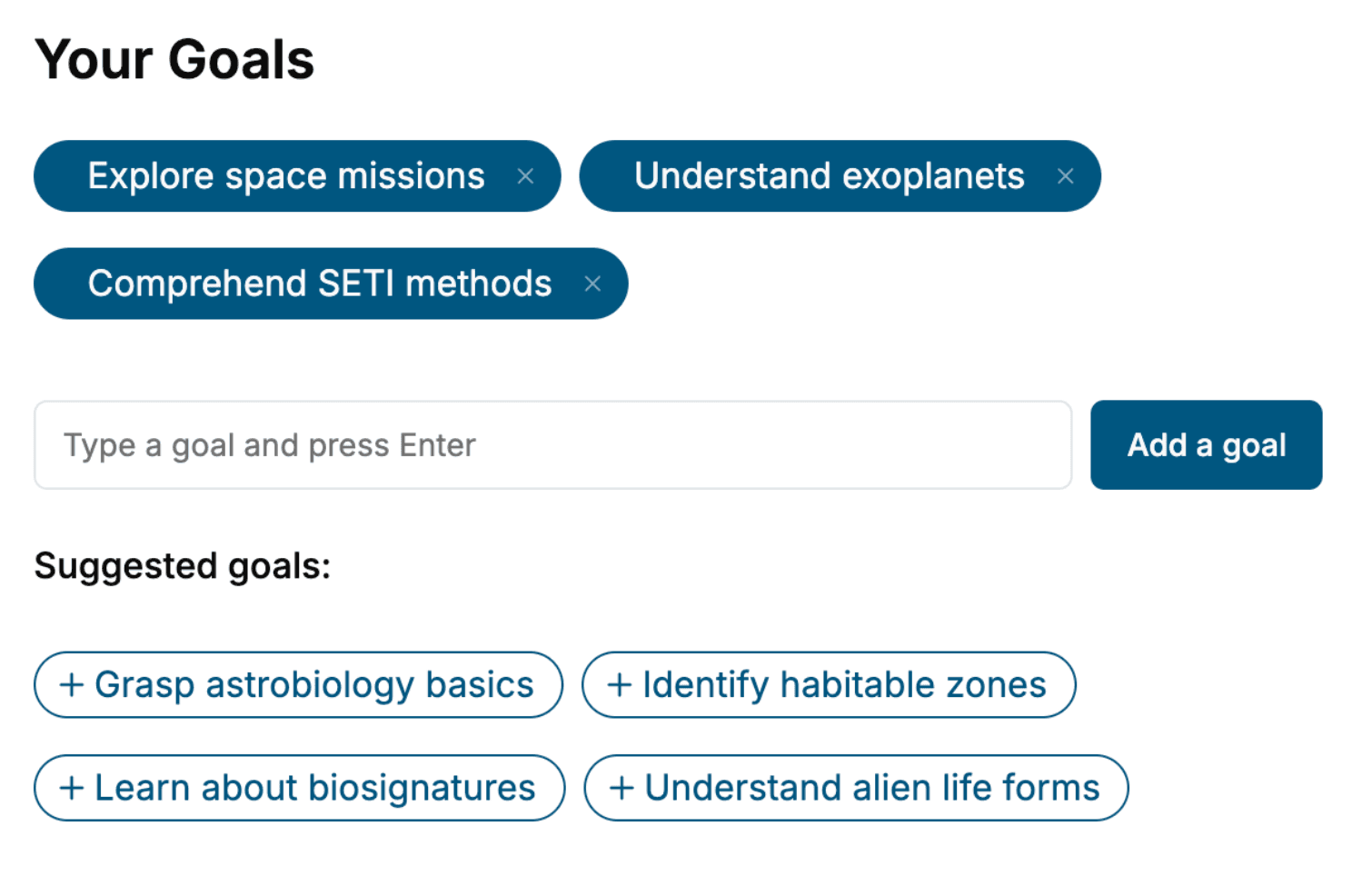
Specify your goals and choose sub-topics to include
- 3. Get your tailored book
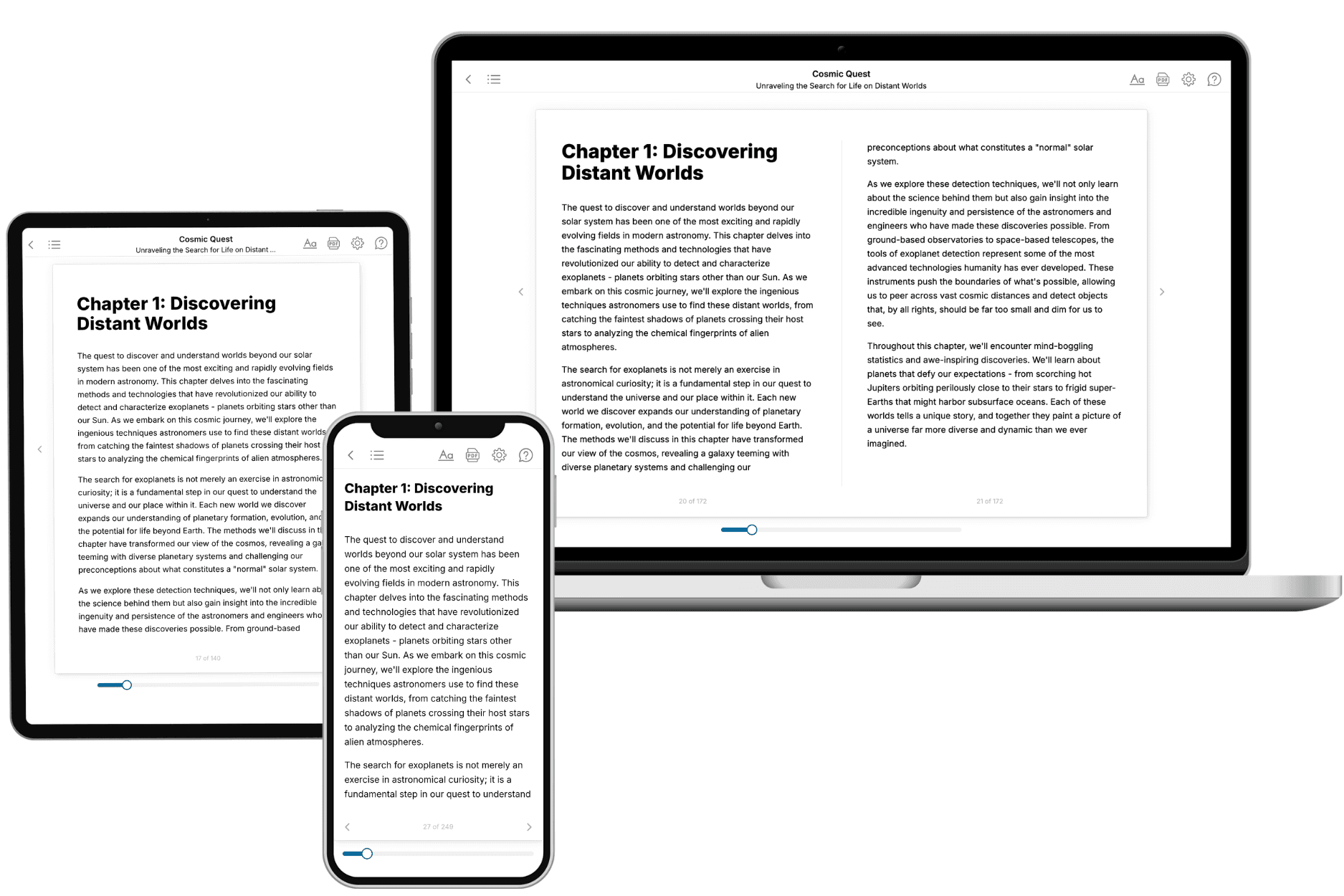
Your book is ready in 10 minutes. Read it online, download as EPUB or PDF, or send to Kindle.

Start from a template
Frequently asked questions
- What is TailoredRead?
TailoredRead creates complete, full-length nonfiction ebooks, written specifically for you. Tell us what you want to learn and why, and TailoredRead writes you a complete ebook on it, with charts, tables, and diagrams throughout. Read it online, on Kindle, or on any e-reader, or download it as a PDF or EPUB. Every book is written fresh the day you order it.
- How is the book tailored to me?
Before anything is written, you answer a few short questions about your goals, your background, and the topics you care about. Your book is then planned around your answers: written at your level, focused on your goals, and covering the topics you chose, instead of the one-size-fits-all book a store sells everyone.
- Will it read like generic AI content?
No. Your book isn't a chat transcript: it's planned chapter by chapter before a single word is written, told in a clear book voice, and explains ideas visually with charts, tables, and diagrams. After writing, every book goes through an editorial pass that polishes chapters so the book reads consistent from start to finish. Judge for yourself: browse thousands of sample books on our Explore Books page.
- How accurate is the content?
Our AI first checks whether your subject needs live research. Niche and fast-moving subjects are researched before writing, and the book plan and chapters are grounded in what it finds. After writing, every book goes through a quality pass that checks its facts and consistency, and researched books list their sources in a Notes section at the back.
- How long is the book?
You choose the length: Comprehensive (250-300 pages), Detailed (150-200 pages), Essential (70-100 pages), or Short (30-50 pages).
- Does the book include visuals?
Yes. Every book includes charts, tables, and diagrams: timelines, checklists, step-by-step guides, decision trees, comparison tables, matrices, and bar charts. A typical book includes dozens of these visual elements.
- Can I read it on Kindle? What formats can I download?
Yes. Every book can be read in our online reader or downloaded as a PDF or EPUB. The EPUB can be opened with Kindle, Apple Books, Kobo, and any e-reader. The Commercial and Author licenses also include an editable Word (DOCX) and Markdown download.
- How much does it cost?
About the price of a regular ebook. The exact price depends on your book's length and complexity, from $2 for the shortest books to $35 for the most comprehensive, and it's shown when you review your book, before you commit to anything. Each book is a one-time purchase, yours to keep, no subscription. Licenses that let you share, teach, or publish your book range from $35.99 to $49.99.
- Can I preview the book before purchasing?
Before you pay, you'll see what your book will cover: the title, a detailed description, the estimated length, and the complete chapter-by-chapter table of contents, so you know what you're getting before you decide. The full text itself is written after you purchase.
- How long does it take to create a book?
About 10 minutes. You can start reading the opening chapters while the rest is still being written.