Urban Engineering Books
Explore tailored Urban Engineering books created by our AI
Green Cities
How Smart Infrastructure Design Creates Healthier, More Resilient Urban Spaces
Cities face unprecedented challenges: flooding, heat waves, poor air quality, and disconnected communities. This book shows how green infrastructure—strategically designed natural and engineered systems—solves these problems while creating vibrant public spaces. You'll discover how permeable pavements reduce flooding, how urban forests cool neighborhoods by up to 8 degrees, and how green roofs transform buildings into ecological assets. Through real-world case studies from Copenhagen to Singapore, you'll learn the engineering principles behind rain gardens, bioswales, and constructed wetlands. More importantly, you'll understand how to integrate these systems into existing cities, navigate financing challenges, and engage communities in the process. Whether you're a civil engineer, urban planner, or sustainability professional, this book provides the practical knowledge and strategic frameworks needed to design cities that work with nature rather than against it—creating spaces that are healthier, more resilient, and more beautiful.
Cities are far more than collections of buildings and streets—they are living systems where millions of lives intersect, where opportunity and inequality coexist, and where the decisions made today shape the world of tomorrow. This book takes you through the essential frameworks for understanding how cities actually work, from the historical forces that created modern urban patterns to the contemporary challenges reshaping our metropolitan areas. You'll explore how cities generate economic growth while grappling with inequality, how communities form and fragment, and how urban environments impact health and wellbeing. By examining real-world examples and evidence-based approaches, you'll gain the analytical tools to understand urban dynamics and recognize the possibilities for creating more equitable, sustainable, and livable cities. Whether you're a student, professional, or engaged citizen, this book equips you with the knowledge to think critically about the urban world around you and the role cities play in addressing society's greatest challenges.
Most cities struggle with sprawl, traffic congestion, and disconnected neighborhoods that isolate residents from jobs, services, and each other. Transit-oriented development offers a proven alternative—creating walkable, mixed-use communities centered around high-quality public transportation. This book explains how TOD works in practice, from the foundational principles that make it effective to the complex coordination required to implement it successfully. You'll discover how cities worldwide are using TOD to reduce car dependency, increase housing options, strengthen local economies, and build more equitable communities. Whether you're a planner, policymaker, developer, or simply someone who cares about your city's future, this guide provides the knowledge and frameworks you need to understand and advance transit-oriented development in your community.
What if the buildings in your neighborhood could serve multiple purposes, creating a place where you could live, work, shop, and socialize without leaving your community? Mixed-use development represents a fundamental shift in how we design cities and neighborhoods—moving away from single-purpose zones toward integrated, walkable communities. This book provides a comprehensive guide to understanding and designing mixed-use developments that work. You'll explore the core principles that make these projects successful, from balancing diverse uses and managing complex logistics to activating public spaces and ensuring financial viability. Whether you're designing a new urban district, revitalizing an underutilized neighborhood, or adapting historic buildings for contemporary needs, this book equips you with practical frameworks, real-world examples, and actionable strategies. Learn how to navigate zoning challenges, create vibrant street-level experiences, phase development strategically, and engage communities throughout the design process. Discover how mixed-use development can address urban challenges while creating places where people genuinely want to live and work.
Water Works
Mastering Hydrology for Sustainable Green Infrastructure Design
Navigate the intersection of water science and sustainable design as you discover how hydrology shapes modern green infrastructure. This comprehensive guide takes you from fundamental hydrological concepts through real-world applications in civil engineering, showing you exactly how water moves through natural and built environments. You'll learn to calculate infiltration rates, design bioswales and rain gardens, model stormwater behavior, and integrate green infrastructure with traditional systems. Each chapter builds practical skills through case studies and technical examples, revealing how hydrological principles translate into resilient, cost-effective solutions. Whether you're designing urban parks, managing stormwater on development sites, or retrofitting existing infrastructure, this book provides the knowledge and tools to make informed decisions that balance water management with environmental stewardship and community benefit.
Urban Greening Essentials
Designing and Implementing Green Infrastructure for Livable Cities
Imagine walking through your city and seeing thriving green spaces on rooftops, rain gardens filtering stormwater on every block, and tree-lined streets that cool neighborhoods naturally. This is the reality that urban greening makes possible. This comprehensive guide takes you beyond the basics to show you how green infrastructure actually works—and how to make it work in your community. Whether you're planning a single project or transforming an entire district, you'll discover practical strategies for designing systems that manage water, reduce urban heat, improve air quality, and create spaces where people want to be. Learn from real-world examples, understand the engineering principles behind effective solutions, and master the stakeholder engagement techniques that turn ambitious visions into lasting change. This book bridges the gap between environmental science and practical implementation, giving you the tools to design resilient, beautiful cities that work for both people and nature.
Sewage Solutions
Engineering a Cleaner Future Through Advanced Disposal Methods
Think sewage disposal is just about getting rid of waste? Think again. The truth is, it's a complex field at the intersection of civil engineering, environmental science, and public health. In "Sewage Solutions: Engineering a Cleaner Future Through Advanced Disposal Methods," you'll discover how modern sewage disposal is revolutionizing our approach to pollution control and sustainable urban development. This book dives deep into the intricate world of wastewater management, exploring cutting-edge technologies and innovative practices that are reshaping our cities and protecting our environment. From the basics of sewage treatment to advanced disposal techniques, you'll gain a comprehensive understanding of the entire process. You'll explore the challenges faced by engineers and policymakers, and learn about the latest solutions being implemented around the globe. Whether you're a civil engineering professional, an environmental science student, or simply curious about the infrastructure that keeps our cities clean, this book offers invaluable insights into one of the most crucial aspects of modern civilization. Prepare to change the way you think about sewage disposal. It's not just about waste management—it's about engineering a cleaner, more sustainable future for all.
Riemannian Geometry and Graphs
A Comprehensive Guide for Urban Planners and Spatial Analysts
Embark on a transformative journey into the world of Riemannian geometry and its applications to graph theory with this groundbreaking book. Tailored for urban planners, spatial analysts, and interdisciplinary researchers, this comprehensive guide bridges the gap between abstract mathematical concepts and real-world applications. You'll start with the fundamentals of manifolds and metric tensors, gradually progressing to more advanced topics such as spectral graph theory, Ricci flow, and differential forms. Each chapter builds upon the last, providing you with a solid foundation in Riemannian geometry while simultaneously exploring its connections to graph theory and urban planning. Through clear explanations, intuitive examples, and practical exercises, you'll gain the tools to enhance your spatial analysis skills, improve your research methods, and integrate sophisticated mathematical concepts into your work. Whether you're looking to collaborate with experts in the field or teach advanced concepts, this book will equip you with the knowledge and confidence to excel in your professional endeavors.
Related books you may like:
Navigate the convergence of classical petroleum engineering and cutting-edge data science to build production forecasting models that drive better reservoir management decisions. This comprehensive guide takes you from foundational decline curve analysis through advanced machine learning and deep learning applications, showing you how to extract maximum value from your production data. You'll learn systematic approaches to feature engineering, probabilistic forecasting, and geological data integration that transform raw well logs and seismic information into actionable predictions. Discover how to validate your models rigorously, benchmark performance against industry standards, and develop workflows that balance statistical sophistication with physical accuracy. Whether you're optimizing reserve estimates, planning capital investments, or improving operational efficiency, you'll gain practical frameworks for integrating domain expertise with advanced analytics. This book bridges the gap between theoretical machine learning and real-world petroleum applications, equipping you with the tools to build forecasts that stakeholders trust and decisions that create value.
Discover how microscopic algae could revolutionize global energy production while addressing climate change and resource scarcity. This comprehensive guide takes you from the fundamental science of photosynthetic lipid production to the real-world economics of bringing algae biofuels to market. You'll learn why major energy companies are investing billions in this technology, why pilot projects are accelerating, and what obstacles still stand between laboratory success and commercial viability. Explore the difference between microalgae and macroalgae, understand the extraction and processing technologies that convert algae into usable fuel, and discover why sustainable aviation fuel represents the most promising near-term application. Whether you're evaluating investment opportunities, researching renewable energy solutions, or simply curious about the future of biofuels, this book provides the scientific foundation, economic analysis, and strategic insights needed to understand algae's role in the energy transition.
Master the technology reshaping modern aviation. ADS-B has revolutionized how aircraft are tracked and managed in the sky, replacing traditional radar with a more efficient, accurate, and cost-effective system. This comprehensive guide walks you through every aspect of Automatic Dependent Surveillance-Broadcast technology—from its fundamental principles and technical architecture to its practical implementation in aircraft design and operations. You'll discover how ADS-B works, why it matters for aviation safety and efficiency, and how it's transforming air traffic management worldwide. Whether you're an engineer designing aircraft systems, a maintenance technician, or an aviation professional seeking deeper technical knowledge, this book provides the insights and practical understanding you need to work confidently with ADS-B technology in today's aviation environment.
Imagine confidently diagnosing complex electrical faults that stump other technicians, designing custom wiring systems that perform flawlessly, and earning professional certification in automotive electrical work. This 90-day mastery program transforms your intermediate electrical knowledge into expert-level competency through a carefully sequenced curriculum that builds from foundational principles to advanced diagnostics and custom installations. Whether you're troubleshooting multi-system failures, designing custom harnesses, or upgrading vehicle electrical systems, this book provides the systematic methodology and hands-on frameworks you need. Each week builds on previous learning, with practical exercises that develop intuitive problem-solving skills. You'll master wiring diagram interpretation, advanced diagnostic techniques, safety protocols, and the specialized tools that separate competent technicians from true experts. Designed specifically for auto electricians ready to elevate their craft, this program combines theoretical understanding with actionable techniques. By day 90, you'll possess the knowledge, skills, and confidence to handle complex electrical challenges independently and pursue professional certification with demonstrated mastery.
Many drivers believe that anti-lock braking systems eliminate the need for proper braking technique, but the reality is far more nuanced. ABS is a sophisticated safety technology that works behind the scenes to prevent wheel lockup and maintain steering control during emergency stops—yet most drivers don't truly understand how it functions or what it can and cannot do. This comprehensive guide demystifies anti-lock braking systems by exploring their mechanical and electronic components, explaining how they interact during critical moments, and revealing why this technology has become essential for modern vehicle safety. You'll discover the engineering principles that make ABS work, learn how to recognize when your system needs attention, and understand how ABS integrates with other safety features. Whether you're a car enthusiast wanting deeper technical knowledge, a vehicle owner seeking to maintain your safety systems, or someone preparing for automotive work, this book provides the practical insights and technical understanding you need to appreciate one of automotive engineering's most important innovations.
Create an Urban Engineering Book Tailored to You
Create an AI-crafted book tailored to your goals, interests, and background






Benefits of AI-tailored books
- Read one book, not ten:
- all the Urban Engineering knowledge you need, gathered into a single book.
- Save days of learning:
- tell us your goals, choose your topics, and the whole book is built around them.
- Learn effortlessly:
- Urban Engineering book written for your specific background and expertise.
- Understand at a glance:
- includes charts, tables, timelines, checklists, decision trees, and more.
- Stay current:
- written the day you order it, not years ago.
- Trust what you read:
- every book is checked for accuracy, with real research when your subject needs it.
Create your unique book in 3 steps
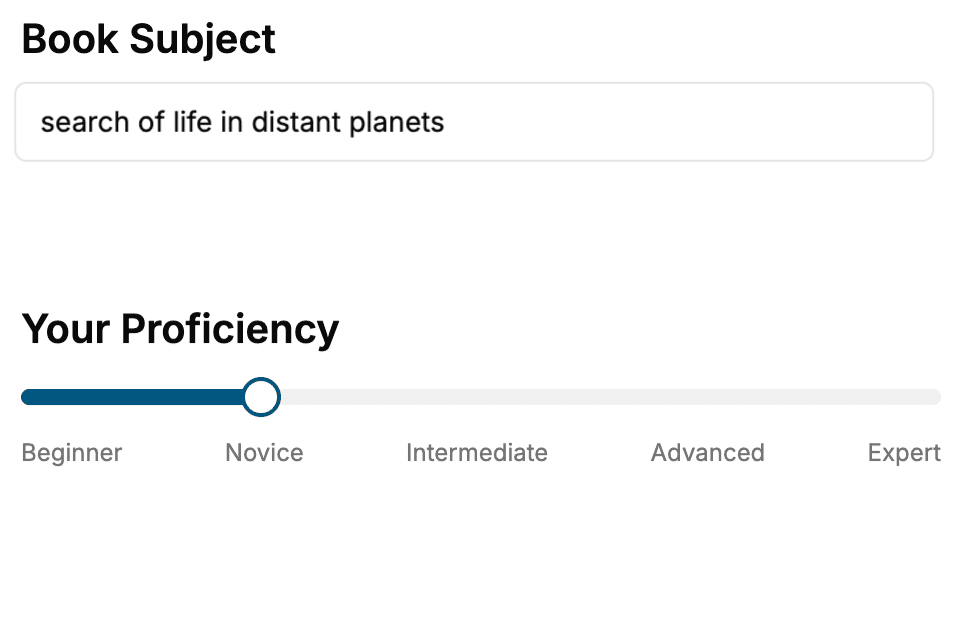
- 1. Select your focus
Select the focus of your Urban Engineering book and share your background
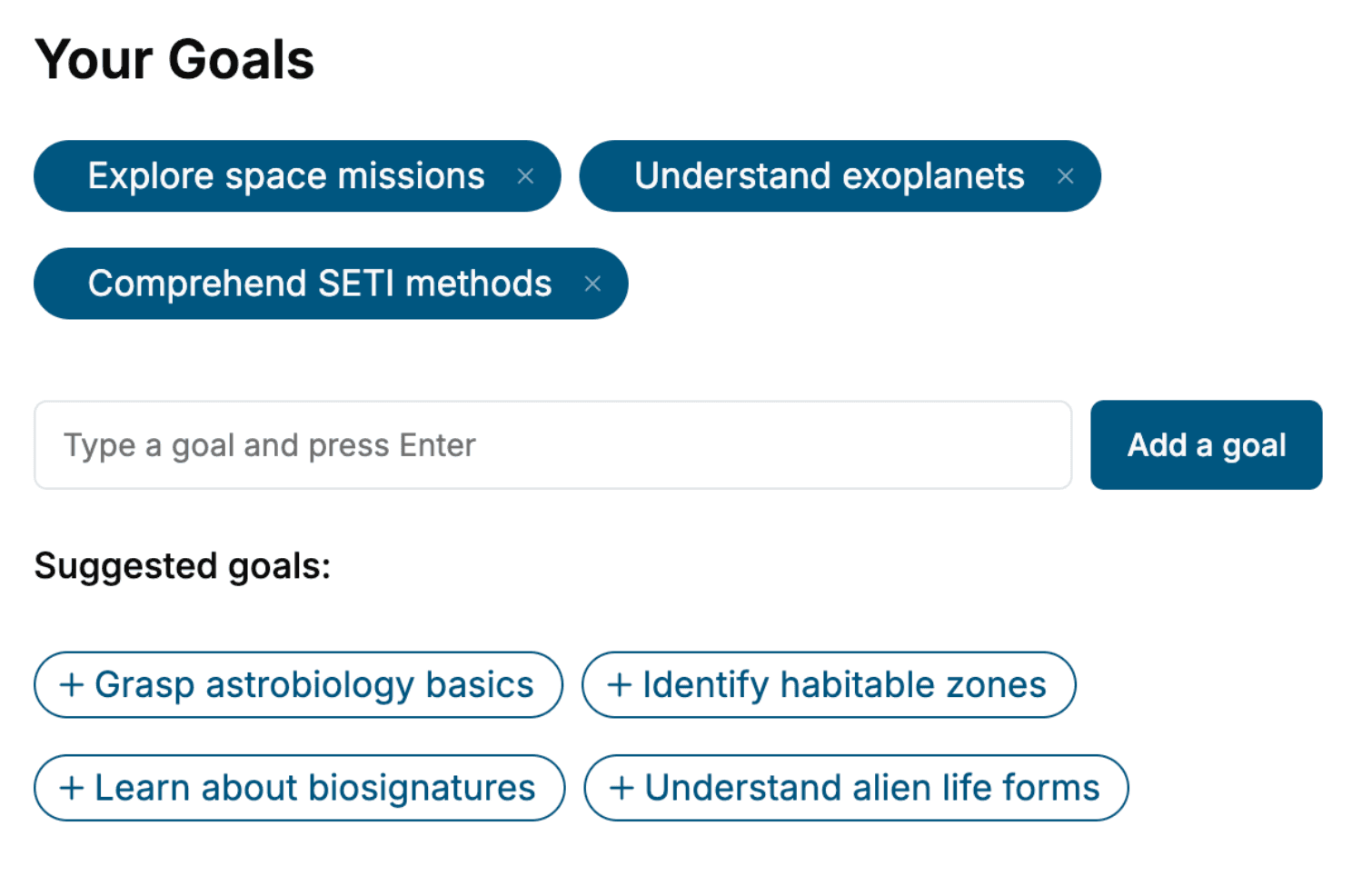
- 2. Personalize your book
Specify your goals and choose sub-topics to include
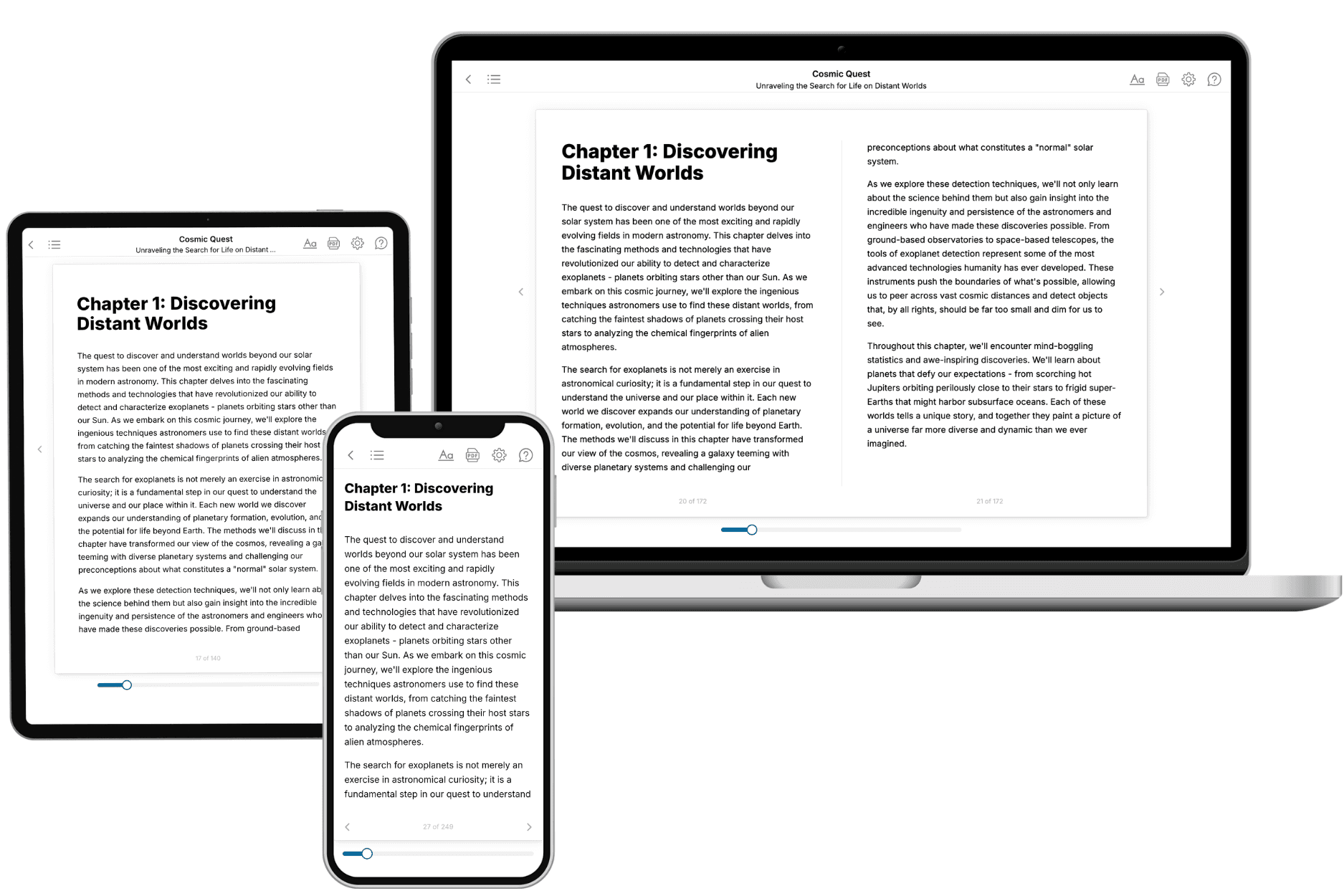
- 3. Get your tailored book
Your book is ready in 10 minutes. Read it online, download as EPUB or PDF, or send to Kindle.
Frequently asked questions
- What is TailoredRead?
TailoredRead creates complete, full-length nonfiction ebooks, written specifically for you. Tell us what you want to learn and why, and TailoredRead writes you a complete ebook on it, with charts, tables, and diagrams throughout. Read it online, on Kindle, or on any e-reader, or download it as a PDF or EPUB. Every book is written fresh the day you order it.
- How is the book tailored to me?
Before anything is written, you answer a few short questions about your goals, your background, and the topics you care about. Your book is then planned around your answers: written at your level, focused on your goals, and covering the topics you chose, instead of the one-size-fits-all book a store sells everyone.
- Will it read like generic AI content?
No. Your book isn't a chat transcript: it's planned chapter by chapter before a single word is written, told in a clear book voice, and explains ideas visually with charts, tables, and diagrams. After writing, every book goes through an editorial pass that polishes chapters so the book reads consistent from start to finish. Judge for yourself: browse thousands of sample books on our Explore Books page.
- How accurate is the content?
Our AI first checks whether your subject needs live research. Niche and fast-moving subjects are researched before writing, and the book plan and chapters are grounded in what it finds. After writing, every book goes through a quality pass that checks its facts and consistency, and researched books list their sources in a Notes section at the back.
- How long is the book?
You choose the length: Comprehensive (250-300 pages), Detailed (150-200 pages), Essential (70-100 pages), or Short (30-50 pages).
- Does the book include visuals?
Yes. Every book includes charts, tables, and diagrams: timelines, checklists, step-by-step guides, decision trees, comparison tables, matrices, and bar charts. A typical book includes dozens of these visual elements.
- Can I read it on Kindle? What formats can I download?
Yes. Every book can be read in our online reader or downloaded as a PDF or EPUB. The EPUB can be opened with Kindle, Apple Books, Kobo, and any e-reader. The Commercial and Author licenses also include an editable Word (DOCX) and Markdown download.
- How much does it cost?
About the price of a regular ebook. The exact price depends on your book's length and complexity, from $2 for the shortest books to $35 for the most comprehensive, and it's shown when you review your book, before you commit to anything. Each book is a one-time purchase, yours to keep, no subscription. Licenses that let you share, teach, or publish your book range from $35.99 to $49.99.
- Can I preview the book before purchasing?
Before you pay, you'll see what your book will cover: the title, a detailed description, the estimated length, and the complete chapter-by-chapter table of contents, so you know what you're getting before you decide. The full text itself is written after you purchase.
- How long does it take to create a book?
About 10 minutes. You can start reading the opening chapters while the rest is still being written.