Biostatistics Books
Explore tailored Biostatistics books created by our AI
Biostatistics Essentials
Master Statistical Methods for Biological and Medical Research
Navigate the intersection of statistics and biology with confidence. This book guides you through the essential statistical methods that drive modern biological and medical research. You'll start by understanding why standard statistics alone isn't enough for biological data, then progress through study design principles that ensure valid conclusions. Learn how to explore your data visually, test hypotheses rigorously, and model complex relationships between variables. Discover specialized techniques for analyzing survival data, categorical outcomes, and high-dimensional genomic information. Each chapter builds practical skills through real-world examples from clinical trials, epidemiological studies, and laboratory research. You'll master both the theoretical foundations and software implementation, learning when to apply each method and how to interpret results in biologically meaningful ways. Whether you're designing experiments, analyzing datasets, or evaluating published research, this book equips you with the statistical literacy needed to make sound scientific decisions and communicate findings effectively to colleagues and stakeholders.
Many believe clinical trials are simply about testing whether a drug works. In reality, they're sophisticated statistical and mathematical enterprises designed to extract reliable truth from noisy, complex data. This book reveals the mathematical architecture underlying clinical research—from the foundational principles of study design to the advanced statistical techniques that determine whether results are real or random. You'll discover why sample size matters, how randomization eliminates bias, what p-values actually mean, and how regulatory agencies use statistical evidence to protect public health. Whether you're evaluating research findings, designing studies, or making healthcare decisions, understanding the statistical framework transforms how you interpret clinical evidence. This practical guide bridges the gap between abstract mathematics and real-world medical research, making rigorous statistical concepts accessible without oversimplifying the science.
You're about to discover why the research you trust may be fundamentally flawed. Most published studies violate core statistical principles, yet their findings are presented as reliable facts. This book reveals the hidden logic of hypothesis testing—how it actually works versus how researchers think it works—and exposes the systematic errors that plague modern research. You'll learn why p-values are misinterpreted, why sampling methods fail, why clinical trials start with flawed designs, and why medical efficacy claims are often fraudulent. Through clear explanations and concrete examples, you'll understand how observational studies, self-selected samples, and convenience sampling destroy statistical validity. You'll see why confidence intervals mean something entirely different than most believe, why the proportional reporting ratio is mathematically broken, and how p-hacking creates false discoveries. By the end, you'll recognize the fundamental requirements of statistical theory and understand why most published research cannot support its own conclusions. This knowledge will change how you read, evaluate, and conduct research.
Many people believe that finding a genetic variant associated with a disease means we've discovered its cause—but GWAS tells a more nuanced story. Genome-Wide Association Studies have revolutionized our understanding of genetic architecture, yet their methodology remains opaque to many. This book cuts through the complexity to reveal how GWAS actually works: from study design and statistical analysis to interpreting results and applying findings to personalized medicine. You'll learn why a significant association doesn't equal causation, how population structure can mislead researchers, and what makes some GWAS results reproducible while others fail. Whether you're navigating research literature, evaluating genetic risk scores, or simply curious about how scientists connect DNA variants to human traits, this guide provides the practical knowledge you need. Discover the power and limitations of GWAS, understand the critical role of validation and replication, and gain confidence in interpreting genomic discoveries that shape modern medicine.
You're about to discover how to design experiments that definitively answer your most important questions. This book walks you through the complete RCT lifecycle—from formulating testable hypotheses and calculating sample sizes to randomizing participants, managing implementation, and interpreting results with statistical confidence. You'll learn why randomization works, how to avoid common pitfalls that compromise validity, and how to navigate the practical constraints that real-world research presents. Whether you're evaluating a new treatment, testing an intervention, or validating a hypothesis, you'll gain the conceptual understanding and practical tools to conduct rigorous trials that stakeholders trust. This isn't theoretical—it's grounded in real examples and actionable guidance that helps you make methodologically sound decisions at every stage.
You're about to dive deep into one of the most sophisticated areas of statistical modeling, where traditional approaches fall short and advanced techniques become essential. This comprehensive guide takes you through the intricate world of Generalized Linear Mixed Models (GLMMs) specifically tailored for non-inferiority studies, bridging the gap between theoretical foundations and practical application. Starting with the mathematical underpinnings that make GLMMs so powerful, you'll discover how these models handle the complexities of correlated data, repeated measures, and hierarchical structures that are common in comparative studies. You'll learn to navigate the unique challenges of non-inferiority research, where the goal isn't to prove one treatment is better, but to demonstrate that it's not meaningfully worse than an established standard. Through systematic exploration of model building, parameter estimation, and inference procedures, you'll gain the expertise to tackle real-world data analysis challenges. The book provides detailed coverage of model selection strategies, diagnostic techniques, and interpretation methods that ensure your conclusions are both statistically sound and practically meaningful. You'll master the art of handling missing data, understanding random effects, and constructing appropriate confidence intervals for non-inferiority margins. By the end of this journey, you'll possess the advanced statistical toolkit needed to conduct rigorous comparative analyses, make confident decisions about model specification, and communicate your findings effectively to both technical and non-technical audiences.
Navigate the intersection of rigorous evidence and personalized medicine to elevate your diagnostic precision and clinical decision-making. This comprehensive guide walks you through interpreting complex systematic reviews, understanding how cognitive biases silently influence your clinical judgments, and harnessing genomic and epigenetic insights to tailor care to individual patients. You'll learn to recognize the limitations of population-based evidence when applied to unique clinical scenarios, master frameworks that counteract systematic thinking errors, and integrate cutting-edge genomic data into your diagnostic workflow. Each chapter builds practical skills grounded in real-world clinical scenarios, from evaluating study heterogeneity to interpreting genetic variants and understanding epigenetic regulation of disease. Whether you're refining your approach to complex cases or staying current with precision medicine advances, this book provides the analytical tools and conceptual frameworks to transform how you reason through clinical problems and deliver evidence-informed, personalized care.
What if you could extract causal insights from observational data with the same confidence as randomized experiments? In a world where controlled experiments are often impossible or unethical, propensity score matching emerges as your most powerful tool for making valid causal inferences from real-world data. This comprehensive guide takes you beyond basic statistical concepts into the sophisticated realm of causal inference. You'll discover how to transform messy observational data into reliable evidence by mastering the art and science of propensity score matching. From understanding the theoretical foundations to implementing cutting-edge algorithms, you'll gain the expertise to tackle complex research questions that have puzzled analysts for decades. Through practical examples and step-by-step methodologies, you'll learn to navigate the critical decisions that separate successful matching from statistical disasters. You'll master balance diagnostics, sensitivity analyses, and modern computational approaches that ensure your results stand up to scrutiny. Whether you're evaluating program effectiveness, analyzing treatment outcomes, or conducting policy research, this book provides the rigorous framework you need to draw meaningful conclusions from observational studies. By the end of this journey, you'll possess the confidence and technical skills to apply propensity score matching across diverse domains, making you an invaluable asset in any data-driven organization where causal questions matter most.
Handling Missing Data
Practical Imputation Techniques for Complete Statistical Analysis
Complete datasets are rare in real-world research. Missing values can silently undermine your statistical conclusions, introduce bias, and lead to invalid inferences. This book equips you with the knowledge and practical skills to handle missing data strategically. You'll learn why missing data occurs, how to diagnose its patterns, and which imputation technique works best for your specific situation. From simple approaches like mean imputation to advanced methods like multiple imputation and machine learning-based techniques, you'll understand not just how to apply each method, but when and why to use it. This guide bridges theory and practice, combining statistical foundations with hands-on implementation guidance. You'll discover how to validate your imputations, assess sensitivity to different assumptions, and communicate your approach to stakeholders. Whether you're analyzing survey data, clinical trials, or observational studies, you'll gain confidence in producing reliable, defensible results even when your data is incomplete.
High Throughput Screening Essentials
Accelerating Discovery in Synthetic Biology and Beyond
Many researchers assume that high throughput screening requires massive budgets and industrial-scale infrastructure. In reality, HTS is a strategic approach to discovery that can be adapted to labs of any size. This book demystifies high throughput screening and shows you how to leverage it effectively in synthetic biology and biological research. You'll learn how to design assays that actually work, implement screening campaigns that generate reliable data, and interpret results with statistical confidence. Whether you're screening genetic libraries, optimizing metabolic pathways, or discovering novel biological functions, this guide provides practical frameworks and real-world examples. You'll understand the critical role of automation without becoming dependent on it, master data analysis techniques that separate signal from noise, and develop validation strategies that confirm your discoveries are genuine. By the end, you'll have a complete toolkit for accelerating your research through intelligent, systematic screening.
Beyond the P-Value
Mastering Frequentist Statistics and Avoiding Common Pitfalls in Research
Imagine confidently evaluating research papers, immediately spotting statistical flaws that others miss, and understanding exactly what p-values actually tell you—and more importantly, what they don't. This comprehensive guide cuts through the confusion surrounding frequentist statistics and reveals the hidden pitfalls that plague modern research. You'll discover why p-values are routinely misinterpreted, how the multiple comparisons problem silently inflates false discoveries, and why statistical significance often masks practical irrelevance. Through clear explanations, real-world examples, and practical frameworks, you'll master the distinction between Type I and Type II errors, learn to recognize data dredging and selective reporting, and understand when Bayesian alternatives offer superior insights. Whether you're designing studies, reviewing manuscripts, or navigating the replication crisis, this book provides the critical knowledge to strengthen your statistical reasoning and contribute to more rigorous science. Build the analytical foundation to question assumptions, evaluate evidence rigorously, and help restore integrity to statistical practice.
Elevate your research methodology with "Mastering Stepped Wedge Designs." This groundbreaking book equips you with the tools to revolutionize your approach to non-inferiority studies and experimental design. You'll gain a deep understanding of the mathematical foundations that underpin stepped wedge designs, allowing you to confidently implement these powerful techniques in your own work. Dive into the intricacies of stepped wedge designs and discover how they can enhance the validity and efficiency of your research. You'll learn to navigate the complexities of non-inferiority studies with ease, mastering the statistical methods that set your work apart in the competitive world of research. From practical applications to advanced mathematical concepts, this book covers it all. You'll develop the skills to design robust studies, analyze complex data sets, and draw meaningful conclusions that push the boundaries of your field. Whether you're a seasoned researcher or an ambitious professional looking to expand your toolkit, "Mastering Stepped Wedge Designs" is your key to unlocking new levels of research excellence.
Gain the ability to confidently interpret organic acid tests and understand what metabolic biomarkers truly reveal about health and disease. This comprehensive guide bridges biochemistry and mathematics, making complex metabolic pathways accessible through clear explanations and practical examples. You'll learn how to read test results systematically, understand the biochemical logic behind each marker, and apply statistical reasoning to distinguish meaningful findings from normal variation. Discover how mitochondrial dysfunction, nutrient deficiencies, and detoxification impairment create recognizable patterns in organic acid profiles. Whether you're a healthcare practitioner, researcher, or health-conscious individual, this book provides the analytical framework and evidence-based knowledge needed to interpret metabolic testing data accurately. Move beyond memorizing reference ranges to truly understanding the metabolic story your lab results tell.
Analyze hierarchical data with confidence and precision. Multilevel modeling is essential when your data has a natural structure—students within schools, patients within hospitals, or measurements within individuals. This book guides you through the complete process of building, interpreting, and validating multilevel models. You'll learn why traditional regression fails with nested data, how to structure models that respect your data's hierarchy, and how to extract meaningful insights from complex statistical results. With practical examples and step-by-step explanations, you'll master the core concepts of fixed and random effects, understand when and how to use multilevel approaches, and develop the skills to implement these models in real-world research. Whether you're analyzing educational outcomes, medical data, or organizational metrics, this book provides the knowledge and tools you need to conduct rigorous, accurate statistical analysis.
Mastering Repeated Measures ANOVA
A Practical Guide for Researchers and Data Analysts
Struggling to make sense of complex experimental designs and their statistical analyses? Repeated measures ANOVA can be a formidable challenge, often leaving researchers and data analysts feeling overwhelmed and uncertain. This comprehensive guide demystifies the intricacies of repeated measures ANOVA, providing you with the tools and confidence to tackle your data head-on. "Mastering Repeated Measures ANOVA" offers a clear, accessible approach to understanding this powerful statistical technique. You'll discover how to design robust experiments, navigate the nuances of within-subjects factors, and interpret your results with precision. Through practical examples and step-by-step tutorials, you'll gain the skills to apply repeated measures ANOVA to your own research questions. From the fundamentals of experimental design to advanced topics like sphericity and post-hoc analyses, this book covers everything you need to know to become proficient in repeated measures ANOVA. By the end, you'll have the expertise to confidently analyze your data, draw meaningful conclusions, and elevate the quality of your research.
Related books you may like:
Many ophthalmologists approach age-related macular degeneration management using standardized protocols that fail to account for the disease's remarkable heterogeneity and individual patient variation. This comprehensive guide bridges the gap between foundational AMD knowledge and advanced clinical practice by synthesizing the latest evidence on surgical techniques, pharmacological interventions, and diagnostic innovations. You'll master anti-VEGF injection optimization, learn to interpret multimodal imaging data for precise staging and prognosis, and develop personalized treatment algorithms that integrate genetic risk factors, biomarker monitoring, and combination therapy strategies. The book covers emerging technologies including adaptive optics imaging and complement system inhibition, while providing practical frameworks for managing complications, preventing subretinal fibrosis, and maximizing patient quality of life. Whether refining injection techniques, integrating new imaging modalities, or designing evidence-based clinical guidelines, this resource equips you with the knowledge and tools to advance your practice and improve outcomes for your AMD patients.
Imagine confidently identifying precise auricular points on your patients' ears and knowing exactly which anatomical landmarks correspond to their pain conditions. This comprehensive guide bridges the gap between anatomical knowledge and clinical practice, providing you with the practical skills needed to master auricular acupuncture. Drawing on your medical background, you'll learn the systematic mapping of ear point anatomy, develop proficiency in point sensitivity assessment, and implement evidence-based treatment protocols for both acute and chronic pain management. Each chapter builds your clinical competency through detailed anatomical descriptions, landmark identification techniques, and real-world application strategies. You'll understand the neurophysiological mechanisms underlying auricular acupuncture's effectiveness and gain the confidence to design individualized treatment plans. Whether you're treating acute injuries or managing chronic conditions, this book provides the anatomical precision and clinical frameworks necessary to deliver effective auricular acupuncture therapy and enhance your patient outcomes.
As a psychiatric nurse practitioner, you understand that ADHD extends far beyond childhood hyperactivity—yet many clinicians lack comprehensive frameworks for recognizing its complex manifestations across development and effectively integrating evidence-based interventions. This resource bridges that gap by providing clinically rigorous, practical guidance grounded in neuroscience and clinical evidence. You'll explore the neurobiological foundations of ADHD, master differential diagnosis across age groups, and implement multimodal treatment strategies that combine pharmacological management, behavioral interventions, and psychoeducational approaches. The book emphasizes neurodiversity-affirming care that reframes ADHD traits as neurological differences rather than deficits, helping your patients recognize inherent strengths like creativity and hyperfocus. Discover how to support families through psychoeducation, develop individualized coping strategies, and navigate the unique challenges of adult ADHD diagnosis and management. With practical assessment tools, treatment algorithms, and real-world clinical scenarios, this comprehensive guide enhances your ability to provide patient-centered, evidence-based care that improves outcomes and reduces stigma.
You'll gain a clear, science-based understanding of how ADHD actually works in your brain and why traditional productivity advice often fails you. This book moves beyond generic tips to explore the neurological reality of attention regulation, executive function, and dopamine sensitivity—and what that means for your daily life. You'll discover why you struggle with certain tasks while excelling at others, learn to recognize your personal ADHD patterns, and access practical strategies for managing time, emotions, relationships, and work. Whether you're newly diagnosed, self-aware but undiagnosed, or supporting someone with ADHD, you'll find evidence-based approaches to medication, therapy, lifestyle design, and environmental modifications. This isn't about "fixing" yourself—it's about understanding your brain's unique operating system and building a life that works with it, not against it. Packed with real-world examples and actionable frameworks, this guide helps you transform ADHD from a source of shame into a manageable aspect of who you are.
Imagine confidently integrating auricular acupuncture into your clinical practice with precision and evidence-based confidence. This comprehensive guide equips you with the anatomical knowledge, diagnostic skills, and practical protocols needed to master auricular point mapping and deliver superior patient outcomes. Designed specifically for physicians, this resource provides detailed visual maps of auricular points for pain management, stress relief, sleep disorders, smoking cessation, and obesity treatment. You'll learn systematic point location techniques, develop point sensitivity testing skills, and understand the neurophysiological mechanisms underlying auricular acupuncture's therapeutic effects. Whether you're treating chronic pain, managing stress-related conditions, or helping patients overcome addiction and weight management challenges, you'll discover evidence-based protocols that integrate seamlessly with your medical practice. The book includes practical guidance on needle-free auricular stimulation techniques, clinical diagnostic approaches, and strategies for patient selection and treatment monitoring. Master the specialized expertise that sets apart clinicians who achieve consistent, measurable results in auricular acupuncture practice.
Create a Biostatistics Book Tailored to You
Create an AI-crafted book tailored to your goals, interests, and background






Benefits of AI-tailored books
- Read one book, not ten:
- all the Biostatistics knowledge you need, gathered into a single book.
- Save days of learning:
- tell us your goals, choose your topics, and the whole book is built around them.
- Learn effortlessly:
- Biostatistics book written for your specific background and expertise.
- Understand at a glance:
- includes charts, tables, timelines, checklists, decision trees, and more.
- Stay current:
- written the day you order it, not years ago.
- Trust what you read:
- every book is checked for accuracy, with real research when your subject needs it.
Create your unique book in 3 steps
- 1. Select your focus
Select the focus of your Biostatistics book and share your background
- 2. Personalize your book
Specify your goals and choose sub-topics to include
- 3. Get your tailored book
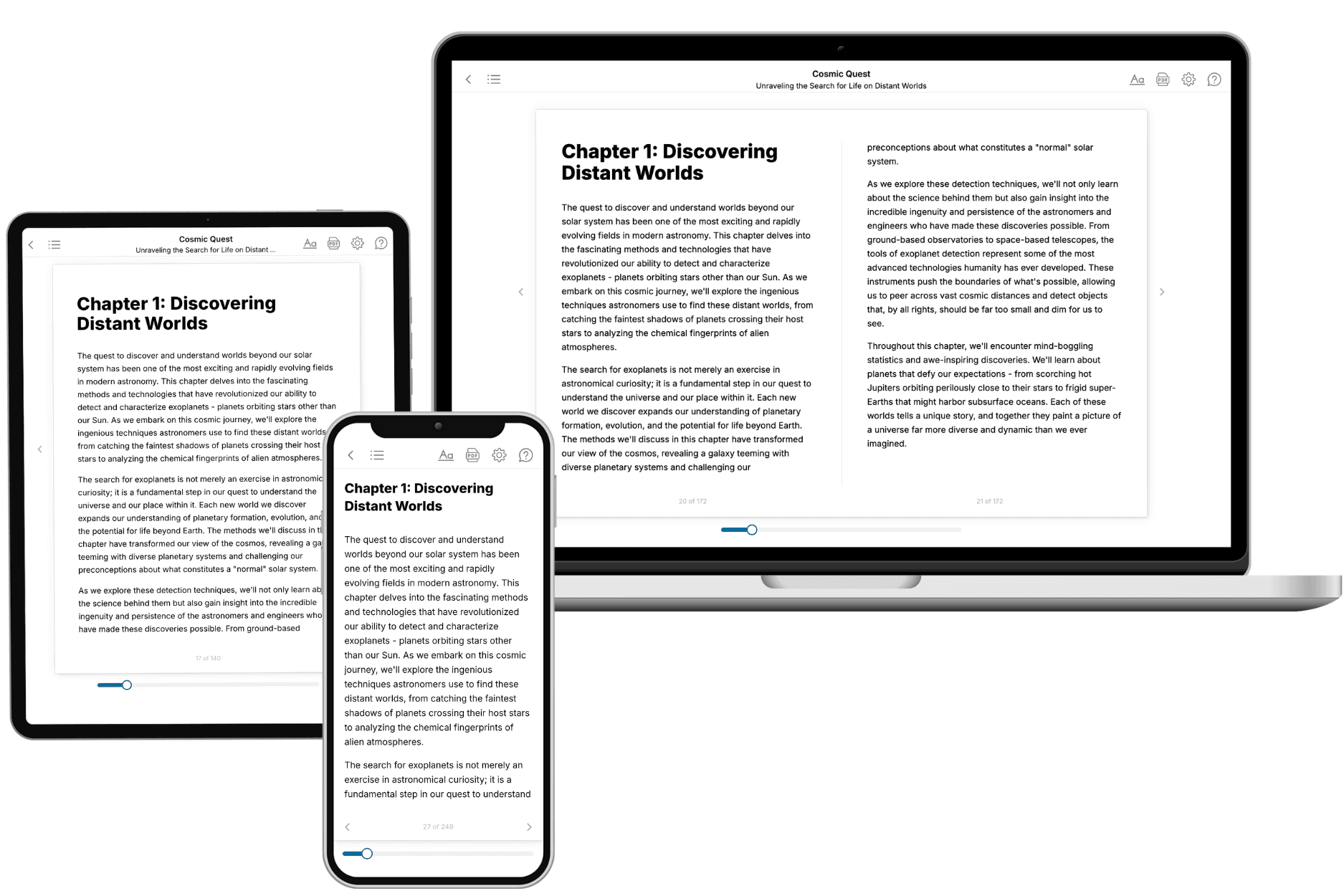
Your book is ready in 10 minutes. Read it online, download as EPUB or PDF, or send to Kindle.

Start from a template
Frequently asked questions
- What is TailoredRead?
TailoredRead creates complete, full-length nonfiction ebooks, written specifically for you. Tell us what you want to learn and why, and TailoredRead writes you a complete ebook on it, with charts, tables, and diagrams throughout. Read it online, on Kindle, or on any e-reader, or download it as a PDF or EPUB. Every book is written fresh the day you order it.
- How is the book tailored to me?
Before anything is written, you answer a few short questions about your goals, your background, and the topics you care about. Your book is then planned around your answers: written at your level, focused on your goals, and covering the topics you chose, instead of the one-size-fits-all book a store sells everyone.
- Will it read like generic AI content?
No. Your book isn't a chat transcript: it's planned chapter by chapter before a single word is written, told in a clear book voice, and explains ideas visually with charts, tables, and diagrams. After writing, every book goes through an editorial pass that polishes chapters so the book reads consistent from start to finish. Judge for yourself: browse thousands of sample books on our Explore Books page.
- How accurate is the content?
Our AI first checks whether your subject needs live research. Niche and fast-moving subjects are researched before writing, and the book plan and chapters are grounded in what it finds. After writing, every book goes through a quality pass that checks its facts and consistency, and researched books list their sources in a Notes section at the back.
- How long is the book?
You choose the length: Comprehensive (250-300 pages), Detailed (150-200 pages), Essential (70-100 pages), or Short (30-50 pages).
- Does the book include visuals?
Yes. Every book includes charts, tables, and diagrams: timelines, checklists, step-by-step guides, decision trees, comparison tables, matrices, and bar charts. A typical book includes dozens of these visual elements.
- Can I read it on Kindle? What formats can I download?
Yes. Every book can be read in our online reader or downloaded as a PDF or EPUB. The EPUB can be opened with Kindle, Apple Books, Kobo, and any e-reader. The Commercial and Author licenses also include an editable Word (DOCX) and Markdown download.
- How much does it cost?
About the price of a regular ebook. The exact price depends on your book's length and complexity, from $2 for the shortest books to $35 for the most comprehensive, and it's shown when you review your book, before you commit to anything. Each book is a one-time purchase, yours to keep, no subscription. Licenses that let you share, teach, or publish your book range from $35.99 to $49.99.
- Can I preview the book before purchasing?
Before you pay, you'll see what your book will cover: the title, a detailed description, the estimated length, and the complete chapter-by-chapter table of contents, so you know what you're getting before you decide. The full text itself is written after you purchase.
- How long does it take to create a book?
About 10 minutes. You can start reading the opening chapters while the rest is still being written.