Resistance Books
Explore tailored Resistance books created by our AI
Flowers of Freedom
The Carnation Revolution and How Ordinary People Toppled a Dictatorship
Imagine a nation where citizens lived under the weight of dictatorship for nearly five decades, where secret police monitored every conversation and colonial wars drained resources and lives. On April 25, 1974, that changed forever. In a single day, ordinary people—workers, students, soldiers, and families—peacefully reclaimed their freedom and transformed their country. This is the story of the Carnation Revolution, one of history's most remarkable examples of how nonviolent resistance can succeed against overwhelming odds. Through vivid accounts of the events leading up to that pivotal day, the revolution itself, and its profound aftermath, you'll discover how a nation rebuilt itself from the ashes of authoritarianism. You'll learn the strategies that made peaceful revolution possible, the role of unexpected allies, and the challenges of creating lasting democratic change. Whether you're studying revolutionary movements, exploring political history, or seeking inspiration about human resilience, this book reveals how ordinary people can achieve extraordinary transformation.
The Easter Rising of 1916
Ireland's Rebellion and the Birth of a Nation
What if a small group of rebels, armed with idealism and determination, could fundamentally reshape the course of a nation's history? The Easter Rising of 1916 stands as one of history's most transformative moments—a six-day rebellion that changed Ireland forever. This book explores the intricate web of political movements, personal sacrifices, and historical circumstances that converged in Dublin during Easter week. You'll discover how decades of failed constitutional reform, the pressures of World War I, and the vision of Irish independence combined to spark an uprising that seemed doomed from the start. Through vivid accounts of the key figures, the street-by-street fighting, and the dramatic executions that followed, you'll understand how a military defeat became a moral victory that galvanized an entire nation. Whether you're exploring Irish history, European politics, or the nature of revolutionary change, this comprehensive examination reveals why the Easter Rising remains a defining moment in the struggle for self-determination.
Most medical education treats patients as cases to be solved rather than persons to be understood. This fragmentation—where clinical reasoning dominates and human narrative disappears—diminishes both care and healing. This book reclaims the ancient tradition of the tragic rhapsode for contemporary medicine and philosophy, showing how interstitial narrative, aesthetic ethics, and performance-based resistance can restore what biomedicine has lost: the patient's voice, dignity, and narrative agency. Drawing on philosophical traditions, literary theory, and medical humanities, this work demonstrates that ethical practice is fundamentally aesthetic—rooted in vulnerability, embodied presence, and the power of storytelling. You'll discover how to recognize interstitial spaces in medical discourse where resistance becomes possible, how to cultivate aesthetic moral philosophy in clinical settings, and how to honor patients as narrative persons whose stories matter. This is essential reading for those committed to transforming medicine from within, integrating humanistic values into pedagogy and practice, and understanding how philosophy, literature, and performance create meaningful resistance to dehumanizing systems.
Gain a nuanced understanding of one of the most transformative periods in Philippine history. This comprehensive account examines the Japanese occupation of the Philippines from 1942 to 1945, exploring how this three-year period fundamentally reshaped Filipino society, politics, and national identity. You'll discover the experiences of ordinary Filipinos—from farmers and merchants to soldiers and students—and learn how communities navigated impossible choices between survival, collaboration, and resistance. The book traces the occupation's ripple effects through post-war Philippine development, examining how this era influenced everything from land ownership patterns to Cold War politics to contemporary national consciousness. By understanding this critical chapter, you'll gain deeper insight into what makes the Philippines and its people uniquely resilient, and how historical trauma and triumph continue to shape Filipino identity today.
This book takes you through one of history's most transformative conflicts—the Irish War of Independence—and shows you how a colonized nation fought for freedom and fundamentally altered the course of European history. You'll discover the deep historical roots of Irish grievance, trace the pivotal moments that shifted public opinion, and understand the guerrilla tactics that challenged imperial power. Through detailed examination of key figures, military campaigns, and political negotiations, you'll see how ordinary people and extraordinary leaders navigated impossible choices during a brutal conflict. The book explores the complex realities often overlooked in simplified accounts: the internal divisions within the independence movement, the experiences of women and working-class activists, and the regional variations across Ireland. You'll gain insight into how the war's outcome—the Anglo-Irish Treaty and partition—created both a new nation and lasting tensions that continue to influence Irish and British politics today. By the end, you'll understand not just what happened, but why it matters for understanding modern Ireland, European history, and the broader patterns of anti-colonial resistance worldwide.
Many people view World War II as a distant European conflict, overlooking the devastating impact it had on Asia and the Pacific. The Japanese occupation of the Philippines from 1941 to 1945 was one of the most transformative and traumatic periods in Philippine history, yet it remains underexplored in mainstream historical narratives. This book provides a comprehensive examination of this critical era, exploring how a nation of over 16 million people endured three years of military rule, economic collapse, and social upheaval. You'll discover the strategic decisions that led to the occupation, the remarkable resistance movements that emerged, the everyday struggles of ordinary Filipinos, and how this period fundamentally reshaped the nation's future. Through detailed accounts of military campaigns, personal stories, and historical analysis, this book illuminates a pivotal chapter that shaped modern Asia and demonstrates the resilience of the Filipino people during their darkest hours.
Stones of Empire
How Colonial Architecture Shaped Power, Identity, and Resistance
What if the buildings around you were designed not to shelter you, but to control you? Colonial architecture stands as one of history's most powerful yet overlooked tools of political domination. From grand administrative centers to segregated urban layouts, these structures encoded the ideology of empire into stone, steel, and space. This book reveals how colonizers weaponized architecture to establish hierarchies, erase indigenous cultures, and consolidate power—and how colonized peoples resisted through adaptation and cultural persistence. You'll discover how the cities you inhabit today still bear the imprint of colonial thinking, from property systems to infrastructure patterns. By understanding how architecture functioned as an instrument of control, you'll gain critical insight into how power operates through the spaces we inhabit, and why decolonizing our built environment matters for creating more equitable futures.
Discover the extraordinary story of how enslaved people in Saint-Domingue transformed themselves into free citizens and built the world's first Black republic. This book traces the Haitian Revolution from its roots in colonial oppression through the thirteen-year struggle that shook the Atlantic world. You'll encounter the brilliant military strategists, visionary leaders, and countless ordinary people who risked everything for freedom. The narrative explores the complex social hierarchies, economic forces, and ideological conflicts that made Haiti's revolution unique among the age of revolutions. You'll understand how enslaved Africans and their descendants drew on African traditions, Enlightenment principles, and practical military knowledge to defeat French armies and establish an independent nation. This comprehensive account examines the revolution's profound impact on global politics, slavery debates, and the struggle for human rights. Whether you're studying history, exploring themes of resistance and liberation, or seeking to understand a pivotal moment that reshaped the modern world, this book provides the context, analysis, and human stories that bring the Haitian Revolution to life.
Rhythms of Resilience
The Enduring Power of Native American Music Through History
Many people view Native American music as a historical artifact rather than a living, evolving force that shaped the course of American history. This book reveals how music became the heartbeat of Native American survival, resistance, and cultural continuity across five centuries of colonization and change. From sacred ceremonies that connected communities to the spiritual world, to powwow gatherings that asserted tribal sovereignty, to contemporary artists reclaiming their heritage, Native American music tells stories of resilience that textbooks rarely capture. You'll discover how diverse nations—from the Navajo to the Lakota to the Tlingit—developed distinct musical traditions reflecting their environments and values. You'll learn how boarding schools tried to silence these traditions, and how Native musicians fought back through innovation and adaptation. By exploring the instruments, songs, and stories that sustained Native American peoples, you'll gain a deeper appreciation for how music transcends entertainment to become an act of cultural preservation and political resistance.
The Velvet Revolution
How Czechoslovakia Peacefully Overthrew Communism and Changed Europe
Discover how a nation of 15 million people peacefully dismantled communist rule in just 10 days without firing a shot. The Velvet Revolution stands as one of history's most remarkable examples of nonviolent resistance, proving that moral courage and strategic organizing can topple even the most entrenched authoritarian systems. This book traces the revolution's roots in decades of cultural suppression and economic decline, introduces the visionary leaders who guided the movement, and reveals the specific tactics and conditions that made peaceful transformation possible. You'll explore how intellectuals, artists, and ordinary citizens built networks of resistance, how international events created a critical window of opportunity, and how the revolution's success reshaped not just Czechoslovakia but the entire political landscape of Europe. Whether you're studying revolutionary movements, seeking inspiration from historical examples of nonviolent change, or simply curious about one of the 20th century's most pivotal moments, this book provides essential context and compelling insights into how ordinary people can achieve extraordinary political transformation.
Many believe Vichy France was simply a German puppet state where the French passively accepted occupation. In reality, the Vichy regime was far more complex—a government with its own authoritarian ideology that actively shaped French society during World War II. This book cuts through popular myths to reveal the genuine political, social, and moral landscape of occupied France. You'll discover how Vichy leaders pursued their National Revolution agenda, how collaboration operated across different levels of society, and why resistance movements took time to organize. Rather than presenting simplistic heroes and villains, this examination explores the difficult choices ordinary people faced, the economic systems that sustained the regime, and the lasting consequences of this period. By understanding Vichy France in its full complexity—including uncomfortable truths about collaboration and complicity—you'll gain deeper insight into how democracies can be undermined, how societies rationalize difficult choices, and how historical memory shapes national identity.
The Underground Railroad
Freedom's Hidden Network and the Fight Against Slavery
Many people imagine the Underground Railroad as a formal organization with a central headquarters and official membership—but this misconception misses the true story of one of history's most remarkable resistance movements. The Underground Railroad was actually a sprawling, informal network of safe houses, routes, and courageous individuals who risked everything to help enslaved people escape to freedom. This book reveals how thousands of ordinary citizens—farmers, ministers, merchants, and formerly enslaved people themselves—created an intricate system that operated in the shadows of American society. You'll discover the ingenious methods used to evade slave catchers, the dangerous routes that led north and into Canada, and the remarkable stories of those who participated in this clandestine network. From the coded language that guided escapees to the safe houses that provided shelter, this exploration illuminates how the Underground Railroad functioned as a powerful act of resistance against slavery and how it shaped the moral and political landscape leading up to the Civil War.
The Bar Kokhba Revolt
Rome's Last Stand Against Jewish Resistance in Ancient Judea
Many assume the Jewish-Roman conflicts ended with the destruction of the Second Temple in 70 CE. In reality, the most dramatic uprising came sixty years later. The Bar Kokhba Revolt (132-135 CE) was a desperate, fierce struggle for Jewish independence that nearly succeeded before Rome's overwhelming military machine crushed it. This book explores the extraordinary story of how a charismatic leader united fractured Jewish communities, how ancient armies clashed across Judean terrain, and how one conflict reshaped the entire Jewish world. Through primary sources, archaeological discoveries, and historical analysis, you'll discover the political tensions, religious fervor, and military strategies that defined this pivotal moment. Whether you're studying ancient history, exploring Jewish heritage, or understanding how empires respond to resistance, this account reveals why the Bar Kokhba Revolt remains one of antiquity's most consequential—and tragic—conflicts.
The Slave Trade in Africa
Origins, Impact, and the Reshaping of a Continent
This book takes you through the intricate history of the slave trade in Africa, moving beyond simplified narratives to reveal the complex realities of this transformative period. You'll explore how slavery existed in African societies long before European contact, how the transatlantic trade fundamentally altered the continent's trajectory, and how African peoples responded with resilience and resistance. The narrative examines the economic mechanisms that drove the trade, the political upheaval it caused, and the demographic catastrophe it represented. You'll encounter the perspectives of merchants, rulers, enslaved people, and resistance leaders—understanding their motivations, constraints, and choices. By the end, you'll grasp not only what happened during the slave trade era, but why it happened, how it unfolded differently across regions, and how its effects continue to reverberate through African and world history today. This is history that acknowledges complexity while honoring the experiences of those affected.
Imagine understanding one of history's most pivotal moments—when ordinary people rose up against an entrenched system and nearly toppled the medieval order. The Peasants' Revolt of 1381 stands as a watershed moment in British and European history, marking the first time common laborers organized to challenge royal authority and demand fundamental social change. This book takes you beyond the dramatic headlines of burning London and confrontations with the young king to explore the deeper forces that ignited the uprising: the devastation of the Black Death, the Crown's desperate taxation, and the rigid feudal system that bound millions to the land. You'll meet the charismatic leaders who mobilized thousands, understand the rebels' sophisticated demands for equality and fair treatment, and discover how their movement—though ultimately defeated—fundamentally altered the course of English society. Whether you're a history student, a curious reader, or someone interested in how social movements emerge and transform societies, this comprehensive exploration reveals why 1381 matters today.
Discover how the American Indian Movement transformed Native American activism and reshaped the relationship between indigenous peoples and the U.S. government. This comprehensive history traces AIM's emergence from urban Indian communities in the 1960s through its most dramatic confrontations, revealing how a grassroots movement challenged centuries of federal oppression and reclaimed Native American sovereignty. You'll explore the movement's pivotal moments—from the occupation of Alcatraz Island to the standoff at Wounded Knee—and meet the visionary leaders who mobilized thousands. Beyond the headlines, you'll understand the complex strategies, internal debates, and hard-won policy victories that fundamentally altered federal Indian policy. This book examines how AIM connected Native American rights to broader civil rights and environmental movements, while honestly assessing both its triumphs and ongoing challenges. Whether you're studying American history, indigenous affairs, or social movements, you'll gain essential context for understanding contemporary Native American activism and the continuing struggle for tribal sovereignty and self-determination.
Related books you may like:
You're about to supercharge your animal advocacy efforts and nonprofit management skills with the power of AI. This groundbreaking guide is tailored specifically for leaders in the animal rights movement who are ready to harness cutting-edge technology to make a bigger impact. Discover how to leverage AI tools to streamline your operations, enhance your strategic planning, and amplify your advocacy campaigns. You'll learn practical techniques for automating administrative tasks, optimizing your workflow, and making data-driven decisions that will take your organization to the next level. From improving time management and task delegation to enhancing donor engagement and project tracking, this book offers a comprehensive roadmap for integrating AI into every aspect of your work. You'll gain insights into AI-driven research methods, problem-solving techniques, and productivity metrics that will revolutionize the way you approach animal advocacy.
Discover how air sign energy shapes your thinking, communication style, and approach to relationships. Whether you have a Gemini, Libra, or Aquarius placement in your birth chart, this guide reveals the intellectual and social gifts these signs bring—along with the blind spots worth understanding. You'll learn why air signs are natural communicators and idea-generators, how each sign expresses itself uniquely, and how your specific air sign placements influence your personality across different life areas. Through practical insights and real-world examples, you'll recognize air sign patterns in yourself and others, harness your natural strengths in connection and innovation, and navigate the challenges of overthinking and emotional detachment. Whether you're exploring your Sun, Moon, Rising, or other planetary placements, this book provides the clarity you need to work with your air sign energy authentically and effectively.
What if you could resolve years of trauma in just a handful of therapy sessions instead of months or years of traditional talk therapy? Accelerated Resolution Therapy (ART) offers a scientifically-grounded approach that harnesses your brain's natural healing capacity to process traumatic memories and emotional distress rapidly. This book demystifies how ART works at the neurological level, explains why it's so effective for conditions like PTSD, anxiety, and phobias, and explores how it differs from conventional therapeutic approaches. Whether you're a mental health professional considering adding ART to your practice, someone exploring treatment options for yourself or a loved one, or simply curious about innovative psychological interventions, this guide provides practical insights into one of the most promising developments in modern therapy. Discover how guided imagery and eye movement can facilitate profound emotional healing, what the research shows about its effectiveness, and whether ART might be the breakthrough approach you've been seeking.
The assumption that political parties are natural, inevitable, or even desirable features of democracy is surprisingly recent. For most of Western political history, the most sophisticated thinkers viewed organized factions as corrupting forces that distorted the pursuit of the common good. This book traces the genealogy of anti-party political thought from Plato's critique of democratic factionalism through contemporary populist movements, examining how philosophers, statesmen, and theorists have conceptualized the dangers of partisanship and imagined alternatives. You'll encounter Rousseau's vision of a general will transcending faction, the Federalist Papers' constitutional anxiety about party machinery, Tocqueville's ambivalent analysis of American partisanship, and the radical rejection of parties by socialist and anarchist movements. Rather than treating anti-party sentiment as mere nostalgia or populist demagoguery, this analysis reveals it as a coherent intellectual tradition grappling with enduring tensions between democratic participation and organized political competition. By understanding how different historical periods and ideological traditions have confronted the problem of faction, you gain critical perspective on contemporary debates about party reform, populism, and democratic alternatives.
Many people believe that behavior is determined either by our genetics or by direct rewards and punishments we experience. However, Albert Bandura's groundbreaking research revealed a more nuanced truth: we learn by watching others. This book explores the life and work of one of psychology's most influential figures and the revolutionary theory that transformed our understanding of human behavior. You'll discover how Bandura's concept of self-efficacy explains why some people persevere through challenges while others give up, how observational learning shapes everything from aggression to prosocial behavior, and why the environment, our thoughts, and our actions are constantly influencing each other. Whether you're an educator seeking to improve student outcomes, a professional interested in behavior change, or simply curious about the science of learning, this comprehensive guide illuminates the principles that govern human development and provides practical insights into how these theories apply to everyday life.
Create a Resistance Book Tailored to You
Create an AI-crafted book tailored to your goals, interests, and background






Benefits of AI-tailored books
- Read one book, not ten:
- all the Resistance knowledge you need, gathered into a single book.
- Save days of learning:
- tell us your goals, choose your topics, and the whole book is built around them.
- Learn effortlessly:
- Resistance book written for your specific background and expertise.
- Understand at a glance:
- includes charts, tables, timelines, checklists, decision trees, and more.
- Stay current:
- written the day you order it, not years ago.
- Trust what you read:
- every book is checked for accuracy, with real research when your subject needs it.
Create your unique book in 3 steps
- 1. Select your focus
Select the focus of your Resistance book and share your background
- 2. Personalize your book
Specify your goals and choose sub-topics to include
- 3. Get your tailored book
Your book is ready in 10 minutes. Read it online, download as EPUB or PDF, or send to Kindle.


Frequently asked questions
- What is TailoredRead?
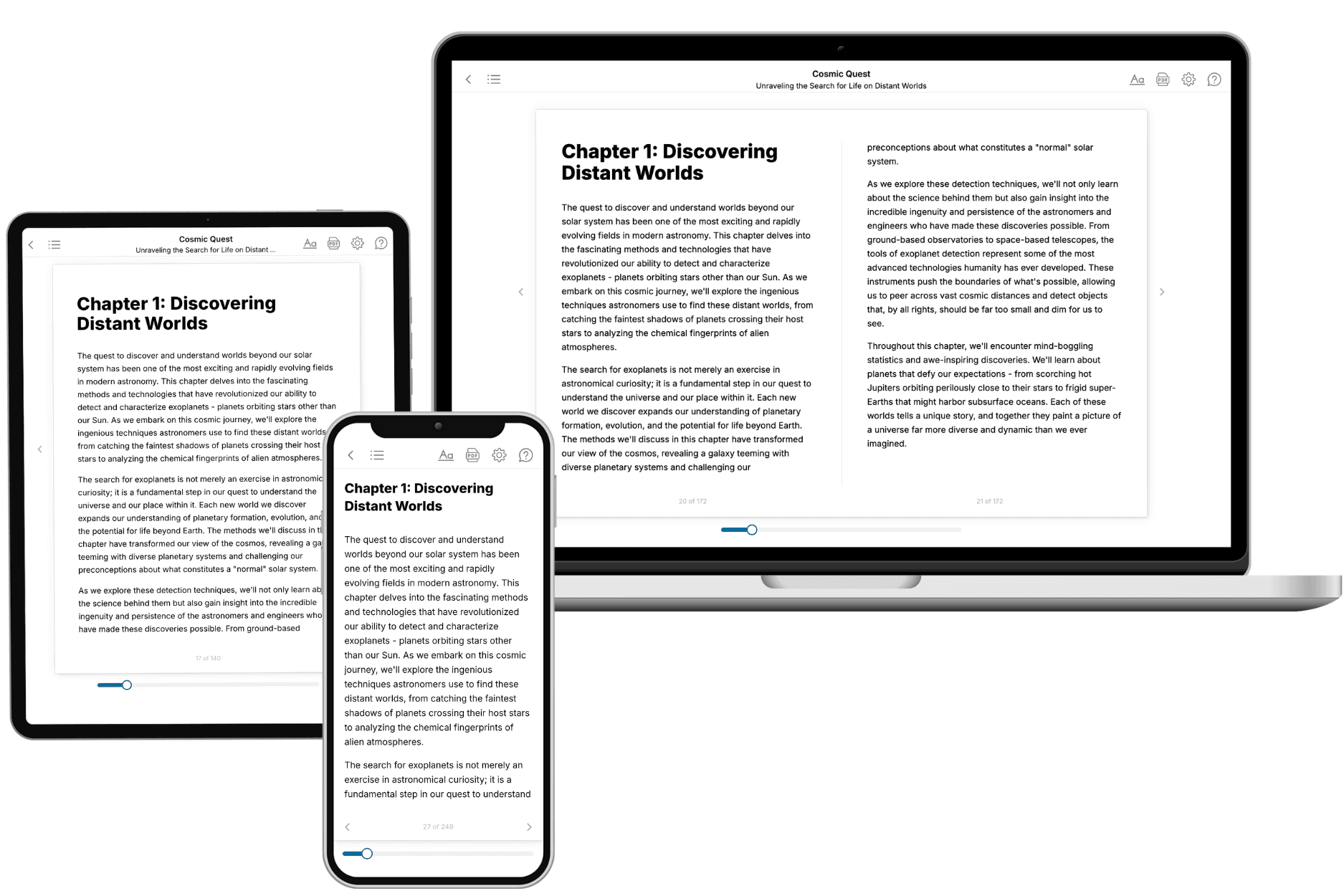
TailoredRead creates complete, full-length nonfiction ebooks, written specifically for you. Tell us what you want to learn and why, and TailoredRead writes you a complete ebook on it, with charts, tables, and diagrams throughout. Read it online, on Kindle, or on any e-reader, or download it as a PDF or EPUB. Every book is written fresh the day you order it.
- How is the book tailored to me?
Before anything is written, you answer a few short questions about your goals, your background, and the topics you care about. Your book is then planned around your answers: written at your level, focused on your goals, and covering the topics you chose, instead of the one-size-fits-all book a store sells everyone.
- Will it read like generic AI content?
No. Your book isn't a chat transcript: it's planned chapter by chapter before a single word is written, told in a clear book voice, and explains ideas visually with charts, tables, and diagrams. After writing, every book goes through an editorial pass that polishes chapters so the book reads consistent from start to finish. Judge for yourself: browse thousands of sample books on our Explore Books page.
- How accurate is the content?
Our AI first checks whether your subject needs live research. Niche and fast-moving subjects are researched before writing, and the book plan and chapters are grounded in what it finds. After writing, every book goes through a quality pass that checks its facts and consistency, and researched books list their sources in a Notes section at the back.
- How long is the book?
You choose the length: Comprehensive (250-300 pages), Detailed (150-200 pages), Essential (70-100 pages), or Short (30-50 pages).
- Does the book include visuals?
Yes. Every book includes charts, tables, and diagrams: timelines, checklists, step-by-step guides, decision trees, comparison tables, matrices, and bar charts. A typical book includes dozens of these visual elements.
- Can I read it on Kindle? What formats can I download?
Yes. Every book can be read in our online reader or downloaded as a PDF or EPUB. The EPUB can be opened with Kindle, Apple Books, Kobo, and any e-reader. The Commercial and Author licenses also include an editable Word (DOCX) and Markdown download.
- How much does it cost?
About the price of a regular ebook. The exact price depends on your book's length and complexity, from $2 for the shortest books to $35 for the most comprehensive, and it's shown when you review your book, before you commit to anything. Each book is a one-time purchase, yours to keep, no subscription. Licenses that let you share, teach, or publish your book range from $35.99 to $49.99.
- Can I preview the book before purchasing?
Before you pay, you'll see what your book will cover: the title, a detailed description, the estimated length, and the complete chapter-by-chapter table of contents, so you know what you're getting before you decide. The full text itself is written after you purchase.
- How long does it take to create a book?
About 10 minutes. You can start reading the opening chapters while the rest is still being written.