Comparative Politics Books
Explore tailored Comparative Politics books created by our AI
Books readers created
21 Comparative Politics books, each written for the reader who ordered it. Read its introduction, then personalize it to get a book of your own.
Systems of Freedom
How Political Systems Shape Liberty Across Nations
Many assume that political freedom is simply a matter of having the right to vote. In reality, political freedom is far more complex—it encompasses the ability to speak freely, organize politically, challenge authority, and participate in governance without fear. This book examines how different political systems around the world approach these fundamental freedoms, revealing the mechanisms that protect liberty and those that suppress it. Through comparative analysis of democracies, authoritarian regimes, and hybrid systems, you'll discover how constitutional design, institutional checks, civil society strength, and legal frameworks either safeguard or undermine political freedom. Whether you're interested in understanding why some nations protect dissent while others criminalize it, or how democratic backsliding occurs, this book provides the analytical tools to make sense of global political variation. By examining real-world examples from multiple continents and political contexts, you'll gain insight into the structural forces that shape political liberty worldwide.
Power Sharing
How Distributed Authority Creates Stronger, More Resilient Governments
Imagine a government where no single leader or party can unilaterally impose their will, where decisions require genuine negotiation and compromise, and where minority voices have real influence over outcomes. This is the promise of power-sharing systems—political structures designed to distribute authority across multiple institutions, branches, and stakeholders. This book explores how democracies around the world implement power-sharing mechanisms and why these systems matter for stability, representation, and justice. You'll discover the constitutional frameworks, institutional arrangements, and cultural practices that make power-sharing work, from separation of powers to federalism to proportional representation. Through real-world examples and practical analysis, you'll understand how different societies balance efficiency with representation, prevent tyranny of the majority, and create governments that serve broader populations. Whether you're interested in comparative politics, democratic reform, or simply understanding how your own government functions, this book provides the insights needed to evaluate power-sharing systems critically and appreciate their role in creating more resilient democracies.
Most people watch regime change unfold on the news without understanding the deeper forces at work. When governments fall, democracies collapse, or authoritarian systems transform, it seems sudden and chaotic. But regime change follows patterns. This book reveals the structural conditions, mechanisms, and actors that drive political transformation across the globe. You'll learn why some regimes are vulnerable to collapse, how different pathways of change—from elections to revolutions to coups—produce different outcomes, and why some transitions succeed while others fail. By examining historical cases and contemporary examples, you'll develop a framework for analyzing political instability and understanding the forces reshaping nations. Whether you're interested in global politics, history, or simply making sense of current events, this book equips you with the analytical tools to understand one of the most consequential phenomena in human affairs.
Political Science Mastery
Personalized Pathways to Political Expertise
Picture yourself confidently navigating complex political discussions, understanding the intricate mechanisms that drive policy decisions, and analyzing governance structures with the precision of a seasoned political scientist. Your innovative mindset, already proven in solving complex wildfire challenges, will find new applications as you master the analytical frameworks that explain how political systems function and evolve. This comprehensive guide builds upon your business acumen and problem-solving expertise to develop sophisticated understanding of political theories, institutional behaviors, and governance dynamics. You'll discover how democratic processes actually work behind the scenes, why certain policies succeed while others fail, and how different political systems address similar challenges through vastly different approaches. Through systematic exploration of comparative politics, electoral systems, and policy development processes, you'll gain the analytical tools to decode political behavior patterns and institutional functions. Your MBA background will serve you well as you examine the strategic dimensions of political communication, campaign dynamics, and bureaucratic operations. Whether you're seeking to enhance your policy engagement capabilities, understand the political landscape affecting your industry, or simply satisfy your intellectual curiosity about governance systems, this book provides the structured pathway to political expertise you've been seeking.
The Path to Democracy
Understanding How Societies Transition to Political Freedom
What separates a thriving democracy from an authoritarian regime? The answer lies not in ideology alone, but in the intricate mechanisms, institutions, and choices that shape how societies govern themselves. This book explores the fascinating and complex process of democratization—how nations transition from authoritarian rule to political freedom and how they sustain democratic systems once established. You'll discover the historical patterns that distinguish successful democratic transitions from failed attempts, the critical role of institutions and civil society, and the real-world challenges that democracies face even after their founding. Through case studies spanning continents and centuries, this book reveals that democratization is neither inevitable nor irreversible. It requires deliberate institutional design, active citizen participation, and a commitment to the principles of accountability and representation. Whether you're interested in understanding global politics, supporting democratic movements, or simply grasping how your own political system came to be, this book provides the essential knowledge to navigate these crucial questions.
You're living in an era where political outsiders challenge established systems, where "the people" battle "the elite," and where traditional institutions face unprecedented scrutiny. This book cuts through the confusion surrounding populism to reveal what it actually is, how it works, and why it matters for your freedom and democracy. Starting with populism's historical roots in 19th-century agrarian movements through today's global political landscape, you'll discover the common patterns that unite seemingly different movements across continents. You'll learn why populism emerges during specific economic and social conditions, how populist leaders mobilize supporters, and what happens when populist movements gain power. This exploration examines populism's complex relationship with democracy—how it can amplify marginalized voices while simultaneously threatening institutional safeguards. By understanding populism's mechanics, rhetoric, and real-world consequences, you'll develop the critical perspective needed to evaluate contemporary politics with nuance and clarity. Whether populism represents democratic renewal or institutional danger depends on context, and this book equips you to make that distinction.
Autocratic Leadership
Understanding Power, Control, and Governance in Authoritarian Systems
Imagine understanding the hidden mechanics of how authoritarian regimes actually function—not through speculation, but through clear analysis of proven patterns and real-world examples. This book cuts through the complexity of autocratic leadership systems to reveal how power is consolidated, maintained, and sometimes lost. You'll discover the specific strategies autocrats use to control populations, manage elites, and suppress opposition. From the institutional structures that enable authoritarian rule to the economic and social consequences that ripple through societies, this comprehensive guide examines both historical and contemporary examples. Whether you're studying political science, analyzing current events, or simply seeking to understand how different governance systems work, you'll gain practical knowledge about the mechanisms of autocracy, the vulnerabilities within authoritarian systems, and the conditions that lead to political change. This is essential reading for anyone who wants to move beyond headlines and truly comprehend how autocratic leadership shapes nations and impacts millions of lives.
The Amendment Process
How Constitutional Change Shapes Democracy and Political Power
Constitutional amendments stand at the intersection of law, politics, and social change. When you understand how these fundamental alterations work, you gain insight into the very DNA of democratic governance. This book takes you through the intricate world of constitutional change, examining why some democracies amend their founding documents frequently while others preserve them for centuries. You'll explore the political forces that drive amendment campaigns, the procedural hurdles that protect constitutions from hasty changes, and the lasting consequences of both successful and failed attempts. Through comparative analysis of amendment processes across different nations and historical periods, you'll discover how societies negotiate their most fundamental disagreements and enshrine new values into their governing frameworks. Whether you're analyzing current political debates or seeking to understand how democracies adapt over time, this book provides the analytical tools and historical context you need. You'll come away with a deeper appreciation for how constitutional design shapes political possibilities and how the amendment process itself reflects the balance between stability and progress.
The Evolution of Political Science
From Ancient Philosophy to Modern Scientific Inquiry
Political science today is a rigorous, data-driven discipline, but few scholars understand how it became one. The challenge many face is viewing political science as either purely scientific or purely philosophical—missing the rich, complex history that bridges these worlds. This book traces the fascinating evolution of political science from ancient philosophical inquiry through its transformation into a modern scientific discipline. You'll discover how thinkers from Plato and Aristotle to Machiavelli and Hobbes grappled with fundamental questions about power and governance, and how Enlightenment scholars introduced systematic methods that would eventually define the discipline. The narrative continues through the professionalization of political science in universities, the behavioral revolution that brought quantitative rigor, and contemporary innovations in computational analysis. By understanding this history, you'll gain deeper insight into why political scientists ask the questions they do, what methods they employ, and how the discipline continues to evolve in response to new challenges and technologies.
The assumption that political parties are natural, inevitable, or even desirable features of democracy is surprisingly recent. For most of Western political history, the most sophisticated thinkers viewed organized factions as corrupting forces that distorted the pursuit of the common good. This book traces the genealogy of anti-party political thought from Plato's critique of democratic factionalism through contemporary populist movements, examining how philosophers, statesmen, and theorists have conceptualized the dangers of partisanship and imagined alternatives. You'll encounter Rousseau's vision of a general will transcending faction, the Federalist Papers' constitutional anxiety about party machinery, Tocqueville's ambivalent analysis of American partisanship, and the radical rejection of parties by socialist and anarchist movements. Rather than treating anti-party sentiment as mere nostalgia or populist demagoguery, this analysis reveals it as a coherent intellectual tradition grappling with enduring tensions between democratic participation and organized political competition. By understanding how different historical periods and ideological traditions have confronted the problem of faction, you gain critical perspective on contemporary debates about party reform, populism, and democratic alternatives.
The Oligarchy Paradox
Understanding Power Concentration in Modern Democratic Societies
You'll gain a sophisticated understanding of how power actually operates in contemporary society, moving beyond simplistic notions of democracy versus authoritarianism to grasp the nuanced reality of oligarchic influence. This comprehensive exploration reveals the hidden mechanisms through which small groups accumulate and maintain disproportionate control over political, economic, and social systems. Through rigorous analysis of historical patterns and modern case studies, you'll develop the analytical tools to recognize oligarchic structures in action. You'll discover how elite networks form, how they perpetuate themselves across generations, and how they adapt to changing circumstances while maintaining their essential character. The book examines both the overt and subtle ways oligarchies shape public policy, influence cultural narratives, and manage social expectations. You'll explore the complex relationship between democratic institutions and oligarchic tendencies, understanding how these seemingly contradictory forces can coexist and even reinforce each other. The analysis extends to the role of technology, media, and information systems in either challenging or strengthening oligarchic control, providing you with insights into the evolving nature of power in the digital age. By the end, you'll possess a framework for critically evaluating power structures in your own society, recognizing the signs of oligarchic influence, and understanding the conditions that either promote or resist the concentration of power among elite groups.
The biggest obstacle facing engaged citizens today is navigating the complex world of political parties without truly understanding how they operate, evolve, and shape democratic governance. You hear about party politics daily, but the inner workings, strategic decisions, and fundamental structures that drive these organizations remain largely mysterious. This comprehensive guide demystifies political parties by examining their essential functions, organizational structures, and profound impact on political freedom and democratic representation. You'll discover how parties serve as crucial bridges between citizens and government, organizing political competition while facilitating meaningful participation in democratic processes. Through clear analysis and practical insights, you'll explore how different party systems affect democratic outcomes, why internal party democracy matters for public trust, and how parties adapt to changing social and technological landscapes. You'll gain a deeper understanding of party ideologies, coalition-building strategies, and the delicate balance between unity and individual autonomy that shapes legislative effectiveness. Whether you're seeking to become a more informed voter, considering political involvement, or simply wanting to understand the forces that shape your democratic system, this book provides the knowledge and analytical framework you need to navigate the complex world of political parties with confidence and clarity.
Beyond the State
Exploring the Principles and Possibilities of Anarcho-Capitalism
In a world dominated by centralized governments and state control, you find yourself questioning the necessity and efficacy of these traditional power structures. The concept of a society without a state may seem radical or even impossible, but what if there was a way to organize human interactions purely through voluntary associations and free markets? "Beyond the State: Exploring the Principles and Possibilities of Anarcho-Capitalism" delves deep into this provocative political philosophy that challenges the very foundations of modern governance. You'll discover how proponents of anarcho-capitalism envision a world where individual liberty and property rights are paramount, and all services—including law and security—are provided through voluntary market mechanisms. This book offers a balanced and thorough examination of anarcho-capitalist theory, its historical context within anarchist thought, and its potential real-world applications. You'll explore the key arguments for and against this system, analyze case studies of stateless societies throughout history, and consider the challenges and opportunities of implementing anarcho-capitalist principles in the modern world. Whether you're a political science enthusiast, a libertarian seeking to expand your understanding, or simply a curious reader interested in alternative socio-economic models, this book will challenge your assumptions and broaden your perspective on the role of government in society.
The Global Stage
Understanding Power, Diplomacy, and Conflict in the Modern World
Many people view international relations as a distant realm of diplomats and politicians, disconnected from everyday life. In reality, the decisions made in boardrooms and government offices directly affect your economy, security, and future. This book demystifies how nations interact, compete, and cooperate in an increasingly complex world. You'll discover why some countries form alliances while others clash, how economic ties can prevent or provoke conflict, and why international institutions matter more than you might think. Through clear explanations and real-world examples, you'll learn the fundamental forces driving global politics—from power dynamics and strategic interests to the role of culture and ideology. Whether you're curious about geopolitics, concerned about global stability, or simply want to understand the news better, this book provides the essential knowledge to make sense of our interconnected world and your place within it.
Beyond the Melting Pot
Understanding Multiculturalism in Theory and Practice
Many people assume that multiculturalism simply means celebrating different cultures at festivals and embracing diversity as an inherently positive force. This surface-level understanding misses the profound complexities and real challenges that diverse societies face every day. Multiculturalism is far more nuanced than popular discourse suggests. It involves intricate questions about how different groups can coexist while maintaining their distinct identities, how societies can balance unity with diversity, and how institutions can fairly accommodate varying cultural needs without fragmenting social cohesion. This comprehensive exploration takes you through the theoretical foundations of multiculturalism while examining its practical applications across different contexts. You'll discover how successful multicultural societies navigate tensions between individual rights and group recognition, explore the mechanisms that foster genuine intercultural understanding, and understand why some multicultural initiatives succeed while others fail. From examining historical models to analyzing contemporary challenges, this book provides the analytical framework you need to understand one of the most significant social and political phenomena of our time. You'll gain insights into how multiculturalism shapes everything from education and urban planning to cultural policy and social integration, equipping you with a sophisticated understanding of how diverse societies can thrive.
Power and Principles
A Practical Guide to Understanding How Nations Interact and Compete
Gain a sophisticated understanding of how the international system works and why nations behave the way they do. This book cuts through the complexity of global politics by introducing you to the major theoretical frameworks that scholars and policymakers use to analyze international relations. You'll learn how realism explains state competition for power, how liberalism emphasizes cooperation and institutions, and how constructivism reveals the role of ideas and identity. Rather than abstract theory divorced from reality, each concept is grounded in real-world examples from trade negotiations to military alliances to humanitarian crises. By the end, you'll be equipped to interpret headlines with greater nuance, understand the motivations behind state actions, and recognize why different observers reach different conclusions about the same international events. Whether you're preparing for further study, engaging in policy discussions, or simply wanting to understand global affairs more deeply, this guide provides the conceptual toolkit you need.
Many assume the Iranian Revolutionary Guards are simply a military force, but they're far more complex—a parallel state institution wielding military, economic, and political power that rivals Iran's civilian government. This book cuts through oversimplification to explain who the Guards really are, how they operate, and why they matter for Middle Eastern stability. You'll discover how their ideology shapes regional conflicts, how they use proxy forces like Hezbollah to extend influence across borders, and why understanding their organizational structure is crucial to grasping Iran's foreign policy. Whether you're tracking geopolitical developments, studying Middle Eastern security, or seeking clarity on one of the region's most influential institutions, this book provides the analytical framework and factual grounding you need. Explore the Guards' evolution from revolutionary force to institutional power broker, their role in Syria, Iraq, and Lebanon, and the strategic calculations driving their regional ambitions.
The Architecture of Power
How Political Systems Shape History and Society
Most people view political history as a collection of disconnected events—wars, revolutions, and famous leaders—without seeing the underlying patterns. In reality, political systems follow predictable trajectories shaped by fundamental forces. This book reveals the hidden architecture that explains how societies organize power, why systems rise and fall, and what drives political transformation. You'll discover how geography constrains political possibilities, why institutions matter more than individual leaders, and how economic systems intertwine with governance structures. By examining pivotal moments—from the fall of empires to the emergence of democracies—you'll gain insight into the forces reshaping politics today. Whether you're trying to understand current events, anticipate political trends, or simply grasp why the world works as it does, this book provides the conceptual tools to see beyond headlines and recognize the deeper currents moving history forward.
Many assume globalization is an inevitable force that simply happens to countries. In reality, globalization is a deeply political process shaped by deliberate choices, competing interests, and power struggles between nations, corporations, and citizens. This book examines how globalization fundamentally reshapes political systems, national sovereignty, and international relations across the world. You'll discover why some nations thrive in the global economy while others struggle, how international institutions both enable and constrain state power, and why globalization fuels political backlash in democracies and authoritarian states alike. Through concrete examples from Europe, Asia, Africa, and the Americas, you'll learn how different political systems navigate the tensions between openness and protection, integration and sovereignty. Whether you're seeking to understand trade wars, migration politics, or the rise of nationalist movements, this book provides the analytical framework to make sense of our interconnected world and the political choices that shape it.
Contested Waters
Understanding the South China Sea Disputes and Their Global Impact
What makes a body of water worth fighting over? The South China Sea represents one of the world's most strategically important and contested regions, yet many people struggle to understand why these disputes matter beyond headlines about military buildups. This book cuts through the complexity to explain the territorial claims, historical grievances, and geopolitical interests that shape this critical region. You'll discover how overlapping claims from six nations create a tangled web of competing interests, why international law offers both solutions and complications, and how the involvement of global powers transforms local disputes into matters of worldwide concern. Whether you're interested in international relations, regional security, or simply understanding a major geopolitical flashpoint, this book provides the context and analysis needed to grasp why the South China Sea remains one of the most important—and fragile—regions in the world.
The Political Spectrum
Understanding Conservative and Liberal Ideologies in Modern Democracy
Political polarization seems to dominate every conversation, leaving many people confused about what conservatives and liberals actually believe and why these differences matter so much. You hear terms like "left" and "right" thrown around constantly, but the nuanced philosophies behind these labels often get lost in heated debates and oversimplified soundbites. This comprehensive guide cuts through the noise to explore the rich intellectual traditions of both conservative and liberal thought. You'll discover how these ideologies developed over centuries, shaped by historical events, influential thinkers, and changing social conditions. Rather than presenting these as opposing teams in a political game, this book reveals the complex spectrum of beliefs that exist within each tradition and the legitimate concerns that drive both perspectives. From economic policy to social issues, from environmental challenges to technological disruption, you'll gain the tools to understand how conservative and liberal frameworks approach the major questions facing society today. You'll explore real-world applications of these philosophies and see how they continue to evolve in response to contemporary challenges. Whether you're trying to better understand your own political beliefs, engage more effectively in civic discussions, or simply make sense of the political landscape around you, this book provides the foundation for more informed and thoughtful participation in democratic society.
Related books you may like:
You're about to supercharge your animal advocacy efforts and nonprofit management skills with the power of AI. This groundbreaking guide is tailored specifically for leaders in the animal rights movement who are ready to harness cutting-edge technology to make a bigger impact. Discover how to leverage AI tools to streamline your operations, enhance your strategic planning, and amplify your advocacy campaigns. You'll learn practical techniques for automating administrative tasks, optimizing your workflow, and making data-driven decisions that will take your organization to the next level. From improving time management and task delegation to enhancing donor engagement and project tracking, this book offers a comprehensive roadmap for integrating AI into every aspect of your work. You'll gain insights into AI-driven research methods, problem-solving techniques, and productivity metrics that will revolutionize the way you approach animal advocacy.
Discover how air sign energy shapes your thinking, communication style, and approach to relationships. Whether you have a Gemini, Libra, or Aquarius placement in your birth chart, this guide reveals the intellectual and social gifts these signs bring—along with the blind spots worth understanding. You'll learn why air signs are natural communicators and idea-generators, how each sign expresses itself uniquely, and how your specific air sign placements influence your personality across different life areas. Through practical insights and real-world examples, you'll recognize air sign patterns in yourself and others, harness your natural strengths in connection and innovation, and navigate the challenges of overthinking and emotional detachment. Whether you're exploring your Sun, Moon, Rising, or other planetary placements, this book provides the clarity you need to work with your air sign energy authentically and effectively.
What if you could resolve years of trauma in just a handful of therapy sessions instead of months or years of traditional talk therapy? Accelerated Resolution Therapy (ART) offers a scientifically-grounded approach that harnesses your brain's natural healing capacity to process traumatic memories and emotional distress rapidly. This book demystifies how ART works at the neurological level, explains why it's so effective for conditions like PTSD, anxiety, and phobias, and explores how it differs from conventional therapeutic approaches. Whether you're a mental health professional considering adding ART to your practice, someone exploring treatment options for yourself or a loved one, or simply curious about innovative psychological interventions, this guide provides practical insights into one of the most promising developments in modern therapy. Discover how guided imagery and eye movement can facilitate profound emotional healing, what the research shows about its effectiveness, and whether ART might be the breakthrough approach you've been seeking.
Many people believe that behavior is determined either by our genetics or by direct rewards and punishments we experience. However, Albert Bandura's groundbreaking research revealed a more nuanced truth: we learn by watching others. This book explores the life and work of one of psychology's most influential figures and the revolutionary theory that transformed our understanding of human behavior. You'll discover how Bandura's concept of self-efficacy explains why some people persevere through challenges while others give up, how observational learning shapes everything from aggression to prosocial behavior, and why the environment, our thoughts, and our actions are constantly influencing each other. Whether you're an educator seeking to improve student outcomes, a professional interested in behavior change, or simply curious about the science of learning, this comprehensive guide illuminates the principles that govern human development and provides practical insights into how these theories apply to everyday life.
Create a Comparative Politics Book Tailored to You
Create an AI-crafted book tailored to your goals, interests, and background






Benefits of AI-tailored books
- Read one book, not ten:
- all the Comparative Politics knowledge you need, gathered into a single book.
- Save days of learning:
- tell us your goals, choose your topics, and the whole book is built around them.
- Learn effortlessly:
- Comparative Politics book written for your specific background and expertise.
- Understand at a glance:
- includes charts, tables, timelines, checklists, decision trees, and more.
- Stay current:
- written the day you order it, not years ago.
- Trust what you read:
- every book is checked for accuracy, with real research when your subject needs it.
Create your unique book in 3 steps
- 1. Select your focus
Select the focus of your Comparative Politics book and share your background
- 2. Personalize your book
Specify your goals and choose sub-topics to include
- 3. Get your tailored book
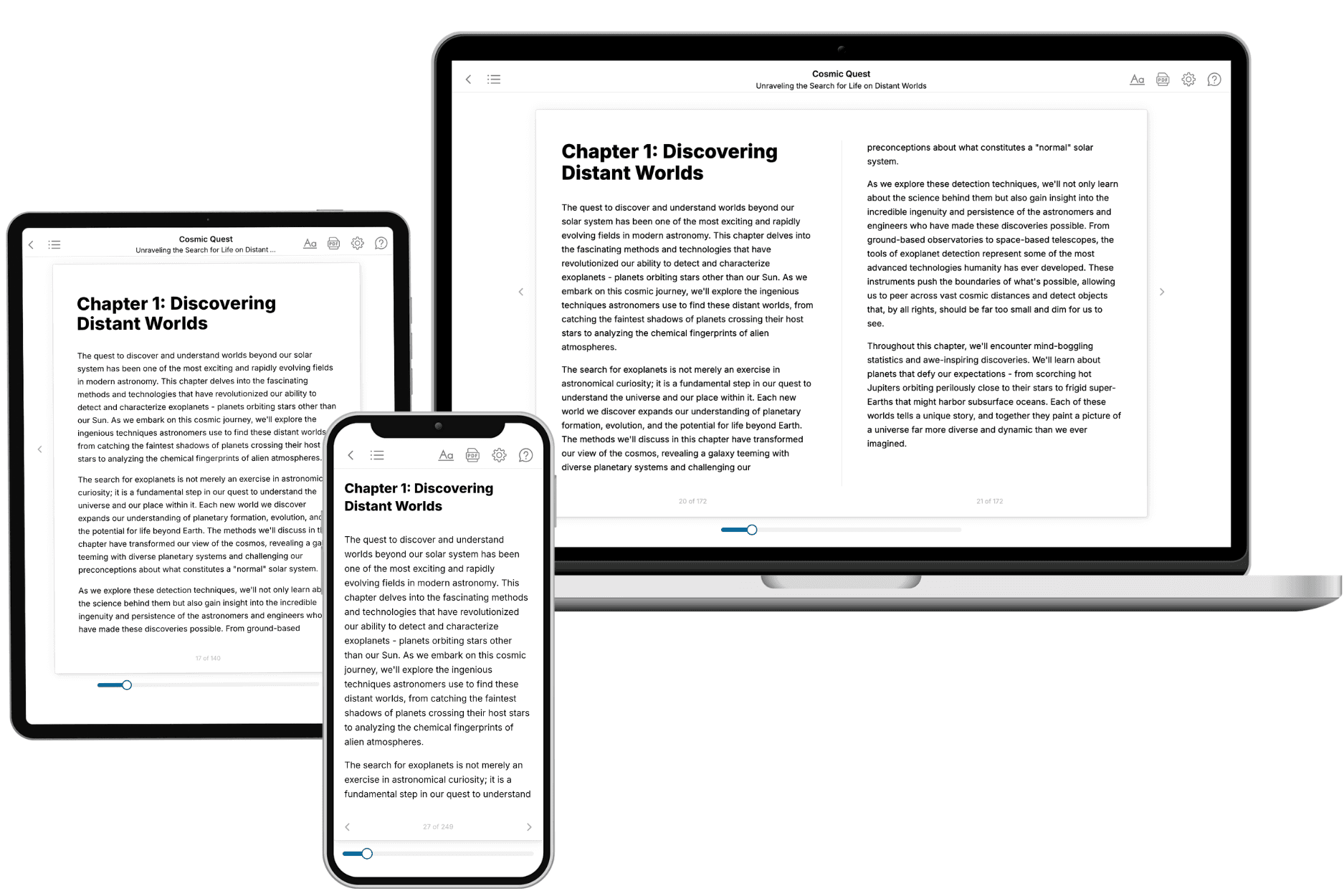
Your book is ready in 10 minutes. Read it online, download as EPUB or PDF, or send to Kindle.

Start from a template
Frequently asked questions
- What is TailoredRead?
TailoredRead creates complete, full-length nonfiction ebooks, written specifically for you. Tell us what you want to learn and why, and TailoredRead writes you a complete ebook on it, with charts, tables, and diagrams throughout. Read it online, on Kindle, or on any e-reader, or download it as a PDF or EPUB. Every book is written fresh the day you order it.
- How is the book tailored to me?
Before anything is written, you answer a few short questions about your goals, your background, and the topics you care about. Your book is then planned around your answers: written at your level, focused on your goals, and covering the topics you chose, instead of the one-size-fits-all book a store sells everyone.
- Will it read like generic AI content?
No. Your book isn't a chat transcript: it's planned chapter by chapter before a single word is written, told in a clear book voice, and explains ideas visually with charts, tables, and diagrams. After writing, every book goes through an editorial pass that polishes chapters so the book reads consistent from start to finish. Judge for yourself: browse thousands of sample books on our Explore Books page.
- How accurate is the content?
Our AI first checks whether your subject needs live research. Niche and fast-moving subjects are researched before writing, and the book plan and chapters are grounded in what it finds. After writing, every book goes through a quality pass that checks its facts and consistency, and researched books list their sources in a Notes section at the back.
- How long is the book?
You choose the length: Comprehensive (250-300 pages), Detailed (150-200 pages), Essential (70-100 pages), or Short (30-50 pages).
- Does the book include visuals?
Yes. Every book includes charts, tables, and diagrams: timelines, checklists, step-by-step guides, decision trees, comparison tables, matrices, and bar charts. A typical book includes dozens of these visual elements.
- Can I read it on Kindle? What formats can I download?
Yes. Every book can be read in our online reader or downloaded as a PDF or EPUB. The EPUB can be opened with Kindle, Apple Books, Kobo, and any e-reader. The Commercial and Author licenses also include an editable Word (DOCX) and Markdown download.
- How much does it cost?
About the price of a regular ebook. The exact price depends on your book's length and complexity, from $2 for the shortest books to $35 for the most comprehensive, and it's shown when you review your book, before you commit to anything. Each book is a one-time purchase, yours to keep, no subscription. Licenses that let you share, teach, or publish your book range from $35.99 to $49.99.
- Can I preview the book before purchasing?
Before you pay, you'll see what your book will cover: the title, a detailed description, the estimated length, and the complete chapter-by-chapter table of contents, so you know what you're getting before you decide. The full text itself is written after you purchase.
- How long does it take to create a book?
About 10 minutes. You can start reading the opening chapters while the rest is still being written.