Reasoning Books
Explore tailored Reasoning books created by our AI
The Trolley Problem
Navigating Moral Paradoxes and the Art of Ethical Reasoning
Master the art of ethical reasoning and discover why moral decision-making is far more complex than it appears. This comprehensive exploration of the trolley problem and related philosophical paradoxes will sharpen your critical thinking skills and deepen your understanding of moral philosophy. You'll dive into the fascinating world of thought experiments that have puzzled philosophers for decades, examining scenarios where saving lives requires making impossible choices. Through careful analysis of utilitarian versus deontological approaches, you'll learn to recognize the hidden assumptions that guide your moral intuitions and understand why equally rational people can reach opposite conclusions about the same ethical dilemma. Each chapter builds upon the previous one, taking you from the basic trolley scenario through increasingly sophisticated variations that challenge conventional moral thinking. You'll explore how factors like intention, causation, and proximity influence our ethical judgments, and discover why the same logical principles can lead to seemingly contradictory conclusions. By the end of this book, you'll possess a robust framework for analyzing complex moral situations, whether in philosophy, everyday life, or professional contexts. You'll understand not just what different ethical theories propose, but why they matter and how to apply them thoughtfully to real-world challenges.
The Fallacy Detective
Master the Art of Spotting Flawed Reasoning and Thinking Clearly
Imagine navigating conversations, debates, and decisions with complete confidence in your reasoning. You spot weak arguments instantly, understand exactly why they fail, and respond with clarity and precision. You're no longer swayed by emotional manipulation or clever-sounding but flawed logic. This book teaches you to think like a reasoning detective, systematically uncovering the hidden flaws in arguments—both those you encounter and those you construct yourself. Through clear explanations, real-world examples, and practical exercises, you'll master the most common logical fallacies and learn the underlying principles that make reasoning sound or broken. Whether you're evaluating claims in the media, winning arguments at work, or simply wanting to think more clearly, this guide transforms you from someone who suspects something is wrong with an argument into someone who knows exactly what it is and why it matters.
The Logic of Arguments
Master Logical Fallacies and Strengthen Your Reasoning
Strengthen your reasoning and become a more persuasive communicator by mastering the art of logical argumentation. This comprehensive guide takes you beyond surface-level understanding to show you exactly how logical fallacies work, why they're so convincing, and how to dismantle them. You'll explore the distinction between formal and informal fallacies, examine the most prevalent fallacies in everyday conversation and debate, and learn practical techniques for constructing bulletproof arguments. Whether you're engaging in professional discussions, academic writing, or casual debates, understanding these logical principles will sharpen your critical thinking and help you identify when reasoning has gone astray. With clear explanations, real-world examples, and actionable strategies, you'll develop the analytical skills needed to evaluate arguments rigorously and communicate with greater clarity and conviction.
Beyond True and False
Understanding Fuzzy Logic and the Philosophy of Imprecision
Discover how fuzzy logic revolutionizes the way we think about truth, reasoning, and decision-making. Most of us learned that statements are either true or false—but the real world rarely works that way. This book guides you through the philosophical foundations and practical power of fuzzy logic, a system that embraces the gray areas between absolutes. You'll explore how fuzzy logic challenges classical philosophy, understand the mathematics behind degrees of truth, and see how this approach solves real-world problems in artificial intelligence, engineering, and everyday decision-making. Whether you're interested in philosophy, mathematics, or practical applications, this book reveals why fuzzy logic isn't just an academic curiosity—it's a more accurate reflection of how the world actually works and how we naturally reason about it. Move beyond binary thinking and gain a deeper understanding of complexity, nuance, and uncertainty.
The Logic Engine
Mastering Propositional Calculus for Clear Thinking and Better Decisions
Most people believe that logic is either something you're born with or a dry academic subject with little practical value. This misconception keeps countless individuals from developing one of the most powerful tools for clear thinking and effective decision-making: propositional calculus. You don't need to be a mathematician or philosopher to harness the precision and clarity that formal logic provides. Propositional calculus offers a systematic framework for analyzing arguments, evaluating claims, and making better decisions by breaking complex problems into their fundamental logical components. When you understand how to work with propositions, connectives, and truth conditions, you gain the ability to see through confusion and identify the core structure of any logical situation. This comprehensive guide takes you from the basic building blocks of propositional logic through advanced techniques for formal proof and logical analysis. You'll discover how to construct and evaluate truth tables, recognize common logical patterns, and apply formal reasoning methods to real-world scenarios. Each concept builds naturally on the previous one, ensuring you develop both theoretical understanding and practical skills. Whether you're looking to sharpen your analytical abilities, improve your argumentation skills, or simply think more clearly about complex issues, mastering propositional calculus will give you a reliable foundation for logical reasoning that serves you in every area of life.
Many people assume Plato's Allegory of the Cave is simply an ancient story with little relevance to modern life. In reality, this 2,400-year-old parable speaks directly to how we perceive reality, consume information, and resist change. The allegory describes prisoners chained in a cave, seeing only shadows on a wall, mistaking them for reality. When one prisoner escapes and discovers the true world, he faces a shocking revelation: everything he believed was false. This powerful metaphor reveals how our perceptions, biases, and the information we're exposed to shape our understanding of reality. Whether you're navigating social media echo chambers, questioning your own beliefs, or seeking deeper understanding, the Allegory of the Cave offers profound insights. This book unpacks the allegory's philosophical foundations, explores Plato's broader ideas about knowledge and reality, and shows how these ancient lessons apply to contemporary challenges. You'll discover why enlightenment is uncomfortable, how to recognize your own "cave," and what it truly means to see clearly.
You'll gain a comprehensive understanding of one of philosophy's most influential ethical frameworks—deontological ethics—and discover how duty-based moral reasoning provides clarity in a world of ethical complexity. This book guides you through the fundamental principles that define right action based on moral duty rather than outcomes, exploring how philosophers from Kant to contemporary thinkers have shaped our understanding of moral obligation. You'll learn to recognize the difference between actions that are inherently right or wrong and those judged solely by their consequences. Through clear explanations and practical examples, you'll explore the categorical imperative, the principle of treating humanity as an end in itself, and the role of moral rules in protecting human dignity. You'll examine real-world ethical dilemmas through a deontological lens, understanding why certain boundaries exist regardless of potential benefits. Whether you're deepening your philosophical knowledge or seeking a robust framework for ethical decision-making, this book provides the tools to think critically about moral duty, universal principles, and the nature of good and evil in human action.
The Rational Mind
A Scientist's Guide to Mastering Critical Thinking and Logical Reasoning
Your scientific training has equipped you with powerful analytical tools, but applying rigorous rational thinking beyond the laboratory requires a different set of skills. This comprehensive guide bridges the gap between academic expertise and everyday reasoning mastery. Drawing from decades of research in cognitive science, evolutionary psychology, and epistemology, you'll discover how to systematically identify and overcome the cognitive biases that cloud even the most educated minds. You'll learn to apply falsifiability criteria to evaluate claims, recognize when appeals to authority are legitimate versus fallacious, and understand why your brain's evolutionary programming sometimes works against rational decision-making. Each chapter builds upon your existing scientific foundation while introducing practical frameworks for enhanced critical thinking. You'll master advanced argumentation techniques, develop sophisticated problem-solving methodologies, and learn to navigate the complex landscape of modern information with the same rigor you once applied to molecular structures. By the end of this journey, you'll possess a comprehensive toolkit for rational thinking that transforms how you approach decisions, evaluate evidence, and engage with complex ideas. Your retirement years will be enriched by clearer reasoning, more effective problem-solving, and the confidence that comes from truly mastering the art of rational thought.
The Duty-Bound Mind
Understanding Deontological Ethics and the Philosophy of Moral Obligation
Develop a sophisticated understanding of one of philosophy's most influential ethical frameworks and learn to navigate moral dilemmas with principled clarity. This comprehensive exploration of deontological ethics takes you beyond surface-level definitions into the rich intellectual tradition that places duty, obligation, and moral rules at the center of ethical life. You'll discover how deontology differs fundamentally from consequentialist approaches, why Kant's revolutionary insights continue to shape contemporary moral philosophy, and how duty-based reasoning applies to real-world ethical challenges. Through clear explanations of complex concepts, careful analysis of key arguments, and examination of both historical foundations and modern developments, you'll gain the tools to think critically about moral obligations, universal principles, and the nature of right action. Whether you're deepening your philosophical knowledge, seeking frameworks for ethical decision-making, or exploring the intellectual foundations of rights and dignity, this book provides the conceptual clarity and analytical depth you need to engage meaningfully with deontological thought.
Discover how science actually produces knowledge and why the methods scientists use matter more than you might think. This book moves beyond the popular image of science as a collection of facts to reveal the philosophical foundations that make scientific inquiry possible. You'll explore the major philosophical movements that have shaped scientific thinking—from the logical positivists who sought absolute certainty to Karl Popper's revolutionary falsificationism to Thomas Kuhn's paradigm-shifting insights. Understand the deep relationship between observation and theory, why the demarcation between science and pseudoscience remains contested, and how scientific knowledge evolves through both gradual progress and dramatic revolutions. By examining these philosophical questions, you'll gain the critical thinking tools to evaluate scientific claims, appreciate the provisional nature of knowledge, and recognize both the power and limitations of the scientific enterprise. This is essential reading for anyone who wants to think more deeply about how we know what we know.
Many students believe that mathematical proofs are mysterious rituals reserved for advanced mathematicians, or that success in algebra means simply getting the right answer. This misconception leaves you unprepared for higher mathematics and unable to truly understand why mathematical statements are true. This book bridges that gap by teaching you how to construct rigorous mathematical arguments using the algebraic concepts you already know. You'll discover how to think like a mathematician, moving beyond computational skills to develop the logical reasoning that underlies all mathematical truth. Through carefully structured explanations and progressive examples, you'll learn to recognize proof patterns, choose appropriate strategies, and communicate your mathematical ideas with clarity and precision. Whether you're preparing for advanced coursework, strengthening your analytical abilities, or simply curious about the foundations of mathematical truth, this book provides the tools and confidence you need to master the art of proof-writing in algebra and beyond.
The Art of Understanding
Hermeneutics and Its Impact on Philosophical Thought
The challenge of truly understanding texts, ideas, and philosophical arguments often feels overwhelming when you realize that interpretation itself is far more complex than it initially appears. Every time you engage with a philosophical work, you bring your own assumptions, cultural background, and historical context to the reading—but how do these factors shape what you understand, and how can you become more aware of this process? This comprehensive exploration of hermeneutics reveals how the art of interpretation has evolved from biblical scholarship into one of philosophy's most influential disciplines. You'll discover how major thinkers like Schleiermacher, Dilthey, Heidegger, and Gadamer revolutionized our understanding of what it means to interpret and comprehend. Through clear explanations and practical examples, you'll learn to recognize the hermeneutical dimensions present in all philosophical inquiry. The book guides you through the key concepts that define hermeneutical thinking: the hermeneutical circle, the fusion of horizons, the role of prejudgments, and the relationship between language and understanding. You'll explore how different philosophical movements—from phenomenology to existentialism to postmodernism—have incorporated hermeneutical insights into their approaches to knowledge and reality. By the end, you'll possess a sophisticated understanding of how interpretation works and why hermeneutics matters for anyone serious about philosophical thinking. You'll be equipped with conceptual tools that will enhance your ability to engage with complex texts and ideas while remaining aware of the interpretive processes at work in your own thinking.
The Thinking Person's Guide to Religion
Understanding Faith Through Philosophy and Reason
Imagine approaching questions of faith, meaning, and spirituality with the same intellectual rigor you'd apply to any important decision. This book equips you with philosophical tools to examine religion not as a believer or skeptic, but as a thoughtful inquirer. You'll explore how major philosophical movements have shaped religious thought, confront timeless questions about God's existence and nature, and discover why the relationship between faith and reason is far more nuanced than popular debates suggest. Whether you're religious, secular, or somewhere in between, you'll gain frameworks for understanding diverse beliefs, engaging in meaningful dialogue across worldviews, and thinking more clearly about spirituality's role in human life. This isn't about convincing you what to believe—it's about helping you think more deeply about why people believe what they do, and what those beliefs mean.
The Logic of Certainty
Understanding Mathematical Proof and Why It Matters
Discover why mathematical proof stands as humanity's most reliable path to certainty. This book guides you through the architecture of mathematical reasoning, revealing how proofs work and why they matter far beyond the classroom. You'll explore the fundamental difference between knowing something is probably true and knowing it's absolutely certain—a distinction that shapes science, philosophy, and rational thought itself. Through clear explanations and illuminating examples, you'll learn how mathematicians construct arguments that withstand scrutiny, what makes a proof valid, and how different proof techniques unlock different kinds of truth. You'll also encounter the philosophical puzzles at mathematics' heart: Do mathematical objects exist in some abstract realm, or are they human inventions? What are the limits of what can be proven? By the end, you'll understand not just how to follow a proof, but why proof represents our deepest form of knowledge and how this understanding transforms the way you think about certainty, logic, and truth.
The Reality of Realism
A Comprehensive Defense and Exploration of Metaphysical Realism
In "The Reality of Realism: A Comprehensive Defense and Exploration of Metaphysical Realism," readers are taken on an intellectual journey through the complex landscape of metaphysical thought. This book offers a deep dive into the principles of metaphysical realism, presenting a robust defense of this philosophical stance while also providing a fair and thorough examination of alternative theories. Beginning with a detailed explanation of metaphysical realism, the book gradually builds a strong case for its validity and importance in philosophical discourse. It then ventures into a comparative analysis, introducing and summarizing various competing metaphysical theories. Through this contrast, readers gain a nuanced understanding of the strengths and challenges associated with different metaphysical perspectives. A significant portion of the book is dedicated to defending metaphysical realism against its critics, offering compelling arguments and addressing common objections. Additionally, it explores the classical understanding of essence and existence, contrasting it with existential interpretations to provide a well-rounded view of these fundamental concepts. Concluding with a comprehensive summary, this book serves as both an in-depth exploration for the philosophically inclined and a valuable reference for students and thinkers. Whether you're new to metaphysics or looking to deepen your understanding, "The Reality of Realism" offers an accessible yet authoritative guide to one of philosophy's most enduring and significant debates.
The Ontological Argument
Understanding the Philosophical Case for God's Existence
What if the existence of God could be proven through pure thought alone, without needing to observe the world around you? This question has captivated philosophers for nearly a thousand years. The ontological argument represents one of the most audacious intellectual endeavors in Western philosophy—an attempt to demonstrate God's existence through conceptual analysis and logical reasoning. This book guides you through the intricate landscape of ontological arguments, from Anselm's medieval formulation to contemporary modal logic approaches. You'll discover how philosophers have refined, challenged, and reimagined these arguments across centuries. By examining the logical structure, historical context, and philosophical implications of ontological reasoning, you'll gain insight into fundamental questions about existence, necessity, and the nature of concepts themselves. Whether you're exploring philosophy for the first time or deepening your understanding of classical arguments, this book provides the clarity and rigor needed to engage with one of philosophy's most fascinating debates.
Most people assume mathematics is a perfectly logical system built on unshakeable foundations. But in 1901, Bertrand Russell discovered something that shattered this illusion: a simple question that broke mathematics itself. Russell's Paradox asks: "Does the set of all sets that don't contain themselves contain itself?" The answer creates an impossible contradiction—yes and no simultaneously. This book explores how one elegant logical puzzle exposed deep flaws in mathematical thinking and forced mathematicians to rebuild their entire discipline. You'll discover how Russell's question emerged from earlier work, why it created a genuine crisis in mathematics, and how brilliant minds developed new frameworks to resolve it. Along the way, you'll encounter related paradoxes, explore the concept of self-reference, and understand why this 120-year-old problem remains relevant to modern computer science and artificial intelligence. Whether you're fascinated by logic, curious about mathematical foundations, or interested in how systems can contain their own contradictions, this book reveals why Russell's Paradox matters far beyond academia.
Related books you may like:
You're about to supercharge your animal advocacy efforts and nonprofit management skills with the power of AI. This groundbreaking guide is tailored specifically for leaders in the animal rights movement who are ready to harness cutting-edge technology to make a bigger impact. Discover how to leverage AI tools to streamline your operations, enhance your strategic planning, and amplify your advocacy campaigns. You'll learn practical techniques for automating administrative tasks, optimizing your workflow, and making data-driven decisions that will take your organization to the next level. From improving time management and task delegation to enhancing donor engagement and project tracking, this book offers a comprehensive roadmap for integrating AI into every aspect of your work. You'll gain insights into AI-driven research methods, problem-solving techniques, and productivity metrics that will revolutionize the way you approach animal advocacy.
Discover how air sign energy shapes your thinking, communication style, and approach to relationships. Whether you have a Gemini, Libra, or Aquarius placement in your birth chart, this guide reveals the intellectual and social gifts these signs bring—along with the blind spots worth understanding. You'll learn why air signs are natural communicators and idea-generators, how each sign expresses itself uniquely, and how your specific air sign placements influence your personality across different life areas. Through practical insights and real-world examples, you'll recognize air sign patterns in yourself and others, harness your natural strengths in connection and innovation, and navigate the challenges of overthinking and emotional detachment. Whether you're exploring your Sun, Moon, Rising, or other planetary placements, this book provides the clarity you need to work with your air sign energy authentically and effectively.
What if you could resolve years of trauma in just a handful of therapy sessions instead of months or years of traditional talk therapy? Accelerated Resolution Therapy (ART) offers a scientifically-grounded approach that harnesses your brain's natural healing capacity to process traumatic memories and emotional distress rapidly. This book demystifies how ART works at the neurological level, explains why it's so effective for conditions like PTSD, anxiety, and phobias, and explores how it differs from conventional therapeutic approaches. Whether you're a mental health professional considering adding ART to your practice, someone exploring treatment options for yourself or a loved one, or simply curious about innovative psychological interventions, this guide provides practical insights into one of the most promising developments in modern therapy. Discover how guided imagery and eye movement can facilitate profound emotional healing, what the research shows about its effectiveness, and whether ART might be the breakthrough approach you've been seeking.
The assumption that political parties are natural, inevitable, or even desirable features of democracy is surprisingly recent. For most of Western political history, the most sophisticated thinkers viewed organized factions as corrupting forces that distorted the pursuit of the common good. This book traces the genealogy of anti-party political thought from Plato's critique of democratic factionalism through contemporary populist movements, examining how philosophers, statesmen, and theorists have conceptualized the dangers of partisanship and imagined alternatives. You'll encounter Rousseau's vision of a general will transcending faction, the Federalist Papers' constitutional anxiety about party machinery, Tocqueville's ambivalent analysis of American partisanship, and the radical rejection of parties by socialist and anarchist movements. Rather than treating anti-party sentiment as mere nostalgia or populist demagoguery, this analysis reveals it as a coherent intellectual tradition grappling with enduring tensions between democratic participation and organized political competition. By understanding how different historical periods and ideological traditions have confronted the problem of faction, you gain critical perspective on contemporary debates about party reform, populism, and democratic alternatives.
Many people believe that behavior is determined either by our genetics or by direct rewards and punishments we experience. However, Albert Bandura's groundbreaking research revealed a more nuanced truth: we learn by watching others. This book explores the life and work of one of psychology's most influential figures and the revolutionary theory that transformed our understanding of human behavior. You'll discover how Bandura's concept of self-efficacy explains why some people persevere through challenges while others give up, how observational learning shapes everything from aggression to prosocial behavior, and why the environment, our thoughts, and our actions are constantly influencing each other. Whether you're an educator seeking to improve student outcomes, a professional interested in behavior change, or simply curious about the science of learning, this comprehensive guide illuminates the principles that govern human development and provides practical insights into how these theories apply to everyday life.
Create a Reasoning Book Tailored to You
Create an AI-crafted book tailored to your goals, interests, and background




Benefits of AI-tailored books
- Read one book, not ten:
- all the Reasoning knowledge you need, gathered into a single book.
- Save days of learning:
- tell us your goals, choose your topics, and the whole book is built around them.
- Learn effortlessly:
- Reasoning book written for your specific background and expertise.
- Understand at a glance:
- includes charts, tables, timelines, checklists, decision trees, and more.
- Stay current:
- written the day you order it, not years ago.
- Trust what you read:
- every book is checked for accuracy, with real research when your subject needs it.
Create your unique book in 3 steps
- 1. Select your focus
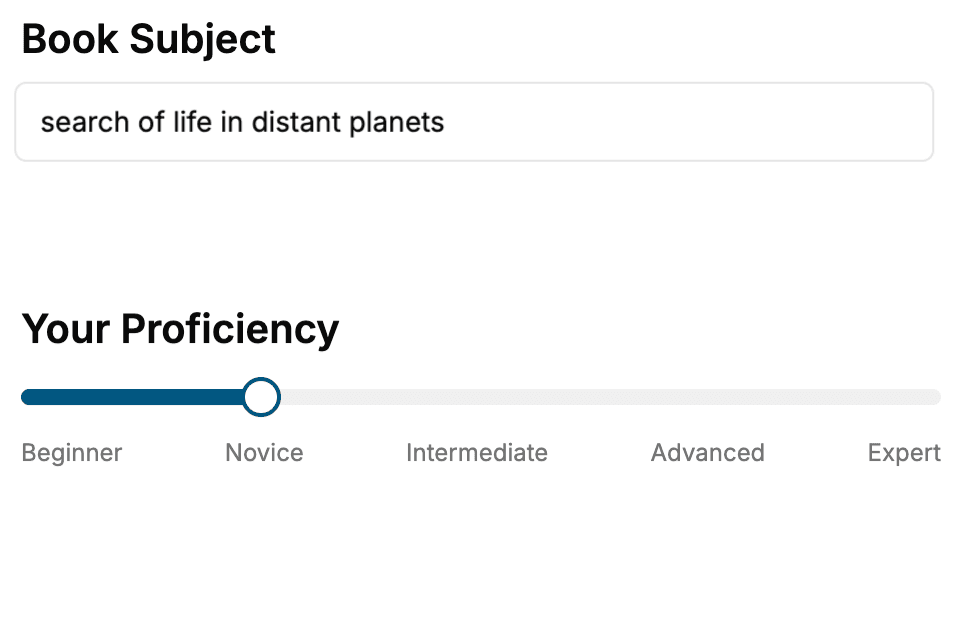
Select the focus of your Reasoning book and share your background
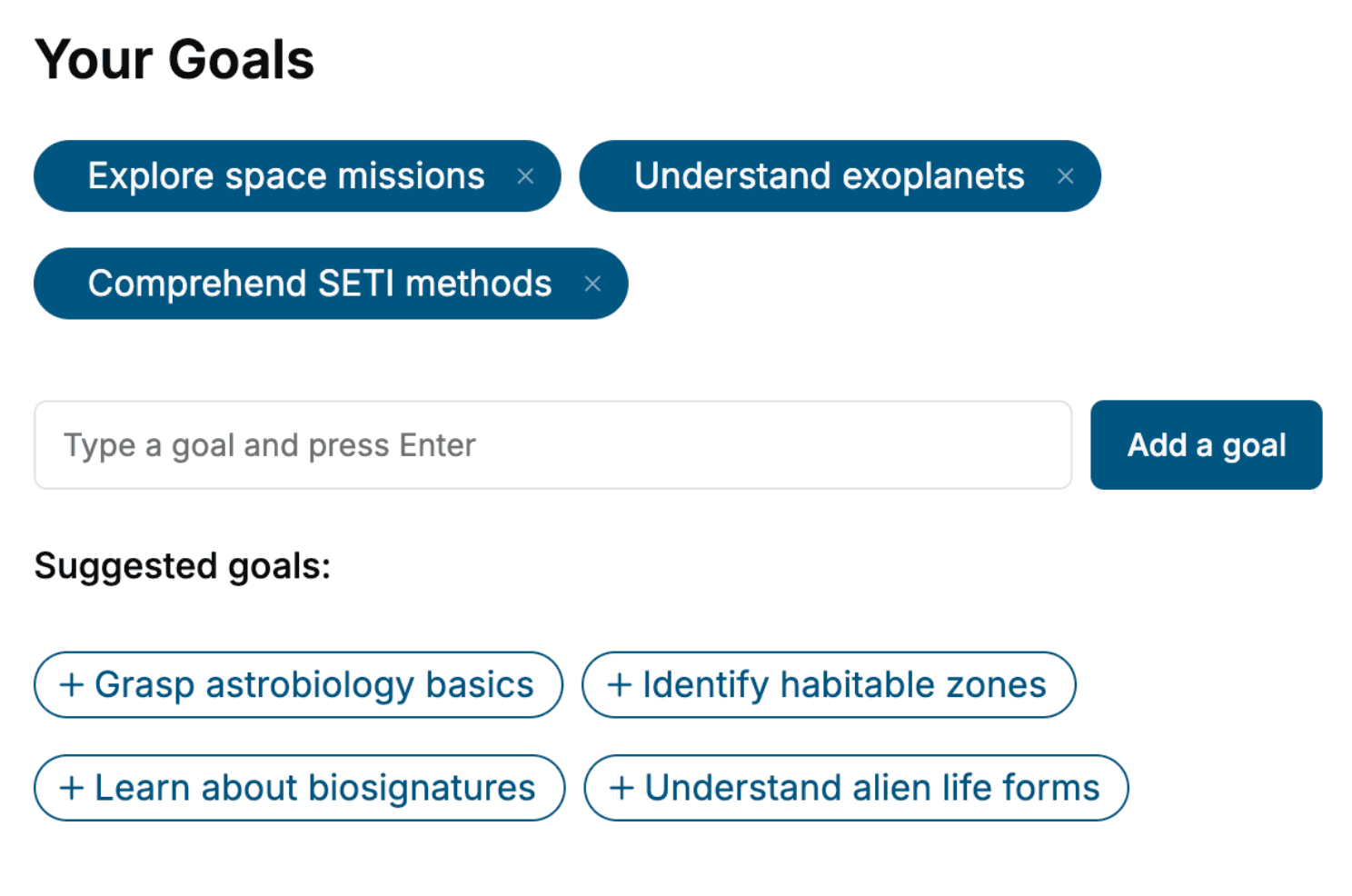
- 2. Personalize your book
Specify your goals and choose sub-topics to include
- 3. Get your tailored book
Your book is ready in 10 minutes. Read it online, download as EPUB or PDF, or send to Kindle.
Start from a template
Frequently asked questions
- What is TailoredRead?
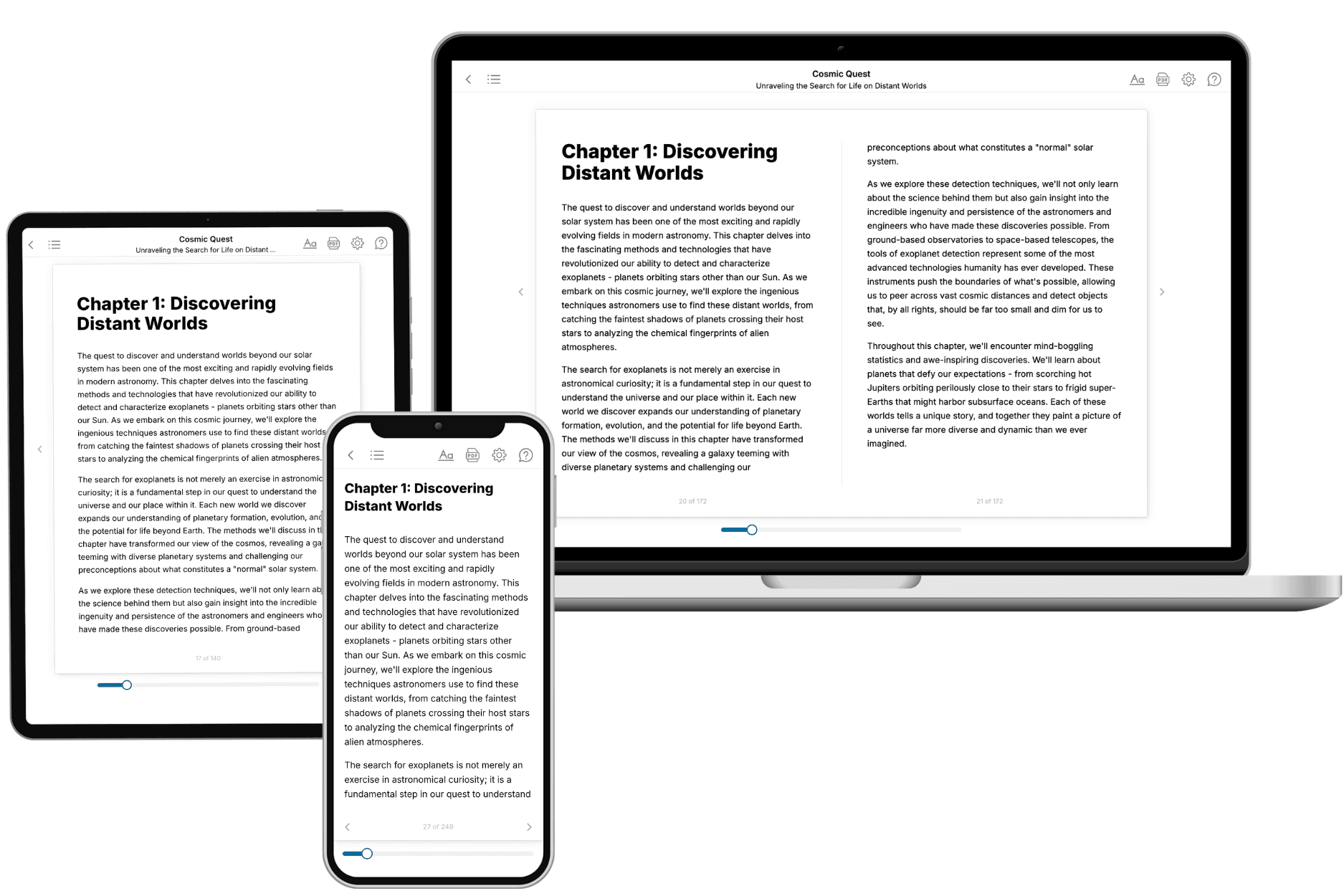
TailoredRead creates complete, full-length nonfiction ebooks, written specifically for you. Tell us what you want to learn and why, and TailoredRead writes you a complete ebook on it, with charts, tables, and diagrams throughout. Read it online, on Kindle, or on any e-reader, or download it as a PDF or EPUB. Every book is written fresh the day you order it.
- How is the book tailored to me?
Before anything is written, you answer a few short questions about your goals, your background, and the topics you care about. Your book is then planned around your answers: written at your level, focused on your goals, and covering the topics you chose, instead of the one-size-fits-all book a store sells everyone.
- Will it read like generic AI content?
No. Your book isn't a chat transcript: it's planned chapter by chapter before a single word is written, told in a clear book voice, and explains ideas visually with charts, tables, and diagrams. After writing, every book goes through an editorial pass that polishes chapters so the book reads consistent from start to finish. Judge for yourself: browse thousands of sample books on our Explore Books page.
- How accurate is the content?
Our AI first checks whether your subject needs live research. Niche and fast-moving subjects are researched before writing, and the book plan and chapters are grounded in what it finds. After writing, every book goes through a quality pass that checks its facts and consistency, and researched books list their sources in a Notes section at the back.
- How long is the book?
You choose the length: Comprehensive (250-300 pages), Detailed (150-200 pages), Essential (70-100 pages), or Short (30-50 pages).
- Does the book include visuals?
Yes. Every book includes charts, tables, and diagrams: timelines, checklists, step-by-step guides, decision trees, comparison tables, matrices, and bar charts. A typical book includes dozens of these visual elements.
- Can I read it on Kindle? What formats can I download?
Yes. Every book can be read in our online reader or downloaded as a PDF or EPUB. The EPUB can be opened with Kindle, Apple Books, Kobo, and any e-reader. The Commercial and Author licenses also include an editable Word (DOCX) and Markdown download.
- How much does it cost?
About the price of a regular ebook. The exact price depends on your book's length and complexity, from $2 for the shortest books to $35 for the most comprehensive, and it's shown when you review your book, before you commit to anything. Each book is a one-time purchase, yours to keep, no subscription. Licenses that let you share, teach, or publish your book range from $35.99 to $49.99.
- Can I preview the book before purchasing?
Before you pay, you'll see what your book will cover: the title, a detailed description, the estimated length, and the complete chapter-by-chapter table of contents, so you know what you're getting before you decide. The full text itself is written after you purchase.
- How long does it take to create a book?
About 10 minutes. You can start reading the opening chapters while the rest is still being written.