Nationalism Books
Explore tailored Nationalism books created by our AI
Discover the intricate tapestry of cultural nationalism and its profound influence on our world today. Cultural Nationalism Unveiled takes you on an illuminating journey through the complex interplay of identity, heritage, and political dynamics that shape nations and societies. Your understanding of cultural nationalism will be enriched as you delve into its historical origins, examine its various manifestations across different regions, and analyze its impact on contemporary politics and social movements. This book offers a balanced and nuanced perspective, encouraging critical thinking about the role of culture in shaping national identities and political landscapes. By the time you finish this book, you'll have gained valuable insights into the forces that drive cultural nationalism, its potential benefits and pitfalls, and its significance in an increasingly globalized world. Whether you're a student of politics, a cultural enthusiast, or simply curious about the forces shaping our world, Cultural Nationalism Unveiled equips you with the knowledge to engage in informed discussions and make sense of complex societal trends.
Forging Nations
The Untold Story of Nationalism's Rise in Europe
Contrary to popular belief, nationalism in Europe didn't emerge overnight. It was a complex, centuries-long process that reshaped the continent's political landscape. "Forging Nations: The Untold Story of Nationalism's Rise in Europe" challenges the oversimplified narratives often presented in history books. This compelling exploration takes you on a journey through time, unraveling the intricate web of social, cultural, and political factors that gave birth to modern European nations. You'll discover how language, literature, and art became powerful tools in crafting national identities, and how economic changes fueled the fires of nationalist sentiment. From the ashes of empires to the birth of nation-states, this book illuminates the pivotal moments that defined Europe's trajectory. You'll gain insights into the complex interplay between enlightenment ideals, romantic notions of cultural uniqueness, and the pragmatic politics that shaped borders and allegiances. By understanding these historical processes, you'll be better equipped to comprehend the nuances of contemporary European politics and society.
The Fabric of Nations
Understanding Nationalism in the Modern Political Landscape
In "The Fabric of Nations: Understanding Nationalism in the Modern Political Landscape," you'll embark on a thought-provoking journey through the complex world of nationalism and its intricate relationship with political freedom and contemporary politics. This comprehensive guide offers a balanced and nuanced exploration of nationalism's historical roots, its evolution over time, and its current manifestations across the globe. You'll gain insights into the various forms of nationalism, from civic to ethnic, and understand how they shape national identities, political movements, and international relations. Through engaging analysis and real-world examples, you'll discover the double-edged nature of nationalism - its potential to unite and divide, to inspire progress and hinder cooperation. The book delves into the challenges nationalism poses to globalization, multiculturalism, and international governance, while also examining its role in preserving cultural heritage and fostering a sense of belonging. Whether you're a student of political science, a concerned citizen, or simply curious about the forces shaping our world, "The Fabric of Nations" will equip you with the knowledge and analytical tools to navigate the complex landscape of modern nationalism and its impact on political freedom and global politics.
This book takes you through one of history's most transformative conflicts—the Irish War of Independence—and shows you how a colonized nation fought for freedom and fundamentally altered the course of European history. You'll discover the deep historical roots of Irish grievance, trace the pivotal moments that shifted public opinion, and understand the guerrilla tactics that challenged imperial power. Through detailed examination of key figures, military campaigns, and political negotiations, you'll see how ordinary people and extraordinary leaders navigated impossible choices during a brutal conflict. The book explores the complex realities often overlooked in simplified accounts: the internal divisions within the independence movement, the experiences of women and working-class activists, and the regional variations across Ireland. You'll gain insight into how the war's outcome—the Anglo-Irish Treaty and partition—created both a new nation and lasting tensions that continue to influence Irish and British politics today. By the end, you'll understand not just what happened, but why it matters for understanding modern Ireland, European history, and the broader patterns of anti-colonial resistance worldwide.
The Easter Rising of 1916
Ireland's Rebellion and the Birth of a Nation
What if a small group of rebels, armed with idealism and determination, could fundamentally reshape the course of a nation's history? The Easter Rising of 1916 stands as one of history's most transformative moments—a six-day rebellion that changed Ireland forever. This book explores the intricate web of political movements, personal sacrifices, and historical circumstances that converged in Dublin during Easter week. You'll discover how decades of failed constitutional reform, the pressures of World War I, and the vision of Irish independence combined to spark an uprising that seemed doomed from the start. Through vivid accounts of the key figures, the street-by-street fighting, and the dramatic executions that followed, you'll understand how a military defeat became a moral victory that galvanized an entire nation. Whether you're exploring Irish history, European politics, or the nature of revolutionary change, this comprehensive examination reveals why the Easter Rising remains a defining moment in the struggle for self-determination.
The Fire of Freedom
Poland's Historic Uprisings and Their Impact on European History
You'll gain a comprehensive understanding of how Poland's centuries-long struggle for independence shaped not only the nation itself but the entire European continent. This detailed exploration takes you through the major Polish uprisings from the 17th century through the 20th century, revealing the strategic thinking, cultural movements, and international dynamics that defined each rebellion. You'll discover how Polish revolutionaries developed increasingly sophisticated approaches to resistance, learning from each defeat to build stronger foundations for future attempts. The book examines the intricate connections between Polish uprisings and broader European political movements, showing how events in Poland influenced nationalism, military tactics, and diplomatic strategies across the continent. Through careful analysis of primary sources and historical records, you'll understand the complex interplay between military action, cultural preservation, and international politics that characterized these pivotal moments. You'll explore how Polish uprisings inspired similar movements throughout Europe and beyond, creating a lasting legacy that extends far beyond Poland's borders. By the end, you'll possess a nuanced appreciation for how these uprisings contributed to the development of modern European political thought and the eventual restoration of Polish independence, while gaining insights into the broader patterns of resistance and liberation that have shaped world history.
The Year of Revolutions
How 1848 Reshaped Europe and Changed the Course of History
What if a single year could fundamentally reshape an entire continent's political future? The revolutions of 1848 swept across Europe like wildfire, challenging centuries of monarchical rule and inspiring millions to demand democracy, national independence, and social justice. Yet within months, most had been crushed by military force. This book explores the dramatic story of how ordinary people rose up against entrenched power, why their movements ultimately faltered, and how their legacy continues to influence our world today. From the barricades of Paris to the streets of Vienna, from the halls of Frankfurt to the mountains of Italy, discover the interconnected revolutions that nearly transformed Europe. Through vivid narratives, historical analysis, and examination of the key figures who shaped these events, you'll understand not just what happened in 1848, but why it matters for understanding modern democracy, nationalism, and social change. This is the story of a pivotal moment when history hung in the balance.
Napoleon's Europe
How One Man Reshaped a Continent and Changed History Forever
Imagine understanding the pivotal moment when Europe transformed from a collection of feudal kingdoms into the modern continent we know today. The Napoleonic Wars represent one of history's most consequential periods—a time when one extraordinary military leader reshaped nations, rewrote laws, and challenged the very foundations of European society. This book takes you through the rise of Napoleon from a Corsican officer to Emperor of France, the sweeping military campaigns that conquered and reorganized Europe, and the coalition efforts that ultimately brought him down. You'll discover how his innovations in military strategy still influence warfare today, how his legal code became the foundation for modern civil law systems, and how the wars he fought sparked nationalist movements that defined the 19th century. Whether you're exploring how empires rise and fall, interested in military history, or curious about the roots of modern Europe, this comprehensive yet accessible guide illuminates the forces, personalities, and decisions that shaped our world.
You'll gain a comprehensive understanding of how the Arab-Israeli conflict evolved from competing imperial ambitions and nationalist movements into one of the world's most intractable disputes. This book traces the historical trajectory from the Balfour Declaration through the British Mandate, the 1948 war, and contemporary peace efforts, examining how imperialism, nationalism, and religious identity intersected to shape the region. You'll explore the origins of the Zionist movement, Palestinian nationalism, and Arab League responses while analyzing concrete disputes over water rights, land partition, and settlement expansion. By examining key events, political causes, and social impacts through a balanced historical lens, you'll develop the contextual knowledge needed to assess current proposals like the two-state solution and understand why previous frameworks like the Oslo Accords achieved limited success. This analysis equips you with the historical foundation to engage thoughtfully with Middle Eastern affairs.
Many believe the Boxer Rebellion was simply a chaotic peasant uprising easily suppressed by Western forces. In reality, it was a complex nationalist response to decades of foreign domination that fundamentally reshaped American foreign policy and global power dynamics. This book examines how Western imperialism, particularly American commercial expansion, created the conditions for the rebellion while simultaneously using it to justify deeper military involvement in Asia. You'll discover how the United States' response to the crisis established patterns of intervention that would define American foreign policy throughout the 20th century. By exploring the rebellion through multiple perspectives—Chinese resistance fighters, American diplomats, and international powers—you'll gain insight into how imperial powers maintained control over colonized regions and how nationalist movements emerged in response. This historical moment reveals the roots of modern tensions between Western powers and Asia, making it essential for understanding contemporary international relations and American global influence.
The French Revolutionary Wars
How Europe's Greatest Conflict Reshaped Nations and Ideologies
Discover how a financial crisis in France spiraled into a quarter-century of warfare that fundamentally transformed Europe. This comprehensive exploration takes you through the ideological fervor, military genius, and political upheaval that defined the French Revolutionary Wars from 1792 to 1815. You'll understand the economic collapse that triggered revolution, the radical ideologies that inspired armies, and the military innovations that changed warfare forever. Follow the rise of Napoleon from artillery officer to emperor, witness the coalition wars that reshaped the continent, and grasp why this conflict mattered more than any other in European history. Whether you're exploring how nations are born from revolution, studying military strategy, or understanding the roots of modern Europe, this book provides the context, analysis, and narrative you need to see how one nation's internal crisis became the defining event of an era.
Many assume globalization is an inevitable force that simply happens to countries. In reality, globalization is a deeply political process shaped by deliberate choices, competing interests, and power struggles between nations, corporations, and citizens. This book examines how globalization fundamentally reshapes political systems, national sovereignty, and international relations across the world. You'll discover why some nations thrive in the global economy while others struggle, how international institutions both enable and constrain state power, and why globalization fuels political backlash in democracies and authoritarian states alike. Through concrete examples from Europe, Asia, Africa, and the Americas, you'll learn how different political systems navigate the tensions between openness and protection, integration and sovereignty. Whether you're seeking to understand trade wars, migration politics, or the rise of nationalist movements, this book provides the analytical framework to make sense of our interconnected world and the political choices that shape it.
Forging a Nation
The Dramatic Story of German Unification and Its Impact on European History
Discover the fascinating journey of how modern Germany came to be. "Forging a Nation" takes you on a captivating exploration of the complex and dramatic process of German unification. From the aftermath of the Napoleonic Wars to the proclamation of the German Empire, you'll gain a deep understanding of the political, social, and cultural forces that shaped this pivotal moment in European history. Through vivid storytelling and insightful analysis, you'll explore the roles of key figures like Otto von Bismarck, witness the power struggles between Prussia and Austria, and understand the impact of events such as the Revolutions of 1848 and the Franco-Prussian War. You'll also discover how the unification process influenced Germany's neighbors and set the stage for future European developments. This book goes beyond mere facts and dates, offering you a nuanced perspective on the challenges, triumphs, and lasting consequences of German unification. You'll gain valuable insights into the formation of national identity, the balance of power in 19th-century Europe, and the roots of modern German society. Whether you're a history enthusiast or simply curious about the forces that have shaped our world, "Forging a Nation" will enrich your understanding of this crucial chapter in European history.
What if the Olympic Games you watch today are fundamentally different from what the ancient Greeks intended—and what if that transformation tells us everything about how power, politics, and human ambition have evolved over millennia? This book traces the remarkable journey of the Olympic Games from their origins as sacred religious ceremonies in ancient Greece to their current status as the world's most watched sporting event. You'll discover how the Games have served as mirrors reflecting the values, conflicts, and aspirations of different eras—from ancient peace treaties to Cold War rivalries to modern social justice movements. Through compelling historical narratives and critical analysis, you'll understand how the Olympics have shaped and been shaped by nationalism, commercialism, technological innovation, and social change. Whether you're a sports fan curious about Olympic history or someone interested in how major institutions reflect broader historical forces, this book reveals the untold stories behind the medals, the politics behind the pageantry, and the human drama that makes the Olympics far more than just athletic competition.
Games of Revolution
How Sports Shaped French Society During the Revolutionary Era
Discover how sports became a battleground for revolutionary ideals during one of history's most transformative periods. This book reveals the surprising connection between athletic pursuits and the French Revolution, showing how games, competitions, and physical activities served as powerful expressions of political change. From the elimination of aristocratic hunting privileges to the creation of mass public spectacles, sports embodied the revolutionary struggle between old and new visions of society. You'll explore how physical education was weaponized to create loyal citizens, how public games became stages for national identity, and how the Napoleonic era redirected athletic culture toward military might. By examining the playing fields and gymnasiums of Revolutionary France, you'll gain fresh perspective on how cultural practices both reflect and drive historical transformation. This accessible exploration bridges sports history and European history, offering unexpected insights into how ordinary activities like games and exercise reveal the deepest currents of social and political upheaval.
Many people struggle to understand why right-wing extremism has grown in recent decades or how ordinary individuals become radicalized. This book cuts through the confusion with a clear, evidence-based examination of extremist movements, their ideologies, and the psychological and social mechanisms that drive radicalization. You'll explore the historical roots of modern extremism, learn how recruitment and indoctrination work in both physical and digital spaces, and discover what research reveals about why people join these movements. The book examines the role of grievance narratives, economic anxiety, and identity politics in fueling extremism, while also presenting real examples of deradicalization and exit strategies. Whether you're concerned about a loved one, seeking to understand current events, or working in education, law enforcement, or community outreach, this book provides the analytical framework and practical insights you need to recognize warning signs and understand the complex factors at play.
This book takes you through one of the most consequential political events of the 21st century: Britain's decision to leave the European Union. You'll discover how historical grievances, economic anxieties, and competing visions of national identity converged to produce a referendum that shocked the world. The narrative explores the decades of tension between British sovereignty and European integration, the regional and generational fault lines that split the nation, and the sophisticated campaigns that shaped public opinion. You'll examine the actual voting patterns, understand the key arguments on both sides, and see how the referendum exposed fundamental questions about democracy, identity, and Britain's place in the world. Finally, you'll explore the immediate and long-term consequences—from political upheaval to economic uncertainty to Britain's evolving relationship with Europe and the globe. This is the story of how a single vote changed the trajectory of a nation and reverberated across the world.
Drawn in Ink, Lived in Blood
How Colonial Borders Shaped Modern Conflicts and Identities
Discover why the world's most intractable conflicts, from the Middle East to sub-Saharan Africa, trace their roots to lines drawn on maps by colonial administrators who never set foot in the territories they divided. This book reveals how European powers carved up continents to serve their economic interests, creating borders that ignored centuries of cultural, ethnic, and religious geography. You'll understand why these arbitrary lines persist today despite their destructive consequences, how they fuel modern wars and humanitarian crises, and what this means for resolving contemporary geopolitical tensions. Through case studies spanning multiple continents and centuries, you'll see the direct connections between colonial boundary-drawing and today's refugee crises, resource conflicts, and identity struggles. Whether you're studying international relations, working in policy, or simply seeking to understand why the world is shaped as it is, this book provides the historical foundation necessary to comprehend modern global challenges.
The Falklands War
Britain's South Atlantic Conflict and the Struggle for Empire
Many assume the Falklands War was simply a minor territorial dispute between two distant nations. In reality, this 1982 conflict was a pivotal moment that reshaped international relations, military strategy, and the political futures of two nations. This book reveals how economic crisis and nationalist fervor in Argentina led to an invasion that Britain could not ignore, and how a small island chain became the stage for a modern naval war. You'll discover the strategic decisions that determined victory, the human stories behind the statistics, and how this brief but intense conflict established precedents that still influence global politics today. From the political calculations in Buenos Aires and London to the experiences of soldiers on the front lines, this account examines every dimension of the war—its origins, its conduct, and its profound consequences. Whether you're interested in military history, geopolitics, or understanding how nations respond to aggression, this book provides the context and analysis you need to grasp why the Falklands War matters.
The Sacred and the Political
Understanding How Religion Shapes Power, Governance, and Society
Many assume religion and politics should remain completely separate—a view so common it feels like common sense. Yet this assumption itself is a philosophical position, not an objective fact. Throughout history and across cultures, religious belief has profoundly shaped political systems, legitimized power, motivated social movements, and defined the boundaries of community. From medieval theocracies to modern democracies wrestling with religious minorities, the relationship between the sacred and the political remains one of the most consequential forces in human society. This book examines how different philosophical traditions understand this relationship, explores historical patterns of religious-political interaction, and analyzes contemporary challenges in pluralistic democracies. Whether you're seeking to understand current political conflicts, explore philosophical foundations of governance, or simply make sense of why religion remains politically significant, this exploration provides essential context for informed citizenship and critical thinking.
What if the most ambitious political experiment in modern history could be explained in a way that actually makes sense? The European Union is often portrayed as either a bureaucratic nightmare or a visionary achievement—but the reality is far more nuanced and fascinating. This book cuts through the complexity to show you how a continent devastated by war transformed itself into an unprecedented union of 27 democracies. You'll discover the historical forces that drove integration, the ingenious (and sometimes frustrating) institutions that make it work, and the real tensions that threaten its future. From the Coal and Steel Community's modest beginnings to today's debates over sovereignty and identity, this book reveals why the EU matters—not just for Europeans, but for understanding how nations can choose cooperation over conflict. Whether you're curious about how Brussels actually functions, puzzled by Brexit, or wondering what Europe's future holds, you'll find clear answers grounded in history and contemporary reality.
Discover the extraordinary life of John Maclean, the Scottish schoolteacher who became a revolutionary force in early 20th-century politics. This biography traces his journey from a modest background in Lanarkshire to becoming one of Britain's most formidable socialist voices, a champion of Scottish independence, and a figure whose defiance of wartime authorities earned him imprisonment and lasting notoriety. Through meticulous research and engaging narrative, you'll explore how Maclean synthesized Marxist theory with Scottish nationalism, creating a political vision that challenged the establishment on multiple fronts. Witness his tireless organizing efforts in Glasgow's industrial heartland, his courageous anti-war stance during World War I, and his unwavering commitment to workers' rights despite personal sacrifice. This comprehensive biography reveals not just the man behind the legend, but the historical forces that shaped him and the enduring influence his ideas continue to exert on Scottish politics and identity today.
Master the complex dynamics of Putin's Russia through systematic analysis of power structures, governance mechanisms, and strategic doctrine. This comprehensive examination provides the analytical framework you need to understand how Putin consolidated authority, how the Kremlin operates through overlapping elite networks, and how Russia projects power domestically and internationally. You'll explore the security apparatus's dual role in governance and constraint, decode the mechanisms of authoritarian consolidation, and analyze the information warfare strategies that sustain regime control. By examining factional competition, oligarchic relationships, and institutional power dynamics, you'll gain the tailored insights necessary to interpret Russian political intrigue and geopolitical strategy. Whether assessing regime stability, evaluating foreign policy intentions, or understanding domestic opposition control, this book equips you with the analytical tools to decode Russia's complex political architecture and anticipate strategic behavior.
1948: The Birth of a Nation
How Israel Emerged from Conflict, Displacement, and Determination
Discover the pivotal events and complex forces that shaped one of the 20th century's most consequential moments. This comprehensive examination takes you through the centuries of Jewish diaspora, the rise of Zionism, and the dramatic final years leading to Israel's establishment in 1948. You'll understand how the Holocaust transformed international politics, why the British Mandate created irreconcilable tensions, and how the UN Partition Plan became a flashpoint for conflict. Through careful analysis of key figures, military campaigns, and political negotiations, you'll gain insight into how a new nation emerged from centuries of displacement and persecution—while grappling with the displacement of another people. This book presents the historical evidence, competing narratives, and lasting consequences of 1948, enabling you to understand not just what happened, but why it matters for the modern Middle East and global politics today.
The Irish Civil War
Nation Divided, History Defined
Discover how a nation's struggle for independence transformed into a devastating internal conflict that reshaped Ireland forever. This comprehensive examination takes you through the Irish Civil War—a pivotal moment when Irish fought Irish over the vision of their newly independent state. You'll understand the political tensions that made the conflict inevitable, meet the leaders whose decisions determined outcomes, and witness the human cost of ideological division. From the controversial Anglo-Irish Treaty that sparked the conflict to the Free State's emergence and the lasting scars on Irish society, you'll gain clarity on how this 11-month war fundamentally altered Ireland's constitutional status, its relationship with Britain, and its path toward becoming a republic. This book reveals not just what happened, but why it mattered—and how its consequences continue to echo through Irish and European history today.
The Great Divide
Understanding the Partition of India and Its Place in World History
Many people believe the Partition of India was simply an inevitable religious conflict that naturally divided Hindus and Muslims. This oversimplified view misses the complex web of political maneuvering, colonial policies, and strategic decisions that actually shaped one of history's most consequential events. The Great Divide takes you beyond surface-level explanations to explore how the partition of British India in 1947 fundamentally altered not just South Asia, but the entire trajectory of world history. You'll discover how colonial administrative choices, key personality conflicts, and international pressures converged to create a perfect storm that displaced over 14 million people and established patterns of conflict that continue today. Through careful analysis of primary sources and historical evidence, you'll gain insight into the roles played by Gandhi, Nehru, Jinnah, and Mountbatten, while understanding how their decisions reverberated across continents. You'll explore how Partition influenced decolonization movements worldwide, shaped Cold War dynamics, and created lasting impacts on global migration patterns. By the end of this comprehensive examination, you'll possess a nuanced understanding of how local events can reshape world history, and why the lessons of Partition remain critically relevant for understanding contemporary geopolitics, religious nationalism, and the ongoing challenges of nation-building in our interconnected world.
Understanding French political parties during the Revolution and its aftermath requires grappling with a fundamental challenge: how do ideological movements transform into functioning political systems? This period witnessed the birth of modern political ideology itself, as competing visions for society crystallized into distinct factions. From the radical Jacobins to the moderate Girondins, from royalist counterrevolutionaries to Bonapartist pragmatists, each movement embodied different answers to revolutionary questions about power, rights, and social organization. This book traces how these early political movements emerged from philosophical debate, shaped the course of revolution, and ultimately established patterns that would define European politics for centuries. You'll discover how personal rivalries, regional interests, and ideological conviction intertwined to create the first modern political parties, and how their struggles to balance revolutionary ideals with practical governance created lasting institutional innovations. By examining the specific parties, their leaders, and their competing visions, you'll gain insight into how political systems develop and why the French Revolution's political legacy remains so influential today.
The Suez Crisis
How a Canal Dispute Reshaped the Modern Middle East and European Power
The Suez Canal Crisis of 1956 stands as one of history's most pivotal moments, yet many struggle to understand its complex causes and far-reaching consequences. This book cuts through the confusion by providing a clear, comprehensive account of how a dispute over a waterway became the event that fundamentally reshaped global power dynamics. You'll discover how Egyptian President Nasser's bold nationalization of the canal challenged Western dominance, why Britain and France's military intervention ultimately failed, and how this crisis marked the definitive end of European colonialism. Through detailed analysis of the key players—from Nasser and Eisenhower to Eden and Mollet—you'll understand the political calculations, military strategies, and diplomatic maneuvering that defined this critical moment. This book reveals how the Suez Crisis accelerated decolonization worldwide, elevated Soviet influence in the Middle East, and established new rules for international conflict. Whether you're studying history, interested in geopolitics, or seeking to understand the roots of modern Middle Eastern tensions, this account provides the context and clarity you need to grasp why 1956 matters today.
The Swedish Crown
A Complete History of Royalty, Power, and Tradition in Sweden
Imagine understanding the complete story of how a small Nordic kingdom built one of Europe's most respected and enduring monarchies. The Swedish Crown has shaped not just governance, but the very identity of a nation that transformed from a warrior kingdom into a beacon of stability and progress. This comprehensive exploration takes you through centuries of royal history—from the legendary Viking kings to today's modern constitutional monarchy. You'll discover how Swedish royals navigated religious upheaval, political revolution, and social transformation while maintaining their relevance and respect. Learn about the personalities, decisions, and innovations that defined each era, and understand how the Swedish approach to monarchy differs fundamentally from its European counterparts. Whether you're fascinated by history, interested in how institutions adapt to change, or curious about the intersection of tradition and modernity, this book reveals the remarkable story of a crown that has endured by evolving.
Globalization promised prosperity for all, yet millions feel left behind. The anti-globalization movement has grown from fringe protests to a major force reshaping elections, trade policy, and international relations. But what exactly is this movement, and what does it actually want? This book cuts through the confusion by examining anti-globalization from multiple angles. You'll discover how the movement emerged from real economic disruptions—factory closures, wage stagnation, and cultural anxiety—rather than mere xenophobia. You'll explore the diverse factions within the movement, from labor unions fighting for worker protections to environmental groups challenging corporate power to nationalist parties questioning immigration and sovereignty. Rather than dismissing or endorsing anti-globalization arguments, this book helps you understand them. You'll learn what critics get right about globalization's costs, where their proposed solutions fall short, and how these movements are reshaping politics worldwide. Whether you're trying to understand your neighbors' political views, make sense of recent elections, or engage in informed debate about global trade and immigration, this book provides the clarity you need.
Common Sense
Thomas Paine's Revolutionary Argument for American Independence
Discover how one 47-page pamphlet ignited a revolution and reshaped the course of human history. Thomas Paine's "Common Sense" was more than a political argument—it was a masterclass in persuasion that transformed colonists from reluctant subjects into passionate revolutionaries. This book takes you through Paine's brilliant logic, examining how he dismantled centuries of monarchical tradition and presented republicanism as the only rational choice. You'll explore the historical moment that made his words explosive, the Enlightenment ideas that shaped his thinking, and the rhetorical techniques that made complex philosophy accessible to ordinary people. From his devastating critique of hereditary rule to his vision of America as a beacon of freedom, you'll understand why "Common Sense" became the bestselling work of its era and how its arguments continue to influence democratic movements worldwide. Whether you're studying the American Revolution or seeking to understand the power of ideas to change the world, this exploration reveals why Paine's words still resonate today.
Related books you may like:
You're about to supercharge your animal advocacy efforts and nonprofit management skills with the power of AI. This groundbreaking guide is tailored specifically for leaders in the animal rights movement who are ready to harness cutting-edge technology to make a bigger impact. Discover how to leverage AI tools to streamline your operations, enhance your strategic planning, and amplify your advocacy campaigns. You'll learn practical techniques for automating administrative tasks, optimizing your workflow, and making data-driven decisions that will take your organization to the next level. From improving time management and task delegation to enhancing donor engagement and project tracking, this book offers a comprehensive roadmap for integrating AI into every aspect of your work. You'll gain insights into AI-driven research methods, problem-solving techniques, and productivity metrics that will revolutionize the way you approach animal advocacy.
Discover how air sign energy shapes your thinking, communication style, and approach to relationships. Whether you have a Gemini, Libra, or Aquarius placement in your birth chart, this guide reveals the intellectual and social gifts these signs bring—along with the blind spots worth understanding. You'll learn why air signs are natural communicators and idea-generators, how each sign expresses itself uniquely, and how your specific air sign placements influence your personality across different life areas. Through practical insights and real-world examples, you'll recognize air sign patterns in yourself and others, harness your natural strengths in connection and innovation, and navigate the challenges of overthinking and emotional detachment. Whether you're exploring your Sun, Moon, Rising, or other planetary placements, this book provides the clarity you need to work with your air sign energy authentically and effectively.
What if you could resolve years of trauma in just a handful of therapy sessions instead of months or years of traditional talk therapy? Accelerated Resolution Therapy (ART) offers a scientifically-grounded approach that harnesses your brain's natural healing capacity to process traumatic memories and emotional distress rapidly. This book demystifies how ART works at the neurological level, explains why it's so effective for conditions like PTSD, anxiety, and phobias, and explores how it differs from conventional therapeutic approaches. Whether you're a mental health professional considering adding ART to your practice, someone exploring treatment options for yourself or a loved one, or simply curious about innovative psychological interventions, this guide provides practical insights into one of the most promising developments in modern therapy. Discover how guided imagery and eye movement can facilitate profound emotional healing, what the research shows about its effectiveness, and whether ART might be the breakthrough approach you've been seeking.
The assumption that political parties are natural, inevitable, or even desirable features of democracy is surprisingly recent. For most of Western political history, the most sophisticated thinkers viewed organized factions as corrupting forces that distorted the pursuit of the common good. This book traces the genealogy of anti-party political thought from Plato's critique of democratic factionalism through contemporary populist movements, examining how philosophers, statesmen, and theorists have conceptualized the dangers of partisanship and imagined alternatives. You'll encounter Rousseau's vision of a general will transcending faction, the Federalist Papers' constitutional anxiety about party machinery, Tocqueville's ambivalent analysis of American partisanship, and the radical rejection of parties by socialist and anarchist movements. Rather than treating anti-party sentiment as mere nostalgia or populist demagoguery, this analysis reveals it as a coherent intellectual tradition grappling with enduring tensions between democratic participation and organized political competition. By understanding how different historical periods and ideological traditions have confronted the problem of faction, you gain critical perspective on contemporary debates about party reform, populism, and democratic alternatives.
Many people believe that behavior is determined either by our genetics or by direct rewards and punishments we experience. However, Albert Bandura's groundbreaking research revealed a more nuanced truth: we learn by watching others. This book explores the life and work of one of psychology's most influential figures and the revolutionary theory that transformed our understanding of human behavior. You'll discover how Bandura's concept of self-efficacy explains why some people persevere through challenges while others give up, how observational learning shapes everything from aggression to prosocial behavior, and why the environment, our thoughts, and our actions are constantly influencing each other. Whether you're an educator seeking to improve student outcomes, a professional interested in behavior change, or simply curious about the science of learning, this comprehensive guide illuminates the principles that govern human development and provides practical insights into how these theories apply to everyday life.
Create a Nationalism Book Tailored to You
Create an AI-crafted book tailored to your goals, interests, and background






Benefits of AI-tailored books
- Read one book, not ten:
- all the Nationalism knowledge you need, gathered into a single book.
- Save days of learning:
- tell us your goals, choose your topics, and the whole book is built around them.
- Learn effortlessly:
- Nationalism book written for your specific background and expertise.
- Understand at a glance:
- includes charts, tables, timelines, checklists, decision trees, and more.
- Stay current:
- written the day you order it, not years ago.
- Trust what you read:
- every book is checked for accuracy, with real research when your subject needs it.
Create your unique book in 3 steps
- 1. Select your focus
Select the focus of your Nationalism book and share your background
- 2. Personalize your book
Specify your goals and choose sub-topics to include
- 3. Get your tailored book
Your book is ready in 10 minutes. Read it online, download as EPUB or PDF, or send to Kindle.


Start from a template
Frequently asked questions
- What is TailoredRead?
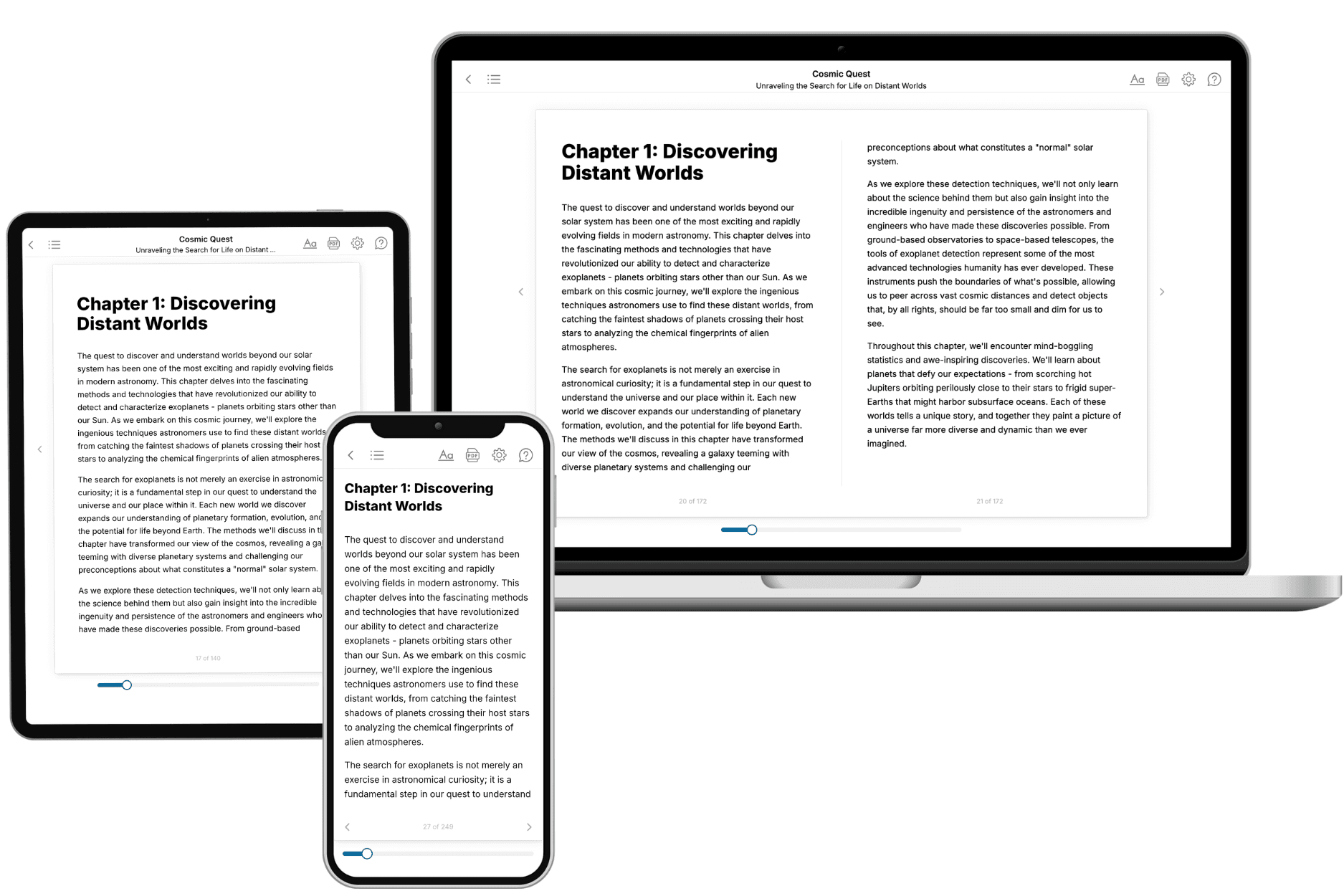
TailoredRead creates complete, full-length nonfiction ebooks, written specifically for you. Tell us what you want to learn and why, and TailoredRead writes you a complete ebook on it, with charts, tables, and diagrams throughout. Read it online, on Kindle, or on any e-reader, or download it as a PDF or EPUB. Every book is written fresh the day you order it.
- How is the book tailored to me?
Before anything is written, you answer a few short questions about your goals, your background, and the topics you care about. Your book is then planned around your answers: written at your level, focused on your goals, and covering the topics you chose, instead of the one-size-fits-all book a store sells everyone.
- Will it read like generic AI content?
No. Your book isn't a chat transcript: it's planned chapter by chapter before a single word is written, told in a clear book voice, and explains ideas visually with charts, tables, and diagrams. After writing, every book goes through an editorial pass that polishes chapters so the book reads consistent from start to finish. Judge for yourself: browse thousands of sample books on our Explore Books page.
- How accurate is the content?
Our AI first checks whether your subject needs live research. Niche and fast-moving subjects are researched before writing, and the book plan and chapters are grounded in what it finds. After writing, every book goes through a quality pass that checks its facts and consistency, and researched books list their sources in a Notes section at the back.
- How long is the book?
You choose the length: Comprehensive (250-300 pages), Detailed (150-200 pages), Essential (70-100 pages), or Short (30-50 pages).
- Does the book include visuals?
Yes. Every book includes charts, tables, and diagrams: timelines, checklists, step-by-step guides, decision trees, comparison tables, matrices, and bar charts. A typical book includes dozens of these visual elements.
- Can I read it on Kindle? What formats can I download?
Yes. Every book can be read in our online reader or downloaded as a PDF or EPUB. The EPUB can be opened with Kindle, Apple Books, Kobo, and any e-reader. The Commercial and Author licenses also include an editable Word (DOCX) and Markdown download.
- How much does it cost?
About the price of a regular ebook. The exact price depends on your book's length and complexity, from $2 for the shortest books to $35 for the most comprehensive, and it's shown when you review your book, before you commit to anything. Each book is a one-time purchase, yours to keep, no subscription. Licenses that let you share, teach, or publish your book range from $35.99 to $49.99.
- Can I preview the book before purchasing?
Before you pay, you'll see what your book will cover: the title, a detailed description, the estimated length, and the complete chapter-by-chapter table of contents, so you know what you're getting before you decide. The full text itself is written after you purchase.
- How long does it take to create a book?
About 10 minutes. You can start reading the opening chapters while the rest is still being written.