Computational Physics Books
Explore tailored Computational Physics books created by our AI
Books readers created
22 Computational Physics books, each written for the reader who ordered it. Read its introduction, then personalize it to get a book of your own.
Master the mathematical foundations and practical implementation of Hamiltonian dynamics to build numerical algorithms that preserve energy and structure in your simulations. This book bridges the gap between classical mechanics and modern computational science, showing you how Hamiltonian principles lead to more accurate, stable, and efficient algorithms. You'll learn why standard numerical methods fail for long-term simulations and how symplectic integrators solve this problem. Through clear explanations and concrete examples, discover how to apply Hamiltonian dynamics to molecular dynamics, optimization, machine learning, and other computational domains. Whether you're simulating physical systems, training neural networks, or solving differential equations, understanding Hamiltonian dynamics gives you powerful tools to improve accuracy while reducing computational cost. This book equips you with both the theoretical understanding and practical skills needed to implement these advanced techniques in your own work.
Computational Physics Essentials
Bridging Theory and Simulation in Modern Physics
How do physicists predict the behavior of systems too complex for pencil-and-paper mathematics? Computational physics has become indispensable for modern theoretical research, yet many practitioners struggle to connect fundamental concepts with practical implementation. This book bridges that gap by teaching you how to translate physical theories into working simulations. You'll explore the essential numerical methods that power contemporary physics research—from solving differential equations to simulating particle systems—while understanding the mathematical foundations and practical limitations of each approach. Rather than overwhelming you with code, this guide emphasizes the physics-first perspective: why certain methods work, when they fail, and how to validate your results. Whether you're studying quantum mechanics, classical dynamics, or field theory, you'll gain the conceptual framework and practical skills to build reliable simulations that advance your understanding of the physical world.
Most people think climate models are black boxes that simply predict future temperatures. In reality, they're sophisticated computational systems built on decades of numerical algorithm research. This book demystifies the mathematical and computational foundations that make climate modeling possible. You'll discover how scientists discretize Earth's complex fluid dynamics equations into solvable computational problems, why certain numerical methods work better than others for different climate phenomena, and how modern supercomputers enable global simulations. Whether you're a student entering the field, a professional seeking deeper technical understanding, or a researcher looking to implement or improve climate models, this guide provides the practical knowledge you need. From grid design and time-stepping schemes to parameterization strategies and parallel computing approaches, you'll gain insight into the real engineering decisions that shape climate predictions and their uncertainties.
You'll advance from intermediate understanding to expert-level mastery of one of the most powerful computational tools in modern physics and system theory. This comprehensive guide takes you deep into the mathematical foundations and practical applications of Markov Chain Monte Carlo methods, showing you how to tackle complex problems that seemed impossible just decades ago. You'll discover how to implement sophisticated sampling algorithms that can handle high-dimensional parameter spaces, learn to diagnose and optimize convergence behavior, and master the art of choosing the right MCMC variant for your specific problem. From the elegant mathematics of detailed balance to the cutting-edge developments in Hamiltonian Monte Carlo, you'll gain the theoretical depth and practical skills needed to apply these methods confidently. The book bridges abstract mathematical concepts with real-world applications in statistical mechanics, quantum field theory, and complex system modeling. You'll work through carefully crafted examples that illuminate the connections between statistical physics and computational methods, while building intuition for when and how to deploy these powerful techniques. By the end, you'll possess the expertise to design custom MCMC algorithms, troubleshoot sampling problems, and push the boundaries of what's computationally possible in your field. This isn't just about learning algorithms—it's about developing the deep understanding that separates true practitioners from casual users of these transformative methods.
Asteroid Impact Simulation
Understanding Planetary Defense Through Computational Modeling
The possibility of an asteroid striking Earth can feel distant and abstract—until you understand the science behind it. Most people don't realize that scientists can now simulate asteroid impacts with remarkable precision, predicting everything from crater size to global climate effects. This book demystifies the computational models and physics that drive these simulations, showing you how researchers assess planetary threats and develop defense strategies. You'll explore the fundamental principles of impact physics, learn how scientists gather data from past impacts and meteorite samples, and discover the cutting-edge simulation tools transforming planetary defense. Whether you're curious about how NASA prepares for potential threats or want to understand the science behind catastrophic events, this guide provides clear, practical insights into one of astronomy's most critical applications. Gain the knowledge to appreciate both the risks and the remarkable human ingenuity working to protect our planet.
WebGL Fluid Simulation
Master Real-Time Fluid Dynamics in the Browser
Master the art of creating stunning, interactive fluid simulations that run directly in your web browser. You'll progress from understanding the physics foundations to implementing a fully-functional, GPU-accelerated fluid solver using WebGL. This book bridges the gap between theoretical fluid dynamics and practical web graphics programming, giving you the knowledge to build smoke effects, water simulations, and dynamic particle systems that respond in real-time to user input. Learn how to leverage WebGL's parallel processing power to compute complex fluid behavior efficiently, optimize your simulations for smooth performance, and render results that captivate your audience. Whether you're building interactive visualizations, game effects, or artistic installations, you'll gain the technical expertise and practical techniques needed to bring fluid dynamics to life on the web.
Your journey from acoustics to geophysics begins here. As an accomplished acoustician with a Ph.D. in Physics, you're poised to expand your expertise into the fascinating world of geophysics. This book is your personalized roadmap, designed to bridge your current knowledge with the multifaceted field of geophysics. You'll dive deep into the core principles of geophysics, exploring everything from atmospheric phenomena to advanced computational modeling techniques. You'll discover how your background in acoustics provides a unique advantage in understanding wave propagation in various Earth systems. Through carefully crafted chapters, you'll develop a robust understanding of geophysical methods, data interpretation, and environmental applications. This book doesn't just present information; it guides you through the process of integrating your acoustic knowledge with geophysical concepts. You'll learn to apply Biot theory to new contexts, advance your modeling techniques, and improve your data visualization skills. By the end, you'll have developed a comprehensive toolkit for tackling complex geophysical problems and crafting custom study plans for continued growth in the field.
Imagine running experiments on molecular systems at the atomic scale—observing how proteins fold, how materials deform under stress, or how chemical reactions unfold—all without setting foot in a laboratory. Molecular dynamics simulation makes this possible. This book guides you through the complete process of building, running, and analyzing molecular dynamics simulations, from understanding the physics that governs atomic interactions to extracting meaningful insights from simulation data. You'll learn how to select appropriate force fields, set up realistic systems, choose integration algorithms, and validate your results against experimental benchmarks. Whether you're optimizing material properties, studying protein dynamics, or exploring chemical processes, this practical guide equips you with the knowledge and skills to conduct simulations that produce reliable, publishable results. With clear explanations of complex concepts and real-world examples, you'll move confidently from theory to implementation.
Build high-performance physics simulations that run directly on the GPU using HLSL. This practical guide takes you from fundamental physics concepts to production-ready shader code, showing you how to harness the parallel processing power of modern graphics hardware to create realistic, real-time simulations for games and interactive applications. You'll learn the mathematical foundations of physics simulation, master HLSL compute shader programming, and discover optimization techniques that keep your simulations running at 60+ frames per second. Whether you're implementing particle effects, rigid body dynamics, or fluid simulations, this book provides the knowledge and code patterns you need to succeed. Includes detailed examples, performance benchmarks, and best practices for debugging GPU-accelerated physics.
Master the Lattice Boltzmann Method and unlock powerful new capabilities for simulating fluid dynamics and complex physical systems. This practical guide takes you from foundational concepts to advanced implementation, bridging the gap between theory and real-world application. You'll discover why LBM has become the preferred approach for handling complex geometries, multiphase flows, and turbulent systems that challenge traditional computational methods. Through clear explanations, practical examples, and step-by-step guidance, you'll learn how to design stable simulations, implement boundary conditions correctly, and leverage modern computing architectures for maximum efficiency. Whether you're developing industrial simulations, conducting research, or optimizing computational performance, this book equips you with the knowledge and techniques to apply LBM confidently to your projects. Gain the expertise to make informed decisions about lattice selection, collision operators, and parameter tuning while understanding the physical principles that make LBM such a versatile and powerful tool.
Metamaterials Mastery
Engineering Extraordinary Properties Through Structure and Design
What if materials could bend light backward, make objects invisible, or focus electromagnetic waves in ways that defy conventional physics? Metamaterials represent one of the most revolutionary advances in materials science, where the arrangement of matter at the microscale creates properties that don't exist in nature. This comprehensive guide takes you deep into the fascinating world of metamaterials, where structure trumps composition and engineering precision unlocks extraordinary capabilities. You'll discover how carefully designed periodic structures can manipulate electromagnetic waves, sound, and even mechanical forces in ways that seemed impossible just decades ago. From the fundamental principles of negative refractive index to cutting-edge applications in cloaking devices, super-resolution imaging, and wireless power transfer, you'll gain the knowledge and tools needed to design, fabricate, and implement metamaterial solutions. Through detailed explanations of fabrication techniques, computational modeling approaches, and real-world case studies, you'll understand how to navigate the challenges of scaling from laboratory prototypes to practical applications. Whether you're developing next-generation antennas, exploring acoustic metamaterials, or pushing the boundaries of optical devices, this book provides the comprehensive foundation you need to harness the transformative power of engineered materials and create solutions that were once confined to science fiction.
Photonic Crystals Explained
Mastering Light Control Through Engineered Materials
Discover how engineered materials can bend light to your will. This comprehensive guide takes you from fundamental principles to cutting-edge applications of photonic crystals—the revolutionary structures that control light propagation with unprecedented precision. You'll learn how photonic bandgaps work, explore the differences between one-, two-, and three-dimensional crystals, and understand the fabrication techniques that bring these structures to life. Whether you're interested in telecommunications, biosensing, or quantum photonics, this book provides the theoretical foundation and practical insights needed to design and implement photonic crystal solutions. With clear explanations, real-world examples, and accessible mathematics, you'll gain the knowledge to evaluate photonic crystal technologies and contribute to this rapidly evolving field. Perfect for researchers, engineers, and advanced students ready to master the science of light control.
Discover how quantum computing principles can be explored and applied on your personal computer. This book bridges the gap between theoretical quantum mechanics and practical computing, showing you how quantum cellular automata work and why they matter for the future of personal computing. You'll progress from understanding classical cellular automata foundations to grasping quantum superposition and entanglement in computational systems. Learn how to simulate quantum cellular automata on standard PCs, explore real-world applications in optimization and cryptography, and understand the mathematical frameworks that make these systems work. Whether you're preparing for quantum computing's mainstream adoption or seeking to expand your technical knowledge, this guide provides clear explanations, practical examples, and actionable insights. Gain the conceptual tools to evaluate quantum cellular automata's potential impact on your work and computing practices.
Bose-Einstein Condensation
Understanding the Quantum State Where Matter Becomes One
What happens when matter is cooled to near absolute zero and quantum mechanics takes over at a macroscopic scale? Bose-Einstein condensation represents one of the most fascinating quantum phenomena in physics, where billions of atoms behave as a single entity. This book guides you through the theoretical foundations and experimental realities of this remarkable state of matter. You'll explore the quantum statistics that make condensation possible, discover how scientists create and observe these exotic systems, and learn about the groundbreaking applications emerging from this research. Whether you're studying condensed matter physics or simply curious about the quantum world, this book provides the clarity and depth needed to understand why Bose-Einstein condensation matters—from fundamental physics to cutting-edge technology. Discover how a century-old theoretical prediction became one of the most important experimental achievements in modern physics.
What if the universe is mostly made of something you've never formally studied? Plasma—the fourth state of matter—comprises over 99% of the visible universe, yet remains mysterious to many. This book demystifies plasma physics by connecting fundamental concepts to real-world applications you encounter daily. From the sun's core to smartphone displays, plasma shapes our world in profound ways. You'll explore how ionization creates plasma, how electromagnetic forces govern its behavior, and why plasma confinement matters for future energy solutions. Whether you're curious about fusion reactors, aurora borealis, or industrial plasma processing, this guide provides the conceptual foundation and practical insights needed to understand this fascinating state of matter. Written for those with basic physics knowledge, it balances mathematical rigor with accessible explanations, making complex phenomena comprehensible without oversimplification.
Radiation affects living tissue in ways that go far beyond simple energy transfer. The same absorbed dose of different radiation types can produce dramatically different biological outcomes—a critical distinction that medical physicists, radiobiologists, and radiation safety professionals must understand. This book demystifies Relative Biological Effectiveness (RBE), the quantitative framework that explains why a proton beam damages cancer cells more effectively than an X-ray beam, or why alpha particles pose greater health risks than beta particles. You'll learn how radiation interacts with biological systems at the molecular level, how to interpret RBE values in clinical and research contexts, and how this knowledge shapes modern cancer treatment and radiation protection strategies. Whether you're optimizing radiotherapy protocols, assessing occupational radiation risks, or advancing your expertise in radiation physics, this guide provides the conceptual foundation and practical insights you need to make informed decisions about radiation safety and effectiveness.
The 30-Day Relativity Code
Master General Relativity Concepts and Applications in One Month
Accelerate your mastery of general relativity with a structured 30-day learning framework designed for technically sophisticated professionals. This guide bridges the gap between abstract mathematical formalism and practical astrophysical applications, providing you with the conceptual clarity and computational skills needed to work confidently with Einstein's theory. Each day builds systematically from foundational spacetime geometry through tensor calculus, Einstein equations, and cutting-edge applications in black holes, gravitational waves, and cosmology. You'll develop intuition for curved spacetime while mastering the mathematical tools that make relativity predictions testable and applicable. Designed for someone with your physics background, this book emphasizes the connections between theory and experiment, showing how general relativity's predictions have been validated through GPS systems, gravitational lensing observations, and gravitational wave detection. By month's end, you'll possess both the theoretical understanding and problem-solving capability to engage with current research and apply relativistic principles to engineering and scientific challenges.
Celestial Mechanics Essentials
Understanding Orbital Dynamics and Dynamical Systems
What determines whether a satellite stays in orbit or crashes to Earth? How do planets maintain stable paths around stars despite countless gravitational influences? The answers lie at the intersection of celestial mechanics and dynamical systems—a field that transforms how we understand motion in space. This book bridges classical orbital mechanics with modern dynamical systems theory, revealing the mathematical structures that govern everything from planetary orbits to spacecraft trajectories. You'll discover how phase space analysis exposes hidden patterns in orbital behavior, why some orbits are stable while others spiral into chaos, and how perturbation theory helps us predict real-world motion. Whether you're studying physics, engineering, or applied mathematics, this guide provides the conceptual foundation and practical tools to analyze celestial motion with confidence and precision.
Piezoelectric Materials
Harnessing Mechanical Energy for Smart Applications
Many people assume that converting mechanical energy into electricity requires complex machinery or moving parts. In reality, piezoelectric materials accomplish this transformation at the molecular level through a remarkable property called the piezoelectric effect. This book demystifies how these smart materials work and why they're revolutionizing industries from consumer electronics to aerospace. You'll discover the physics behind piezoelectric behavior, explore the most effective materials available today, and learn how engineers integrate them into practical devices. Whether you're designing sensors, energy harvesters, or actuators, this guide provides the knowledge you need to select the right materials and optimize their performance. With clear explanations, practical examples, and insights into emerging applications, you'll understand not just how piezoelectric materials function, but how to leverage them for innovation in your field.
This comprehensive treatment develops the mathematical formalism of classical mechanics from first principles, guiding you through the geometric structures that underlie dynamical systems. Beginning with the calculus of variations on manifolds, you'll establish the Lagrangian framework on tangent bundles and discover how symmetries generate conservation laws. The text then transitions to Hamiltonian mechanics, where symplectic geometry becomes your primary tool for understanding phase space dynamics. You'll master canonical transformations, Hamilton-Jacobi theory, and the momentum map—tools that reveal hidden symmetries and enable systematic reduction of complex systems. As you progress, you'll explore completely integrable systems and their action-angle variables, then venture into perturbation theory and KAM theory to understand stability in nearly-integrable regimes. The final sections address Hamiltonian chaos through ergodic theory, extend mechanics to time-dependent systems via contact geometry, and introduce infinite-dimensional systems and geometric quantization. Throughout, rigorous mathematical development is balanced with physical intuition, preparing you for advanced research in dynamical systems, mathematical physics, and geometric analysis.
Predicting the Atmosphere
How Numerical Weather Prediction Works and Why It Matters
What makes a weather forecast accurate, and why do meteorologists sometimes get it wrong? The answer lies in numerical weather prediction—a sophisticated blend of physics, mathematics, and computing that transforms raw atmospheric data into the forecasts you check daily. This book reveals how meteorologists use supercomputers to solve the equations governing wind, pressure, temperature, and moisture, and why even the most powerful computers have limits. You'll discover how observations from thousands of satellites and ground stations feed into models, how ensemble systems quantify uncertainty, and why a forecast for next week is fundamentally different from one for tomorrow. Whether you're a student exploring meteorology, a professional in aviation or agriculture, or simply curious about the science behind weather prediction, this guide makes the complex accessible without oversimplifying the remarkable achievement of modern forecasting.
You'll journey through the fascinating world where pure mathematics meets physical reality, discovering how abstract equations describe everything from planetary orbits to quantum particles. This exploration begins with the foundational tools—differential equations, linear algebra, and symmetry principles—that form the backbone of modern physics. You'll learn why mathematicians and physicists speak the same language and how mathematical elegance often signals physical truth. Through concrete examples and clear explanations, you'll see how variational principles simplify complex problems, how Fourier analysis reveals hidden patterns in waves and oscillations, and why quantum mechanics demands mathematical sophistication. You'll understand the power of conservation laws, the role of symmetry in nature, and how computational methods extend our ability to solve real-world problems. By the end, you'll appreciate mathematical physics not as abstract theory, but as humanity's most powerful tool for understanding and predicting the natural world.
Related books you may like:
Discover how advanced functional materials are reshaping industries and enabling solutions to humanity's greatest challenges. This comprehensive guide takes you beyond basic materials science to explore the cutting-edge world of engineered materials designed to perform specific, transformative functions. You'll learn how scientists and engineers manipulate atomic structures and processing conditions to create materials that respond to stimuli, conduct electricity with unprecedented efficiency, or heal themselves. From smart polymers that change properties on demand to nanomaterials with revolutionary capabilities, this book reveals the principles behind these innovations and their practical applications in healthcare, energy, electronics, and aerospace. Whether you're advancing your career, developing new products, or simply fascinated by the materials shaping our future, you'll gain the knowledge to understand, evaluate, and potentially contribute to this rapidly evolving field.
Most chemical reactions should happen instantly, yet they don't. The culprit? Activation energy—the invisible barrier that keeps reactants locked in place until enough energy arrives to break them free. Without understanding this fundamental concept, enzyme kinetics remains a mystery, and the elegant mechanisms by which life accelerates reactions seem like magic. This book demystifies activation energy and enzyme kinetics through clear explanations, practical examples, and visual frameworks. You'll discover how enzymes perform their catalytic miracles by lowering activation energy, explore the mathematics of reaction rates through the Arrhenius equation and Michaelis-Menten kinetics, and learn how inhibition mechanisms control biological processes. Whether you're studying biochemistry, developing pharmaceuticals, or optimizing industrial processes, this guide equips you with both the conceptual understanding and quantitative tools needed to predict, analyze, and manipulate enzyme-catalyzed reactions with confidence.
Achieve reliable, reproducible separations of complex chemical mixtures using adsorption chromatography. This practical guide bridges the gap between theoretical principles and real-world laboratory application, providing you with the knowledge and skills to design effective separation strategies for your specific analytical needs. You'll explore the fundamental science of how compounds interact with adsorbent materials, learn to select optimal stationary and mobile phases, and master the practical techniques that ensure consistent results. Whether you're working with thin-layer chromatography, column chromatography, or HPLC systems, this book equips you with systematic approaches to troubleshooting common problems, optimizing separations, and interpreting data with confidence. Packed with practical examples, decision-making frameworks, and evidence-based strategies, you'll develop the expertise to tackle challenging separation problems and advance your analytical capabilities in pharmaceutical, environmental, or materials research.
Many assume adipose tissue is simply inert fat to be minimized or removed. In reality, it's a sophisticated, metabolically active organ with remarkable regenerative potential. This book reveals how adipose tissue engineering is revolutionizing medicine by creating functional tissue solutions for reconstruction, regeneration, and therapeutic applications. You'll discover the biological foundations of adipose tissue, learn how scientists harvest and cultivate adipose-derived stem cells, and explore cutting-edge engineering strategies that transform these cells into viable tissue constructs. From scaffold design and bioreactor optimization to vascularization techniques and clinical translation, this guide provides practical insights into the science and engineering behind adipose tissue regeneration. Whether you're a researcher, student, or healthcare professional, you'll gain actionable knowledge about the current state of the field, emerging technologies, and the real-world challenges of bringing engineered tissues from the laboratory to clinical practice.
In the rapidly evolving world of ultra-high-speed communications, the challenge of designing secure and efficient chips has never been more daunting. As a Principal Architect, you face the complex task of integrating cutting-edge VLSI techniques with robust cryptographic solutions. This book is your comprehensive guide to conquering these challenges. "Advanced VLSI Design" delves deep into the intricacies of modern chip architecture, offering you practical insights into overcoming CMOS scaling limitations, harnessing the power of 3D IC integration, and implementing state-of-the-art FinFET technology. You'll explore innovative approaches to low-power design and high-speed SerDes, crucial for next-generation communication systems. This book doesn't just stop at performance; it equips you with the knowledge to build security from the ground up. From hardware Trojan detection to side-channel analysis resistance, you'll learn how to create chips that are not only fast but also fortified against modern security threats. Dive into advanced topics like quantum-dot cellular automata and EUV lithography, positioning yourself at the forefront of VLSI innovation.
Create a Computational Physics Book Tailored to You
Create an AI-crafted book tailored to your goals, interests, and background






Benefits of AI-tailored books
- Read one book, not ten:
- all the Computational Physics knowledge you need, gathered into a single book.
- Save days of learning:
- tell us your goals, choose your topics, and the whole book is built around them.
- Learn effortlessly:
- Computational Physics book written for your specific background and expertise.
- Understand at a glance:
- includes charts, tables, timelines, checklists, decision trees, and more.
- Stay current:
- written the day you order it, not years ago.
- Trust what you read:
- every book is checked for accuracy, with real research when your subject needs it.
Create your unique book in 3 steps
- 1. Select your focus
Select the focus of your Computational Physics book and share your background
- 2. Personalize your book
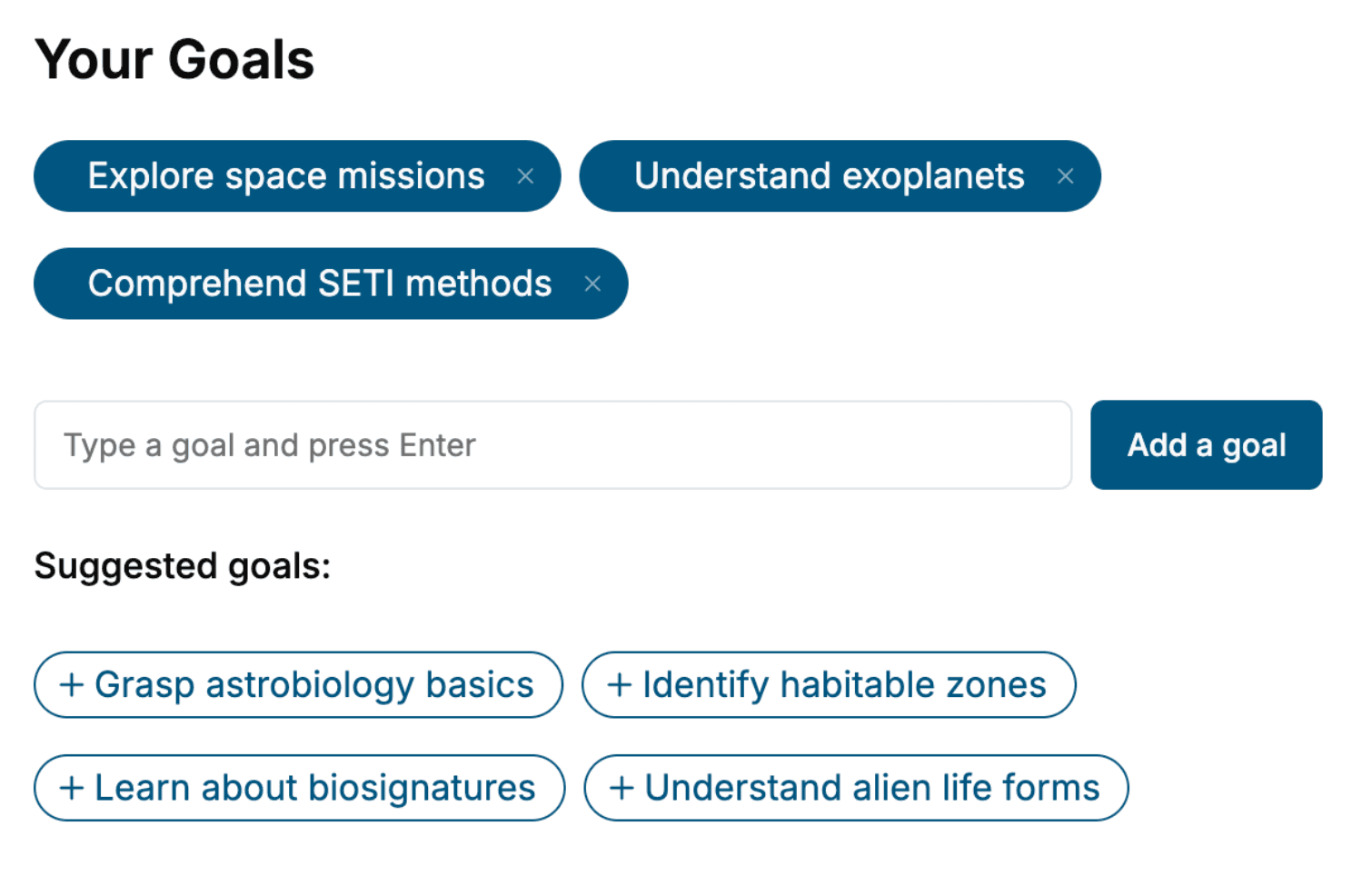
Specify your goals and choose sub-topics to include
- 3. Get your tailored book
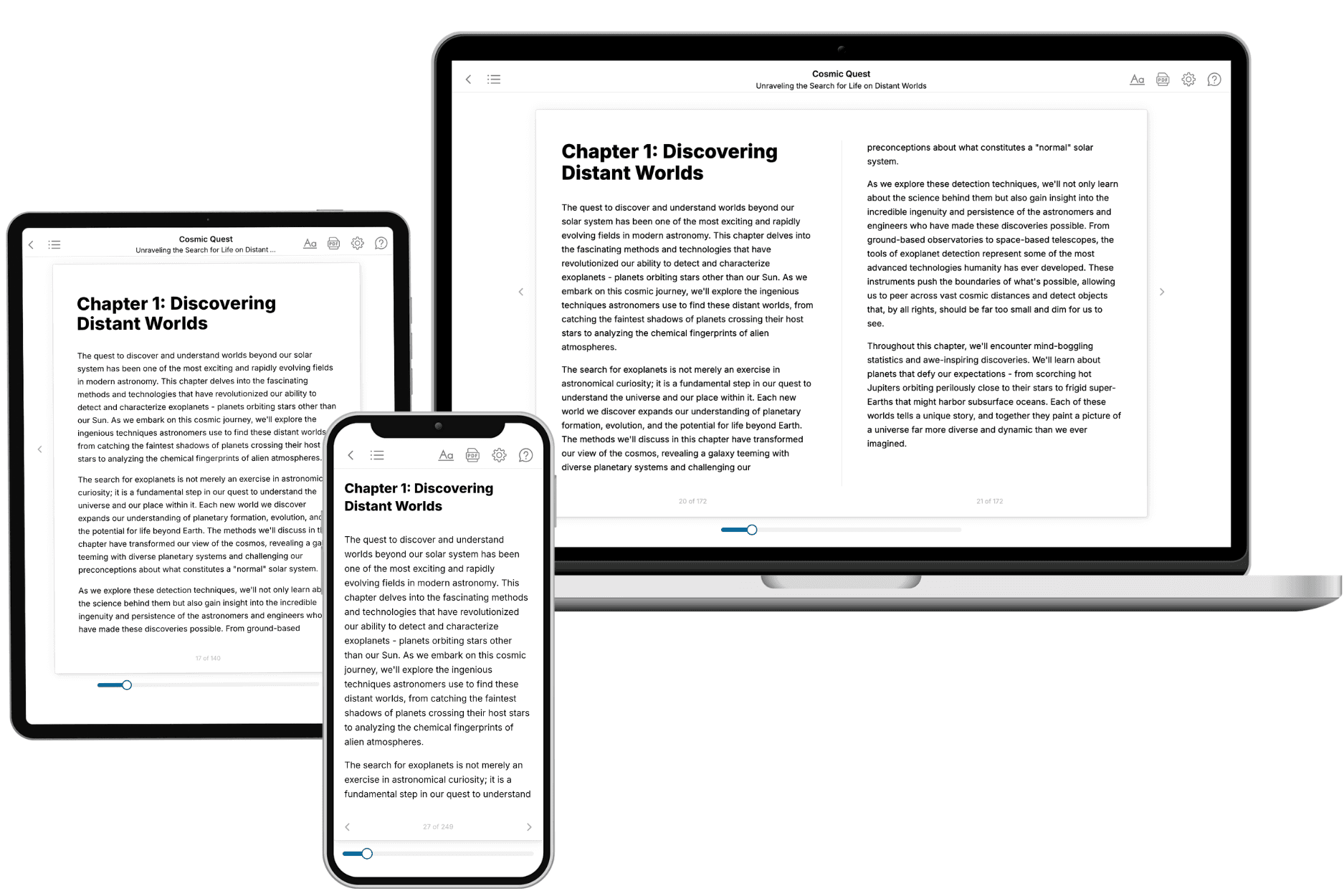
Your book is ready in 10 minutes. Read it online, download as EPUB or PDF, or send to Kindle.

Frequently asked questions
- What is TailoredRead?
TailoredRead creates complete, full-length nonfiction ebooks, written specifically for you. Tell us what you want to learn and why, and TailoredRead writes you a complete ebook on it, with charts, tables, and diagrams throughout. Read it online, on Kindle, or on any e-reader, or download it as a PDF or EPUB. Every book is written fresh the day you order it.
- How is the book tailored to me?
Before anything is written, you answer a few short questions about your goals, your background, and the topics you care about. Your book is then planned around your answers: written at your level, focused on your goals, and covering the topics you chose, instead of the one-size-fits-all book a store sells everyone.
- Will it read like generic AI content?
No. Your book isn't a chat transcript: it's planned chapter by chapter before a single word is written, told in a clear book voice, and explains ideas visually with charts, tables, and diagrams. After writing, every book goes through an editorial pass that polishes chapters so the book reads consistent from start to finish. Judge for yourself: browse thousands of sample books on our Explore Books page.
- How accurate is the content?
Our AI first checks whether your subject needs live research. Niche and fast-moving subjects are researched before writing, and the book plan and chapters are grounded in what it finds. After writing, every book goes through a quality pass that checks its facts and consistency, and researched books list their sources in a Notes section at the back.
- How long is the book?
You choose the length: Comprehensive (250-300 pages), Detailed (150-200 pages), Essential (70-100 pages), or Short (30-50 pages).
- Does the book include visuals?
Yes. Every book includes charts, tables, and diagrams: timelines, checklists, step-by-step guides, decision trees, comparison tables, matrices, and bar charts. A typical book includes dozens of these visual elements.
- Can I read it on Kindle? What formats can I download?
Yes. Every book can be read in our online reader or downloaded as a PDF or EPUB. The EPUB can be opened with Kindle, Apple Books, Kobo, and any e-reader. The Commercial and Author licenses also include an editable Word (DOCX) and Markdown download.
- How much does it cost?
About the price of a regular ebook. The exact price depends on your book's length and complexity, from $2 for the shortest books to $35 for the most comprehensive, and it's shown when you review your book, before you commit to anything. Each book is a one-time purchase, yours to keep, no subscription. Licenses that let you share, teach, or publish your book range from $35.99 to $49.99.
- Can I preview the book before purchasing?
Before you pay, you'll see what your book will cover: the title, a detailed description, the estimated length, and the complete chapter-by-chapter table of contents, so you know what you're getting before you decide. The full text itself is written after you purchase.
- How long does it take to create a book?
About 10 minutes. You can start reading the opening chapters while the rest is still being written.